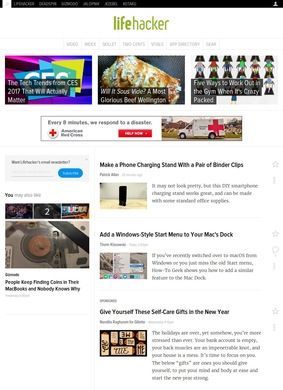
Lifehacker started life in 2005 as a blog about squeezing more out of your software, and two decades on it has grown into a full consumer-lifestyle publication that still keeps the same practical instinct at the center of everything it prints. The name has drifted into everyday language, which can obscure what the site actually does day to day. It publishes advice. Lots of it, across a spread of subjects that has widened well past the tech tips it built its reputation on.
Technology fixes and app advice
The technology coverage remains the backbone of Lifehacker. There are pieces on software and apps, gadgets, phones and computers, browsers, smart home devices, and the growing pile of AI tools that consumers are now trying to make sense of. A good share of it is troubleshooting: what to do when Windows misbehaves, how to fix something in macOS, why an iOS or Android setting works the way it does. The writing tends toward the step-by-step, aimed at a reader who has a specific problem open in another tab and wants it solved before lunch. Product roundups and deals coverage sit alongside the how-to material, so the same section that explains a feature will also point you at what to buy.
Money health and home sections
What surprises people who remember the old Lifehacker is how far the subject list now stretches. Money is a standing section, covering budgeting, careers, taxes, and banking. Health runs fitness, sleep, mental health, and food. Home takes on cleaning, DIY, home improvement, and gardening. There is an Auto section and an Entertainment one, the latter dealing in streaming, gaming, and recommendations for movies and TV. The through-line is the same across all of them: take an ordinary task most people muddle through, and hand over a cleaner way to do it.
Who is lifehacker written for?
Lifehacker does not write for a specialist. It is the general consumer who wants a straight answer to a household or workday question, whether that is trimming a monthly budget, getting a phone to stop doing something annoying, or figuring out which streaming service is worth keeping. That framing shapes the tone. Articles assume curiosity and a bit of impatience, not expertise, and they are short enough to act on rather than study.
Daily publishing formats
Publishing runs daily, and the format mix keeps it from feeling like a single template repeated forever. There are tutorials and life-hack tips, product roundups, troubleshooting guides for both hardware and software, and the occasional quiz or poll to break up the how-to rhythm. The deal and shopping-recommendation content is a recurring feature in its own right, not an afterthought bolted onto the reviews. A reader can drop in for a five-minute fix and leave, or wander the archives and turn up something they were not looking for, which is the older behavior the site was originally built to encourage.
Browsing across categories
The category spread rewards a reader willing to browse. Someone who arrives for a Windows fix might notice a piece on cutting a phone bill two headlines down, or a sleep guide sitting next to a gardening walkthrough. The Money section alone runs the gamut of the things people quietly worry about, from filing taxes to sorting out a bank account to steering a career, and it treats each with the same hands-on tone the site applies to a browser setting. Health does the same for fitness and food, Home for cleaning and repairs. The effect is a general-purpose reference that happens to have grown out of a tech blog, and the tech roots still show in how methodical the instructions tend to be.
The standard media plumbing on Lifehacker is all present: sections, search, article archives, a newsletter signup, and social links. None of it is flashy, and it does not need to be. The value is in the volume and steadiness of the output, and the navigation exists mainly to help you find the one article that matches the problem in front of you.
Ownership under Ziff Davis
Behind the site sits Ziff Davis, the media group that also owns PCMag, Mashable, and IGN. That ownership matters for how the operation runs. Lifehacker is staffed with writers and editors, and the articles carry bylines, so a piece is attributable to a named person rather than an anonymous content mill. The house it lives in is a portfolio of established technology and entertainment brands, which explains both the professional polish and the heavy leaning into deals and product coverage that runs through those sibling publications too.
Weighing quality across articles
It is worth being honest about the trade-off in that model. A publication that posts this much, this often, across this many subjects, will inevitably produce lightweight entries next to the genuinely useful ones. A quick tip about a phone setting delivers far less than a careful troubleshooting walkthrough, and both live under the same masthead. Readers who treat Lifehacker as a place to browse for ideas will get more out of it than those expecting every article to be a definitive reference. The site is a starting point and an idea generator more than a final word.
Consistency across unrelated topics
Where it earns its keep is the breadth combined with the practical bent. Most single-topic sites make you jump elsewhere the moment your question crosses a category line, going from a tech fix to a tax question to a cleaning method. Lifehacker keeps all of those under one roof and writes them in the same accessible register, so the reader who trusts the approach on software tends to try it on money or home matters too. That consistency of voice across unrelated subjects is harder to pull off than it looks, and it is the reason the brand held together while its scope quadrupled.
The AI-tools coverage is a useful marker of how the site keeps current. As consumer software absorbs machine-learning features, Lifehacker has folded that into the same explain-it-plainly treatment it gives any other app, which keeps the material relevant to readers trying to figure out what these tools do without wading through jargon. It is the 2005 mission applied to 2020s software: here is a new thing everyone is talking about, here is how you actually use it.
Everyday problems solved daily
For anyone who wants everyday problems solved in plain language, Lifehacker is a deep well to draw from, and the daily cadence means there is nearly always something new. The site does not pretend to make you an expert. It gets you to a working answer and lets you move on, and it does that across a wider range of daily life than almost any comparable outlet. A reader looking for practical, actionable help on tech, money, health, or the running of a home will find that Lifehacker has probably already written the article, filed it under the right section, and put a search box at the top to help you dig it out.