Origins on the hillside above the bay
When California chartered its first university in 1868, it did so by folding a struggling private college in Oakland into a land-grant program that Congress had handed the young state under the Morrill Act. The new institution needed a home, and the trustees chose a slope of open land in the hills across the bay, with a clear line of sight to the Golden Gate. They named the town that grew up around it for George Berkeley, the Anglo-Irish philosopher whose line about the course of empire taking its way westward suited a school looking toward the Pacific. Classes moved to the site in 1873. The motto carved into the seal, Fiat Lux, means "let there be light," and the university has spent more than 150 years trying to live up to the plainness of that phrase.
Berkeley is the founding campus of the University of California and remains its flagship. As a land-grant institution it carried an obligation from the start to teach agriculture and the mechanical arts alongside the classics, a mandate that pushed it toward practical research early and never fully let go. Today the central campus covers about 178 acres inside the city of Berkeley, with additional university holdings, research stations, and open space running to several thousand acres more.
The campus and its landmarks
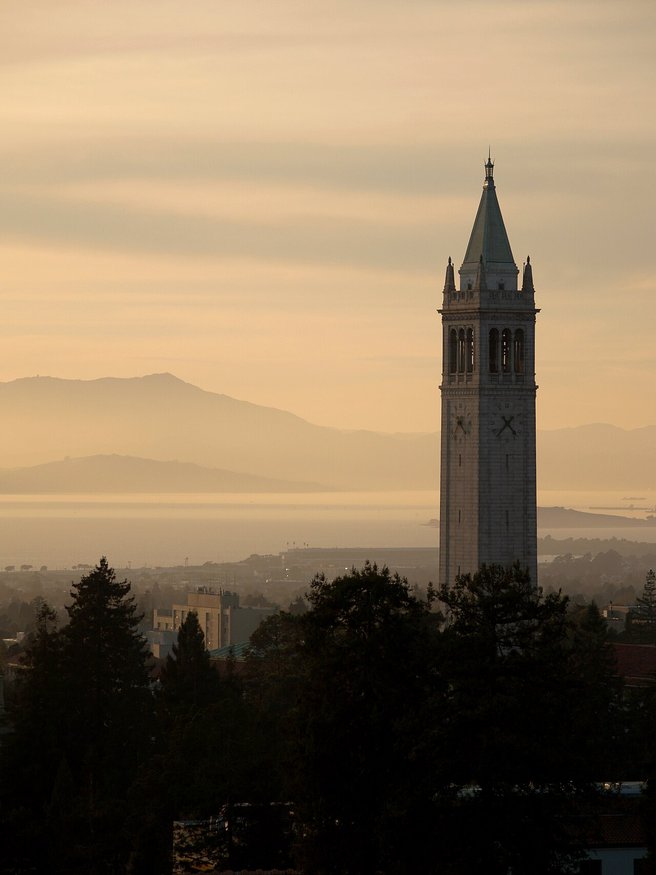
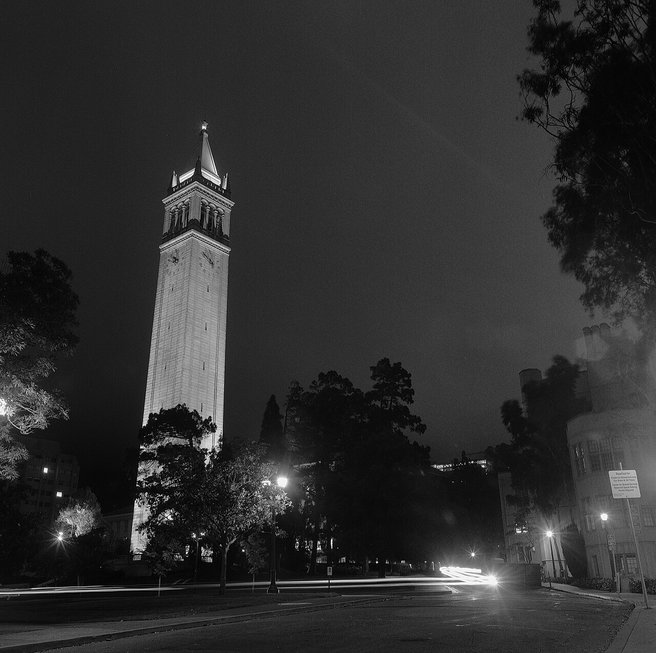
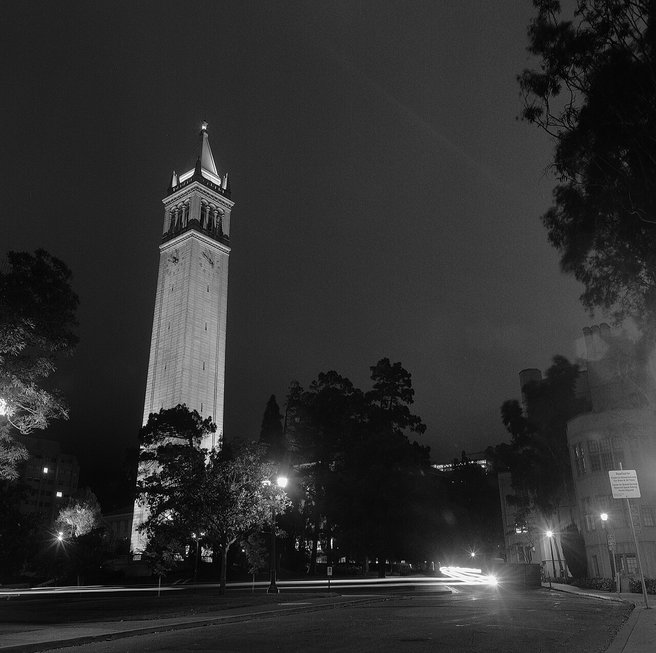
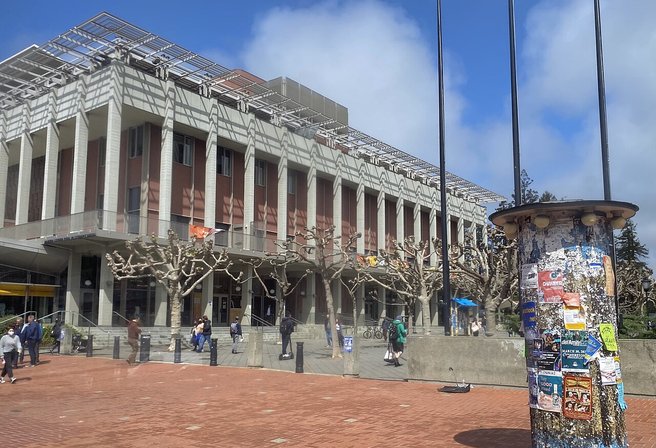
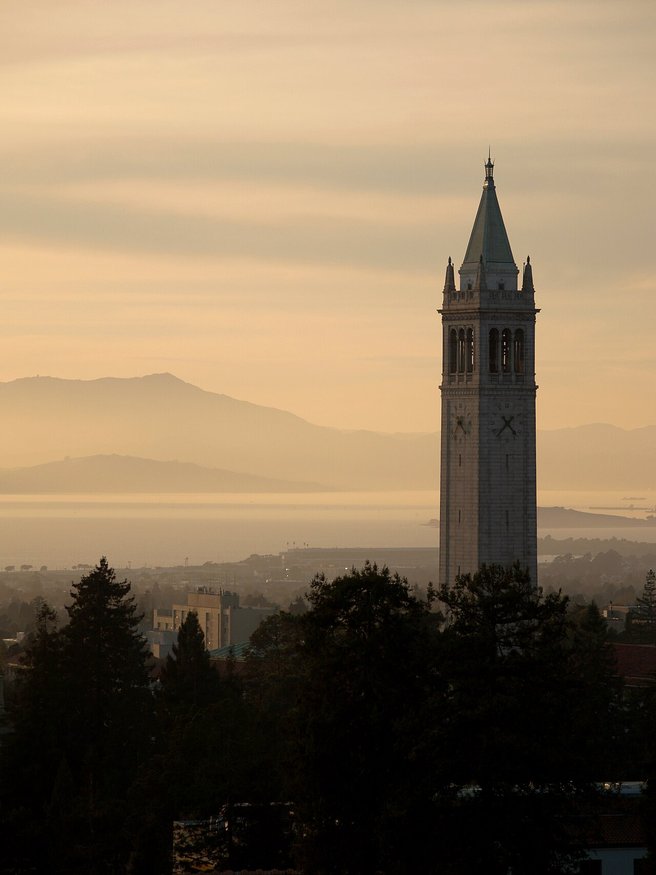
Anyone who has spent an afternoon on the grounds knows Sather Tower, the granite bell tower modeled on the campanile in Venice and finished in 1914. At 307 feet it is one of the tallest structures of its kind, and its carillon still marks the hours over Memorial Glade. Around it stand the Beaux-Arts buildings of the original core: Doe Memorial Library, California Hall, Wheeler Hall, and the classical facade of the Hearst Greek Theatre cut into the slope above. Sproul Plaza, at the south edge of campus, is where the Free Speech Movement gathered in 1964, and the steps of Sproul Hall still carry that memory for anyone who studies the history of American protest.
The setting is not incidental to the work. Strawberry Creek runs through the grounds, and the eucalyptus grove near the west entrance is among the tallest stands of hardwood in the country. From the fire trails in the hills above, the whole campus, the bay, and the two great bridges come into view at once. It is a working place first, though, crowded most of the year with roughly 45,000 students moving between more than 130 academic departments.
How it is organized
The university is built out of fourteen colleges and schools. The College of Letters and Science is the largest, teaching most undergraduates across the humanities, the natural sciences, and the social sciences. Around it sit the professional schools: the College of Engineering, the College of Chemistry, the Haas School of Business, the School of Law, the Goldman School of Public Policy, the Graduate School of Journalism, and the schools of public health, education, and social welfare. Roughly 1,800 full-time faculty teach some 33,000 undergraduates and 13,000 graduate students, a scale that lets the university run doctoral programs in fields most schools cannot staff at all.
Research, and a record in the social sciences
Berkeley's research reputation is easiest to state in numbers. Sixty-three Nobel laureates have been affiliated as faculty, alumni, or researchers, and the periodic table itself carries the campus name in berkelium, an element first synthesized here. The Lawrence Berkeley National Laboratory, founded by the physicist Ernest Lawrence and now run for the Department of Energy, sits in the hills directly above the campus and grew out of the university's own cyclotron work. Faculty have shaped whole fields, from the chemistry of photosynthesis to the economics of information.
The social sciences are a particular strength, which is the reason an entry for the university sits well in a social sciences reference category. Its departments of economics, political science, sociology, anthropology, geography, and psychology rank among the best anywhere, and their faculty have long fed the public argument over policy, inequality, and the reach of government. The Institute of Governmental Studies, the Survey Research Center, and a string of area-studies programs keep the empirical side of that work supplied with data. Graduate training here has placed several generations of social scientists in universities and agencies across the country.
- Founding campus of the ten-campus University of California system
- Fourteen colleges and schools, more than 130 academic departments
- About 45,000 students and roughly 1,800 full-time faculty
- Home to Lawrence Berkeley National Laboratory and dozens of organized research units
A public university's obligations
For all its research standing, Berkeley remains a public university, and a large share of its undergraduates are California residents, many of them the first in their families to attend college. State support has fallen over the decades as a fraction of the budget, and the endowment, which passed nine billion dollars in 2025, now carries weight it was never meant to carry alone. The tension between public mission and private money runs through most of the debates on campus, and it is an honest thing to name rather than hide.
Where it is and how to reach it
The University of California, Berkeley occupies the hills at the east edge of the city of Berkeley, in Alameda County across the bay from San Francisco. Central administration sits in California Hall, and the campus mailing address is 200 California Hall, Berkeley, CA 94720. The campus operator can be reached at +1 510-642-6000, and the university's website carries department-by-department directories for anyone trying to reach a specific school, laboratory, or social sciences program. As a reference point for the study of society and government, few American institutions have a longer or better documented record.
Business address
University of California, Berkeley (The Regents of the University of California)
200 California Hall,
Berkeley,
California
94720
United States
Contact details
Phone: +1 510-642-6000