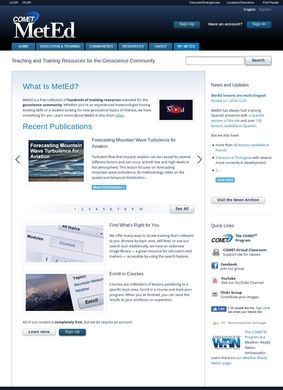
More than a thousand courses on meteorology, weather, water, and the geosciences sit behind no paywall here, and they have been accumulating since 1997. That single fact sets the tone for MetEd: Meteorology Education & Training. The platform is run by The COMET Program, a unit of UCAR Community Programs under the University Corporation for Atmospheric Research, and the funding model leans on sponsors and voluntary tax-deductible donations instead of subscription fees. For a field where good training material can be expensive and scattered, an archive this deep being open to any learner worldwide is worth a steady, unhurried look.
Course catalog scope
What sits inside the MetEd: Meteorology Education & Training catalog is broad without being shallow. The topics range across satellite meteorology, with material on JPSS CrIS water vapor and RGB products, through dual-polarization radar fundamentals, into tropical cyclone intensity estimation using the Dvorak Technique. There is coverage of severe storm hazards, and material that steps outside pure forecasting too, including digital media literacy aimed at people who communicate weather to the public. That last inclusion is genuinely useful. A meteorologist who can read a radar loop still has to explain it to an audience, and MetEd: Meteorology Education & Training treats that communication skill as part of the discipline, not a secondary concern.
Who benefits from this platform?
The audience the catalog is built for is wider than the operational forecaster, although that person is clearly served well. Researchers, students, and private-sector weather professionals all have a path through the material. MetEd: Meteorology Education & Training even folds in private-sector career preparation through an AMS partnership, which points to an understanding that not every learner is headed for a government forecast desk. Some are building toward consulting work, broadcast roles, or commercial weather services, and the content acknowledges that spread without forcing every user through the same narrow channel.
Finding your way through a thousand courses
A library this large can become a maze, and the way MetEd: Meteorology Education & Training handles that is worth examining. The platform uses AI-powered personalized course recommendations to steer learners toward material that fits what they have already studied. There is a private learning dashboard that tracks progress, keeps transcript records, and handles notifications without making the user dig for information. For someone working through a structured path over months, that record-keeping is directly practical. A transcript that documents completed training is the difference between casual browsing and something a professional can present to an employer or licensing body.
Interactive learning and scenario-based practice
The teaching approach leans interactive throughout. Simulations and real-world, scenario-based exercises run through much of the catalog, which suits a subject where pattern recognition and judgement matter as much as memorized definitions. Reading about the Dvorak Technique is one thing; working through a scenario that asks you to apply it to a developing system is closer to how the skill is used in practice. That choice to build exercises around realistic situations is a clear sign that MetEd: Meteorology Education & Training was designed by people who understand how meteorologists actually learn, and what understanding looks like in the field.
Multilingual access for global learners
Reach gets attention as well. Content in MetEd: Meteorology Education & Training is available in multiple languages, and the platform notes enhanced accessibility features. Both choices matter for something positioned as a global resource. Weather knows no borders, and a training archive aimed at operational forecasters across the world would undercut its own mission if it stayed locked to one language or excluded users who rely on assistive technology. The multilingual availability in particular widens the practical value of MetEd: Meteorology Education & Training well beyond an English-speaking core.
The people behind it are scientists, instructional designers, and developers based at UCAR and COMET. That mix shows in the output. Pure scientists can produce material that is rigorous and unteachable; pure designers can produce something polished and hollow. Pairing subject experts with instructional designers is how you get content that stays technically sound and still gets through to a learner. COMET has been doing this since 1989, with MetEd: Meteorology Education & Training itself running since 1997, so the institutional experience behind the teaching is not a recent thing.
It is worth being clear about what MetEd: Meteorology Education & Training is and is not. This is training and education material, structured and self-paced, drawing on a long-running program rather than a quick-turnaround content shop. The breadth across meteorology, weather, water, and the wider geosciences means a learner can stay within one platform across a long stretch of a career, moving from radar fundamentals early on to specialized satellite product interpretation later. That continuity is part of what makes MetEd: Meteorology Education & Training more than a loose collection of one-off lessons.
If there is a caution, it sits in the nature of a catalog this size and age. A thousand-plus items built up over decades will inevitably mix newer interactive simulations with older lessons, and a learner should expect some unevenness in how current any given module feels. That is the trade-off for depth. The recommendation engine and dashboard in MetEd: Meteorology Education & Training help thread a coherent path through it, and the topic coverage stays current on the things that change fast, satellite products and radar techniques among them, so the archive does not read as frozen in an earlier era.
The verdict lands solidly positive, with eyes open. For an operational meteorologist sharpening a specific skill, a student building foundations, or a private-sector professional needing documented training, MetEd: Meteorology Education & Training offers depth, structure, and a teaching method that respects how the work gets done in practice. Free access removes the usual barrier. The interactive exercises beat passive reading, and the transcript and dashboard give the effort somewhere to accumulate. Some unevenness across a decades-old archive is the predictable cost of scale, and the sheer size rewards the patient. Meteorology and the geosciences have a free, well-structured, professionally credible training resource in MetEd: Meteorology Education & Training, and the depth of the catalog makes it worth returning to across a career instead of treating it as a one-time stop.