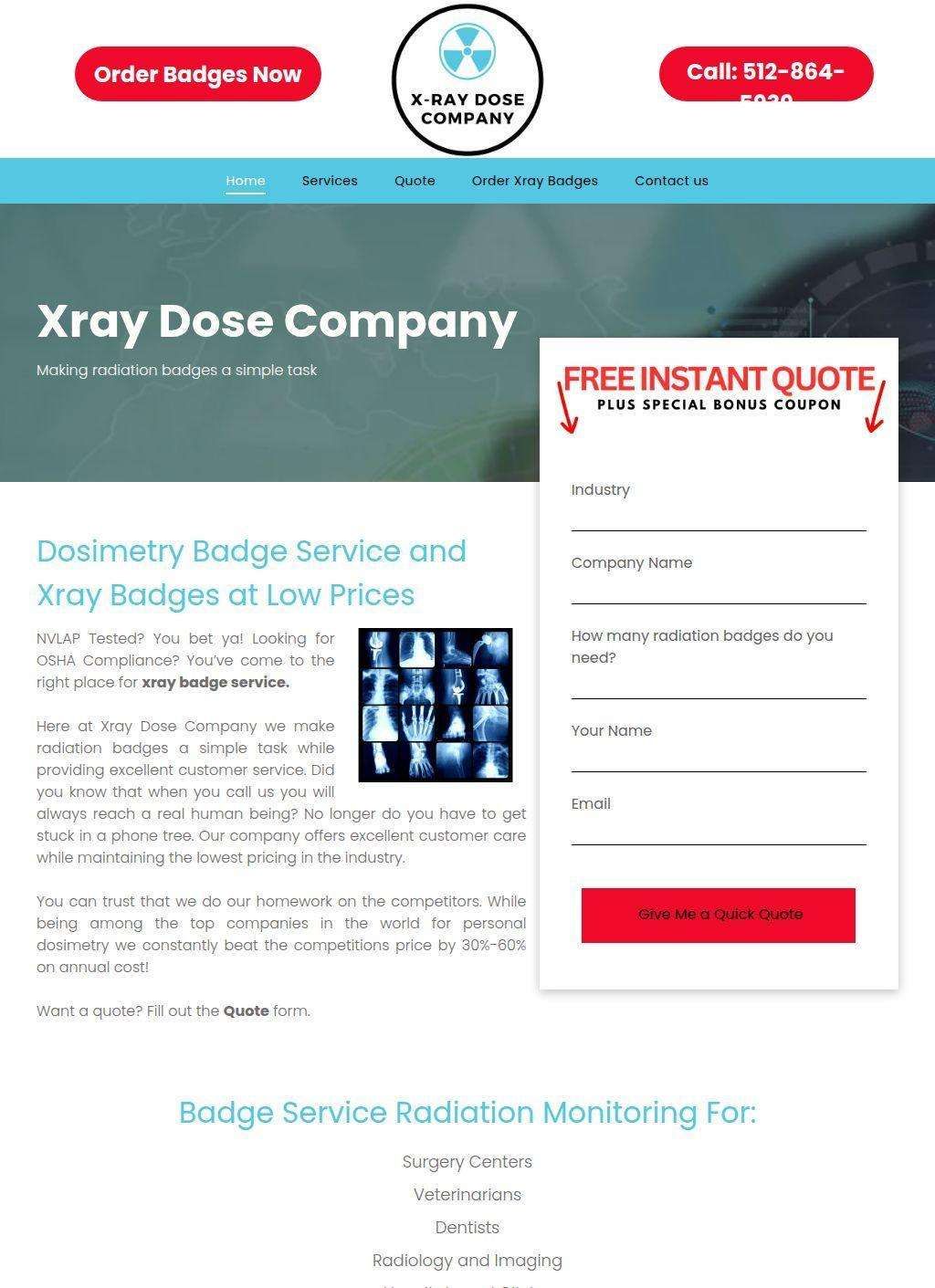
Radiation badge monitoring is a recurring compliance obligation for anyone operating X-ray equipment, and Xray Dose Company has built a business around handling exactly that paperwork. The core product is the Instadose electronic dosimeter, a badge that reads exposure in real time and pushes data to an online portal, so a clinic does not have to wait for a quarterly lab cycle to learn what dose a worker absorbed. Alongside it sits the OSL badge, the optically stimulated luminescence format that gets mailed out, worn, returned, and read in the traditional way. A practice that wants live visibility picks the electronic route; one comfortable with periodic reporting keeps the OSL. Between those two formats, most monitoring schedules are covered.
Electronic and OSL badge formats
The Georgetown, Texas operation is narrow by design. Badges arrive on a schedule, worn ones go back for reading, and the results land in an online administration system where an account holder can manage who wears what and pull the numbers by person or date range. Reports come quarterly or monthly depending on the plan, and the records carry lifetime exposure tracking across years and employers, which is a regulatory requirement in many settings. The reporting is paperless and electronic, so the cumulative history is supposed to live in one place instead of scattered across mailed printouts. Xray Dose Company routes its readings through a partner laboratory that holds NVLAP accreditation, which is the credential a regulatory audit will actually ask about.
Online portal with lifetime tracking
Who needs this turns out to be a longer list than the typical clinical picture. Hospitals, radiology and imaging centers, and surgery centers form the obvious core. Then come the smaller offices running X-ray equipment: dental practices, veterinary clinics, chiropractors. Beyond clinical medicine, the same badge service extends to nuclear facilities, colleges and universities, government agencies, and soil engineering firms, which use radiation-emitting density gauges in the field. That spread means Xray Dose Company handles a one-dentist office and a multi-site institution on the same back-end system, without separate enterprise pricing tiers or a dedicated account management layer for small accounts.
Industries served beyond hospitals
Pricing is where the site makes its loudest claim, advertising savings of thirty to sixty percent against competitors. That is a wide band, and the page gives no breakdown of how it is calculated or against whom, so it reads as a sales figure more than a verifiable one. Dosimetry is a recurring cost that scales with headcount and badge count, so a practice running a dozen badges has a real reason to shop around, and Xray Dose Company at least signals it expects to be measured on the invoice rather than on brand recognition.
Direct support and replacement accessories
One detail in the service model is more useful than the cost claim. Xray Dose Company advertises round-the-clock sales support with direct human contact and no automated phone menus. For a small dental or veterinary office where the person handling radiation safety is also the office manager and three other roles, reaching a person instead of navigating a phone tree is a practical advantage when a badge goes missing or a report reads wrong. The company also sells replacement badge holders and accessories, the small consumables that get lost or cracked in any practice that has been wearing badges for a few years.
Contact options and physical location
Contact information is open and specific. The site lists a phone number, a street address in Georgetown with posted hours, and three separate email routes split by function: one for a named contact, one for sales, one for support. That separation is a small sign of an operation that fields inquiries and wants them routed correctly, and the physical address plus posted hours give the listing grounding that a purely web-based reseller often lacks. A prospective client can see exactly where Xray Dose Company is and how to reach the right person while weighing a monitoring contract.
Assessing credibility without public reviews
The weaker spot is third-party reputation. A search for independent feedback on Xray Dose Company specifically turns up nothing useful: the results that surface belong to other, unrelated X-ray businesses, and no rating or review count attaches to this company on the usual platforms. That is not damning for a niche business-to-business service. Dosimetry vendors rarely accumulate the public review trail that a restaurant or retail shop does, because their customers are radiation safety officers and practice managers who renew contracts quietly and do not post about them publicly. But it does mean a prospective client cannot lean on crowd verdicts and has to judge Xray Dose Company on the site, the NVLAP-accredited lab partnership, and a direct conversation with the people answering those email addresses.
What Xray Dose Company puts on the table is coherent and easy to parse, which is more than many specialty vendors manage. The NVLAP accreditation reference is the detail with the most practical weight, since it speaks to whether dose readings will survive a regulatory audit. A practice is not buying the plastic holder; it is buying a defensible exposure record, and the laboratory behind the reading is where that record either holds or collapses. Two badge formats, online management, lifetime tracking, a price pitch, and a human on the phone is a complete-enough package to evaluate, and Xray Dose Company puts enough on the page for a safety officer to form a reasonable first impression without picking up the phone twice.
Important pages
Business address
Xray Dose Company
3320 FM 3405,
Georgetown,
TX
78633
United States
Contact details
Phone: 5128645939