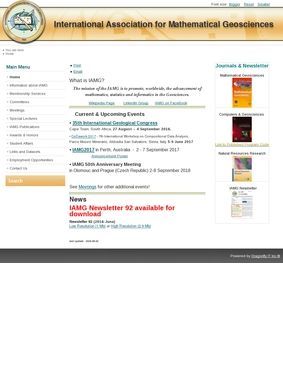
Where does a geologist turn to keep up with the mathematics and statistics running underneath the science? The International Association for Mathematical Geosciences is built around exactly that question. Its stated mission is to promote, worldwide, the advancement of mathematics, statistics, and informatics in the geosciences, and everything the association offers follows from that one line.
Membership is open widely, to geoscientists, statisticians, and any other individuals or organisations with an interest in the quantitative side of earth science. That openness is deliberate. The field sits at a crossroads of disciplines, and the International Association for Mathematical Geosciences is trying to hold that crossroads together in one professional body.
What membership opens up
The offering is the usual apparatus of a scholarly society, assembled with a clear sense of who it serves. Conference invitations and networking sit at the front of it, giving members a route to the people doing the same specialised work in other countries and other institutions.
For a discipline this narrow, that reach is the practical value: the person who can answer your problem may be on another continent. The networking side is not a throwaway line either, since a specialism this thin depends on the same few hundred people staying in contact, and the association is the thing that keeps that contact from lapsing between one annual meeting and the next.
Underneath the conferences runs a substantial body of published and educational material. The International Association for Mathematical Geosciences provides access to publications and research materials, a newsletter, and a monograph series, plus an online encyclopedia of mathematical geosciences that acts as a reference point for the field's terms and methods. That encyclopedia is the sort of asset that outlasts any single meeting.
Behind the membership sits an ordinary administrative footprint. The International Association for Mathematical Geosciences is run from an office in Wichita, Kansas, and lists a phone line and an email address for members and prospective ones to use, so the body is reachable by more than a web form.
It also keeps a presence on Facebook, X, and LinkedIn, the channels through which a scattered international membership hears about a call for papers, a grant deadline, or a new volume in the monograph series without waiting for the next newsletter. For an organisation whose members are spread across continents, those quieter lines of contact do a fair amount of the day-to-day work of holding it together.
Grants, awards and recognition
A good part of what the International Association for Mathematical Geosciences does is aimed at people early in their careers and at recognising strong work. Student research grants and travel grants lower the cost of getting into the field and getting to the meetings where it happens, which matters in a specialism small enough that missing the annual gathering can mean missing the conversation entirely. Professional awards and honours sit at the other end, marking the work the association judges worth holding up.
Together the grants and the honours cover a career from its first conference to its established later stages. The grants in particular do work out of proportion to their size, since a few hundred dollars toward a plane ticket can be the difference between a graduate student presenting at the annual meeting and skipping it altogether.
Publications, lectures and the encyclopedia
The educational side is where the International Association for Mathematical Geosciences does its quieter work. Recorded lectures give members access to teaching they would otherwise have to travel for, and the newsletter and monograph series keep a steady stream of current material moving. The online encyclopedia deserves singling out, since a reference built and maintained by the association itself is the kind of resource a graduate student or a working researcher returns to repeatedly, and it anchors the terminology of a field that borrows heavily from three parent disciplines at once.
A society that maintains its own encyclopedia is also making a quiet commitment, since a reference work only earns trust if someone keeps it current, and that upkeep is exactly the sort of unglamorous task a professional body is better placed to sustain than any single author working alone.
Who it really serves
The membership description is broad, but the real audience is narrow, and it helps to be honest about that. The International Association for Mathematical Geosciences serves people who apply mathematics, statistics, and informatics to earth science, and for anyone outside that intersection the offering will mostly look like machinery built for someone else's trade. A field geologist with no quantitative bent, or a statistician with no interest in geoscience, gains little here. For the person standing squarely in the overlap, though, the grants, the encyclopedia, and the network are hard to assemble anywhere else.
The value of the International Association for Mathematical Geosciences is therefore sharply conditional. As a general resource it means little; as the professional home for quantitative geoscience it is close to purpose-built, gathering conferences, funding, publications, and a reference work under one roof. Whether it is worth joining comes down to a single test, whether a person's work genuinely lives at the meeting point of maths and the geosciences, and for the fraction who can answer yes, few alternatives cover the same ground as completely.