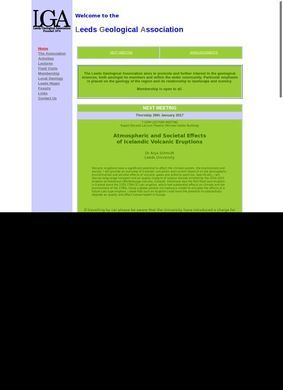
Three field visits sit on the Leeds Geological Association's calendar as its most tangible offer to anyone thinking of joining: Flamborough, Cayton Bay, and Bacup. Those are not lecture-hall abstractions but real coast and Pennine sites where members go and stand on the rock, and they tell you more about the character of this society than any mission statement could. The association has been at this since 1874, which is a long run for a regional body devoted to the geology of one district.
What follows from that longevity is a group that has settled into a clear rhythm of talks and trips, backed by a set of reference material built up over the decades. The Leeds Geological Association organizes its work into a handful of plain sections, and each one suits a different kind of visitor.
A society organized around lectures and field visits
The two activities that define the Leeds Geological Association are its regular lectures on geological topics and its organized visits to sites in the field. One is indoor and the other is boots-on-the-ground, and between them they cover both the theory and the practice of reading rocks. The events calendar carries both, so a prospective member can see what is coming and decide whether the schedule suits them.
This is a working society, not a static archive. The lectures keep coming, the trips keep being planned, and the calendar reflects that steady output. For a subject that rewards being shown things in person, the pairing of talk and trip is the sensible way to run a local group.
Field trips to Flamborough, Cayton Bay, and Bacup
Flamborough Head is chalk and dramatic coastline, Cayton Bay is a fossil-bearing stretch of the Yorkshire coast, and Bacup sits over the Pennine coal measures. Three named destinations, three quite different geological stories, and all reachable on a day trip from Leeds. The value of an organized visit is that someone who knows the ground leads it, so a beginner is not left squinting at a cliff wondering what they are looking at.
The Leeds Geological Association handles that guiding as a matter of course, and its archive of past field-visit reports means the trips are documented rather than simply held and forgotten. A newcomer nervous about turning up alone to a clifftop gets a structured, led outing instead of a solitary guess, and the Leeds Geological Association has clearly built its year around making that access routine.
The lecture calendar
The talks give the association its year-round spine. Between field seasons, the lectures keep members engaged with topics they might never encounter on a single outing, and they draw the more studious end of the membership as much as the casual enthusiast. A programme of regular talks is also how a society like the Leeds Geological Association passes knowledge down rather than letting it stay locked in a few heads.
The events calendar lists them alongside the trips, which keeps the whole year visible in one place. For members who cannot make every field date, the talks keep the connection to the subject alive through the darker months, which is how a volunteer society holds its numbers together year on year.
Resources for the Leeds district
Beyond the calendar, the site functions as a small reference library for the geology of the Leeds area. The Local Geology section covers the rocks, fossils, and mineral resources of the district, along with geological maps that place all of it on the ground. For a resident curious about what lies under their own city, that focus on one region is exactly the point. A national resource would never get this local.
The Resources section widens things out with learning materials, museum guides, and further maps, and the Leeds Geological Association's Archive holds the record of past activities, publications, and those field-visit reports. Photo galleries document what the group has done over the years, which gives a newcomer a real sense of the outings before ever showing up for one. The museum guides in the same section extend the reach past the association's own outings, steering members toward collections they can visit on their own time.
Local geology: rocks, fossils, and maps
The maps are the part worth singling out. Geological maps of the Leeds district turn a vague interest into something a person can actually use on a walk, and pairing them with plain accounts of the local rocks, fossils, and mineral resources makes the material usable by someone with no formal training. The Leeds Geological Association pitches this content at a wide audience deliberately, from the casual enthusiast to the serious student, and the range of the About Us, membership, and council pages shows a group organized enough to keep all of it maintained.
Mineral resources get their own treatment beside the rocks and fossils, a reminder that the geology of a place like Leeds is as much about what was quarried and mined as about what sits in a display case.
The archive and learning materials
An archive is only as useful as the effort put into keeping it, and the Leeds Geological Association treats its past activities, publications, and field-visit reports as worth preserving. Add the book recommendations and the learning materials in the Resources section, and the site becomes a genuine starting point for self-study, more than a noticeboard for upcoming events.
Someone who reads through the archive before their first meeting arrives already knowing what the group does. The book recommendations are a modest, telling touch, pointing a beginner toward reading that a search engine would never surface as neatly.
Who the membership is for
Membership is open to anyone with an interest in the geological sciences, and the association is explicit that this stretches from casual enthusiasts to serious students. That breadth is the deciding factor for most people weighing whether to join. A total beginner will not feel out of place on a Flamborough trip, and a geology undergraduate will still find the lectures and the archive worth their time.
Few local societies manage to hold that range without tilting entirely toward one end, and the Leeds Geological Association's mix of accessible trips and substantive lectures is what keeps both kinds of member on the books.
The About Us pages set out the membership terms, the council, and the organizational rules, so the structure of the Leeds Geological Association is laid bare for anyone who wants to understand how the group is run before they sign up. That transparency is reassuring in a volunteer society, where it is not always clear who does what.
Set against a national body such as the Geologists' Association, which covers the whole country and casts a correspondingly wider net, the Leeds Geological Association wins on depth in one place: it knows the Leeds district's rocks intimately and takes members to stand on them.
A reader whose interest is national or academic in scope might be better served by the larger organization, but for someone rooted in West Yorkshire who wants lectures, guided trips to Flamborough or Cayton Bay, and maps of the ground beneath home, the Leeds Geological Association is the closer fit, and the one that will actually get them outdoors.