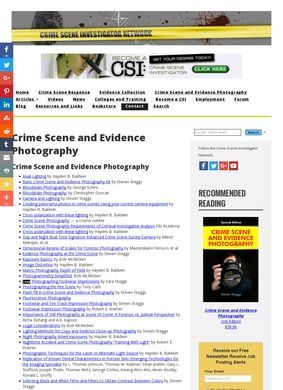
How do you photograph a bloodstain or a shell casing so the image survives a defense challenge at trial? That is the practical question the Crime Scene and Evidence Photography page, part of the Crime Scene Investigator Network, sets out to answer.
The page walks through the fundamentals of shooting a scene and its evidence, then goes past the basics into the procedures that decide whether a digital image is admissible once a case reaches court. That last step is what separates evidence work from ordinary photography: the picture has to survive cross-examination, a bar a magazine cover or a family portrait never has to clear.
This is reference material, not a product pitch, and Crime Scene and Evidence Photography is aimed at a specific audience: law enforcement, forensic photographers, working investigators, and the students heading into those jobs. It reads less like marketing and more like a briefing, written for people who will be judged on whether their photographs hold up, not on whether a visitor enjoyed the page.
What the page teaches
The Crime Scene and Evidence Photography page is organized around the real tasks a scene photographer faces, and it does not stop at pointing a camera. Several of its sections address problems that only surface in forensic work, the situations a wedding or product photographer would never encounter.
Digital imaging and admissibility in court
The section on digital imaging is what separates this from a general photography guide. It covers the procedures for handling digital images and, critically, their admissibility in court, the chain of questions a defense attorney will raise about whether a photo was altered, when it was taken, and who touched the file. For anyone whose pictures might end up as exhibits, that is the line between evidence that stands and evidence that gets thrown out.
Crime Scene and Evidence Photography treats the courtroom as the true test of the work, which is the correct frame, because a technically perfect photo that fails an admissibility challenge is worthless to a case.
Infrared, ultraviolet, and lighting techniques
Beyond the standard shot, the page covers specialized techniques: infrared and ultraviolet imaging, and lighting methods built for copy work and close-up evidence photography.
These are the skills that reveal a bruise pattern under the skin or a document alteration the naked eye misses. Lighting a small piece of evidence for a clean close-up is its own discipline, and copy work carries rules of its own. It is genuinely useful that Crime Scene and Evidence Photography sets these next to the fundamentals, because a new investigator rarely learns them anywhere convenient.
Video recording guidelines
Still images are only half the record. Crime Scene and Evidence Photography also lays out guidelines for video recording a crime scene, a format with its own pitfalls around narration, continuity, and what a camera should and should not capture on the record.
A careless comment caught on a scene walkthrough can follow a case into court. Grouping video with the stills keeps the whole visual record under one set of standards.
The free Staggs textbook
The most concrete thing on offer is a free download of Steven Staggs' textbook, "Crime Scene and Evidence Photography, 2nd Edition." A full second-edition text at no cost is a real resource for a student or a department on a tight budget, and having a named, published author behind the page adds real credibility. That the site gives the book away rather than selling it says something about the reference-first intent behind the whole project.
The Crime Scene and Evidence Photography page sits inside a much larger site. The Crime Scene Investigator Network also runs articles on crime scene response and evidence collection, bloodstain pattern analysis, DNA, fingerprints, and firearms, plus instructional videos, listings of university forensic-science programs, career guidance for becoming a crime scene investigator, and job posting resources. The copyright line on the site spans well over two decades, which counts for something in a field where reference sites come and go.
A student can move from a photography lesson to a fingerprint article to a list of degree programs without leaving the site, which is part of why it works as a first stop and not a single-topic page.
On credibility, an honest note is needed. The reviews that surface in a search are almost all Amazon customer reviews of the printed Staggs book, not of the Crime Scene and Evidence Photography page itself; I could find no third-party rating or review of the Crime Scene Investigator Network as a site.
That does not undercut the material, which is detailed and clearly written by people who know the field, but a reader looking for outside validation of the site will not find much beyond the book's own reception. The site's longevity and the named author stand in for the star ratings it does not carry, and for a reference resource that is a fair trade, though it does ask a first-time visitor to take the quality on trust.
Contact is the weaker part. There is a contact page link and a free newsletter signup, but no phone number, email, or address is prominently shown. For a reference resource that is fine for most visitors, who come to read rather than to reach anyone, though a student hoping to ask a direct question has a less direct path than the depth of the content would suggest.
The clearest use of the page is straightforward. Download the free Staggs second edition before spending a dollar on a textbook, then work through the digital-imaging and courtroom-admissibility sections first, since those are the ones that decide whether a set of crime-scene photographs holds up once a defense attorney starts asking questions in front of a jury.