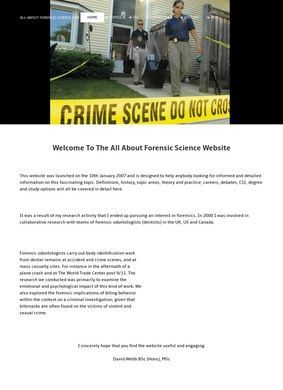
One person, David Webb, holding a BSc and an MSc, sits behind the whole of All-About-Forensic-Science.com, and that fact colours how you should read the rest of the site. This is not a university department or a professional body dressed up online. All-About-Forensic-Science.com is an independent educational project built by someone who knows the field, and it covers a genuinely wide slice of forensic science across more than twenty-five separate topic areas. DNA, ballistics, pathology, forensic psychology, toxicology, forensic accounting, even forensic animation get their own space. The scope is closer to a small reference library than a blog, and I found myself checking a few of the subject pages on All-About-Forensic-Science.com just to see whether the breadth held up under the surface or thinned out into stubs.
For the most part it holds up. The material reads like it was written by someone comfortable explaining forensic concepts to people who are new to them, which fits the stated audience: students, aspiring professionals, and general readers curious about careers, degree routes, and the theory-versus-practice gap. All-About-Forensic-Science.com leans into the career and study angle openly, with pages on degree and study options sitting alongside the harder science. That combination is useful. A teenager weighing a forensics degree and a working adult wanting to grasp what a toxicology report means can both land here and find something pitched at their level.
Crime scene investigation and the CSI Effect
Two parts of the site stand above the general run of topic pages. The first is a dedicated CSI section on All-About-Forensic-Science.com that walks through crime scene basics, documentation, and evidence collection techniques, then goes further and takes on the so-called CSI Effect, the way television has warped public expectations of what forensic work can deliver. That willingness to address a myth rather than feed it tells you the author is thinking about accuracy, not clicks. Anyone who has watched a procedural drama and assumed real labs return DNA matches in an afternoon would benefit from reading it.
Interviews with forensic professionals
The second is the Expert Q&A section, and this is where All-About-Forensic-Science.com earns some real credibility. It carries interviews with named forensic professionals, including Professor Sue Black and Dr. Dean Hildebrand, people with standing in the field. Getting practitioners of that calibre to answer questions is not something a low-effort content mill manages. It shows the site has built enough standing within forensic circles for working experts to lend their names to it, a quieter form of endorsement than any star rating.
Historical cases and landmark figures
Alongside these, a History section digs into landmark cases and pioneering figures such as Alphonse Bertillon, the man behind early anthropometric identification. All-About-Forensic-Science.com also runs a blog with recent articles and RSS feeds for people who want to follow along, plus a lighter touch in the form of forensic-themed murder mystery games and an old-fashioned guestbook. The games feel like a nod to keeping casual visitors engaged, and the guestbook is a relic from an earlier era of the web, though its presence adds a certain human warmth that slick modern sites tend to strip out.
The obvious strength of All-About-Forensic-Science.com is how much ground it covers without asking for money or a login up front. It states plainly in a privacy note that it does not sell personal information, a modest but decent commitment for a site running ads and RSS. The forensic accounting and forensic animation pages point to a compiler who kept expanding the map into corners most general readers would never think to ask about, and that thoroughness is the site's real selling point.
Checking publication dates on technical pages
The weakness sits right next to the strength. A resource this broad, maintained by one author, invites a fair question about how current every corner stays. Forensic science moves, particularly in DNA analysis and digital evidence, and a page written some years ago on a fast-moving technique may quietly drift out of date while the older material on Bertillon and historical cases ages perfectly well. The brief gives no way to check publication dates across the site, so I would treat the science pages as a solid grounding and the very latest methods as something to confirm against a more specialised or peer-reviewed source before relying on them for coursework, a job application, or anything else with real stakes.
No external reviews or ratings available
On reputation, there is honestly not much to report, and I would rather say that than pretend otherwise. A search for outside reviews of All-About-Forensic-Science.com turns up nothing specific to the site. The results that surface point elsewhere entirely: a forensic science journal, an IMDb entry for a film called Forensic, employer reviews on Glassdoor and Indeed for unrelated forensic companies, and a NIST page. None of them are about this website. So for All-About-Forensic-Science.com there is no Google rating, no Trustpilot score, no body of user feedback to weigh. That absence is not damning for an educational resource of this kind, since sites people read for reference rarely accumulate reviews the way a shop or a restaurant does, but it does mean the credibility case rests almost entirely on the content itself and on those named expert interviews.
Contact options for readers
Getting in touch is straightforward as far as it goes. All-About-Forensic-Science.com has a contact page reachable through the site navigation, so a reader with a question or a correction has a clear route to the author. What All-About-Forensic-Science.com does not put up is a phone number or a physical address, and no direct email is posted in plain view either. For an independent information site that is entirely normal and not a mark against it. A contact form does the job, and expecting a one-person educational project to publish a phone line would be unreasonable. Still, it is worth setting expectations: this is a site you read, not an organisation you ring.
Who should use this site
Who should bookmark it? Students mapping out a forensic career, curious readers who want the reality behind the television version, and anyone who wants a single starting point that fans out into DNA, ballistics, pathology, and the odder specialisms. The teaching voice is clear, the coverage is unusually wide for a solo effort, and the expert Q&A gives it a spine that most amateur reference sites lack. All-About-Forensic-Science.com does what it sets out to do, and it does it without hard-selling anything.
Maintenance concerns for a solo-authored resource
The doubt I cannot fully put to rest is the one about upkeep. A site's value as a reference depends on someone tending it, and everything here flows from a single author whose ongoing activity the available evidence does not confirm. If All-About-Forensic-Science.com is still being maintained and the technical pages are being refreshed as the science shifts, it is one of the more complete free forensic primers a general reader is likely to find. If it has been left to sit, the breadth becomes a snapshot of where the field stood at some unstated point, useful for fundamentals and history, less so for the moving edge. Nothing on the site itself resolves which of those is true, and that is the question a careful reader should keep in the back of their mind while using it.