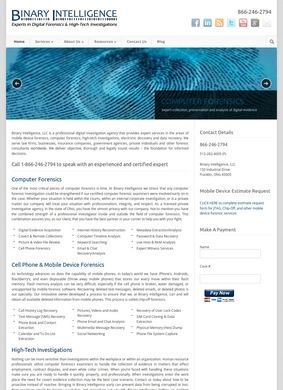
Chip-off forensics, where a technician lifts the raw flash-memory chip off a dead or locked device and reads it directly, is one of the harder services to find outside a police lab. Binary Intelligence, LLC keeps it on the standard menu. The firm is a digital forensics and technology investigations shop, and its work sits mostly where ordinary IT stops: damaged, encrypted, or proprietary devices that will not simply hand over their contents.
It has been at this since 2000, a long run in a field that reinvents itself every few years. For a client, the appeal of Binary Intelligence, LLC is narrow and specific: it is the place to send the device nobody else could open.
What it recovers, and from where
The service list is unusually complete. Computer forensics covers evidence extraction from Windows, Mac, Linux, and external storage. Cell phone forensics handles data recovery from iOS and Android, including phones that are damaged or locked. Beyond those staples, Binary Intelligence, LLC reaches into places most shops avoid: vehicle forensics, cloud data forensics, and the internet of things.
Vehicle forensics pulls data from infotainment systems and CAN sensors, the running record a modern car keeps of itself. Cloud data forensics recovers remote email, social media, and application data. IoT forensics goes after smart-home devices and wearables. The breadth is the selling point, because a single case can span a phone, a laptop, a car, and a smart speaker, and one lab handling all of them is simpler than coordinating four.
For a lawyer building a timeline, that single chain of custody is worth nearly as much as the recovery itself, since evidence pulled cleanly by one accredited hand is easier to defend in court than a patchwork stitched together from several vendors.
Phones, chips, and locked devices
The phone work is where the firm's depth shows. Alongside standard recovery from iOS and Android, it does chip-off forensics, physically removing the flash-memory chip to read it when a device is destroyed or proprietary, plus In System Programming and getting into passcode-locked handsets.
Those same capabilities are sold as outsourced acquisition services to other forensic laboratories, which is telling: Binary Intelligence, LLC does the hard extractions that other labs send out rather than attempt in house.
Computers, vehicles, cloud, and the smart home
The non-phone side is just as concrete. A computer case might mean carving deleted files off an external drive; a vehicle case might mean reading an infotainment unit after a crash; a cloud case might mean reconstructing an account's activity from server-side data. Pulling wearable and smart-home data into evidence is a newer frontier, and listing IoT forensics at all signals a shop keeping current with where personal data now actually lives.
A modern investigation increasingly turns on exactly these sources, a car's trip log or a watch's heart-rate record, so a lab that can read them is a step ahead of one still limited to hard drives.
Whether the firm checks out
Credibility here rests more on specialization and who relies on the firm than on a wall of star ratings. Binary Intelligence, LLC works for attorneys, insurance claim investigators, HR professionals, law enforcement, and private-sector forensic labs. That client mix is itself a signal, because these are buyers who cannot afford a botched extraction that gets evidence thrown out. The clearest tell is that other forensic laboratories send their toughest acquisitions, the chip-off and In System Programming jobs, to Binary Intelligence, LLC to handle for them.
Contact is open and easy to verify, which counts for a provider that may be handling evidence bound for court. There are three phone lines, a toll-free number alongside separate Cincinnati and Dayton numbers, an email address, a downtown Cincinnati street address, and a contact page. A reader can reach a person without hunting, and a real physical address means there is an office behind the work.
Licensed since 2000
Binary Intelligence, LLC was founded in 2000 and holds an Ohio private investigator license, number 2003005424. Two decades in digital forensics is meaningful in a field where devices, operating systems, and encryption change constantly, and a state PI license is the kind of verifiable credential a cautious client can look up independent of this business directory entry. Longevity plus a checkable license is a steadier foundation than any single glowing testimonial.
The reputation, such as it is
Independent ratings barely surface for this firm. Goodfirms hosts a company profile with client testimonials referenced, but no numeric score or review count surfaced. The Better Business Bureau lists the firm in Franklin, Ohio as not accredited, with no complaint count or letter grade shown. HGExperts names it as an expert-witness provider, and its LinkedIn page shows a modest 48 followers.
No star ratings turned up on Google, Yelp, or Trustpilot for this specific company. One caution for anyone searching: a similarly named outfit called Binary Informatics carries its own Glassdoor score, but that is a different company and says nothing about this one.
The upshot is that a client vetting Binary Intelligence, LLC will find credentials and case references sooner than crowd ratings, which fits a firm whose customers are mostly lawyers and investigators and not the walk-in public.
A litigation attorney or an insurance investigator holding a locked, water-damaged, or otherwise stubborn device that ordinary IT has already given up on is the customer this firm is built to serve. The practical next step is to call one of the lines and ask, before shipping anything, whether chip-off or In System Programming acquisition suits the exact make and model in hand.