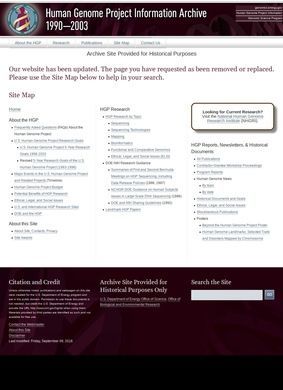
DNA Forensics is the listing name attached to the U.S. Department of Energy's archived website for the Human Genome Project, the 13-year effort that DOE and the National Institutes of Health ran jointly to sequence and map the full set of human chromosomes, wrapped up in 2003. The label sits a little oddly over the content, because the site is not a lab that runs paternity tests or crime-scene panels.
It is a public record of how the human genome was read for the first time, kept online long after the project itself closed. Anyone arriving here expecting a service will instead find an archive, and a deep one.
The material is organised into a handful of large branches, and each one rewards a slow read. The value is in the primary documents, not in slick presentation.
What the archive holds
The "About the HGP" branch lays out the project's goals, its timeline, its budget, and the organizational structure that tied DOE and NIH together, along with the international research sites that shared the sequencing load. This is the section that gives the rest of the site its footing. Read it first and the later technical pages make far more sense.
From there the site opens into the science itself. The "Research Topics" area is the densest part, covering DNA sequencing methods and the instruments that made high-throughput reading possible, chromosome mapping, bioinformatics, and comparative genomics that sets the human sequence against other organisms. Woven through all of it is the ELSI strand, the ethical, legal, and social implications work that the project funded deliberately alongside the wet-lab science. That pairing of hard biology with social research is one of the more unusual things about the whole endeavour, and the archive treats it as a first-class topic instead of an afterthought.
The chromosome viewer
Among the interactive pieces, the chromosome viewer is the one I kept clicking back to. Each chromosome gets its own page, with detail on what was mapped and where, and it turns an abstract idea into something you can walk through by number.
It is dated in look, and it loads like a page from an earlier web, but the information underneath is sound and specific. For a student trying to picture how the genome is partitioned, this beats any amount of textbook prose. The DNA Forensics entry gives no clue that a tool like this is buried inside.
The publications archive
The Publications section is the quiet centerpiece. It gathers historical project documents, several of the landmark papers that came out of the sequencing effort, and the full back run of Human Genome News, the newsletter that tracked the work as it happened. Reading those back issues in order is close to watching the project unfold in real time, with the open questions and the shifting timelines still visible instead of smoothed over by hindsight. Sources like this are exactly what tends to vanish when an institution redesigns its web presence, and here they are still preserved and reachable.
This is the kind of holding the DNA Forensics label buries entirely. A visitor could spend an afternoon in Human Genome News alone and come away understanding the sequencing race in a way no summary quite manages.
Where forensics enters the picture
The link to DNA Forensics as a field exists, but it sits upstream, in the foundations rather than the applied practice. Forensic genomics rests on the same sequencing chemistry, the same reference maps, and the same bioinformatics groundwork that this project produced, so a reader who wants to understand where forensic DNA methods come from will find the origin story here in a way most crime-lab sites never bother to explain.
What the site does not do is teach casework. There is no protocol for STR typing, no guide to interpreting a mixed sample, no walkthrough of how a profile is matched in an investigation.
So the DNA Forensics framing is best read as a category placement, not a description of the service. If you land on this DNA Forensics entry hoping for a testing provider, you have the wrong door. If you land here wanting the scientific bedrock beneath forensic DNA work, the fit is much closer than the mismatch first suggests. The DNA Forensics label points, in effect, to the science that came before the courtroom application.
Who gets the most from it
The audience the archive serves well is broad but specific in its needs. Genomics researchers come for the historical record and the primary papers. Educators and students come for structured, correct background they can cite. Policymakers get the economic and legislative material in the "Impacts" branch, which walks through potential benefits, the ethical and legal fallout, genetics legislation, and the spinoff technologies the project seeded. A general reader curious about how genome sequencing works, and why it stirred the debates it did, is also well served, provided they are comfortable reading instead of clicking through animations.
Seen that way, the DNA Forensics tag undersells the range of people who would get something out of a visit.
How the archive reads today
Nobody should arrive expecting a modern interface. The layout is plain, the navigation is old-school, and some pages carry the visual fingerprints of the era they were built in. That plainness is not really a fault. The pages load fast, the text is legible, and nothing stands between the reader and the documents. An archive maintained by the Biological and Environmental Research Information System under DOE's Biological and Environmental Research Program is doing its job when it keeps the record intact and accessible, and that is what this one does.
What you trade for the dated look is a kind of stability. The content is not chasing the latest genomics headlines and was never meant to. It is a snapshot of a completed effort, frozen at the point the work concluded, and that fixedness is part of why it stays useful as a reference for DNA Forensics readers who need a fixed account instead of a moving one.
What the archive does not try to be
It is worth being blunt about the gaps, since the DNA Forensics heading invites expectations the site will not meet. There is no interactive database you can query with your own sequence, no current news feed, no active research being posted. The interactivity begins and ends with the chromosome viewer and a scattering of period tools. Everything else is text and documents, which is the right form for an archive but a disappointment if you wanted a living platform.
For a topic that gets rewritten constantly across the wider web, having one steady, official account of how the human genome was first mapped is worth knowing about. The DNA Forensics entry links historians of science, working researchers, and classroom teachers to the same set of primary material, and each can draw on it for their own reasons.
The DNA Forensics page, then, indexes something more like a museum than a marketplace. The depth waiting behind it is the reason to go, and none of that depth shows on the way in. What the DNA Forensics listing actually connects to is a completed scientific project, documented by the agency that helped run it, still sitting where it was left.