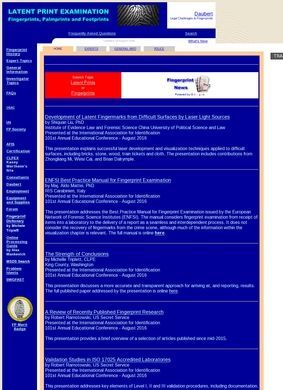
Where does a fingerprint examiner go when a single comparison turns into a courtroom problem, or when a junior analyst needs the exact wording of a technical term before testifying? For a sizeable slice of the friction ridge community, the answer has been onin.com/fp, the nonprofit portal that operates as Latent Print Examination. It pulls together the working references that scattered agency intranets and textbooks usually keep apart, and it does so without a paywall or a sign-up wall.
Fingerprint Dictionary and core sections
The spine of the site is a Fingerprint Dictionary that runs deep on terminology, the sort of resource an examiner reaches for when a definition has to be precise enough to survive cross-examination. Around it sit several practical sections that read as if they were built by people who do the work rather than people describing it from the outside. There is an AFIS information area covering automated identification systems, a documented set of case studies on problem identifications, and a FAQ that handles general fingerprint science for anyone coming in cold. Each of these answers a question a real examiner or student would have, and the answers stay specific.
Daubert legal challenge archive
One section that sets Latent Print Examination apart from a generic explainer is the Daubert legal challenge archive. Fingerprint evidence has spent years under scrutiny in admissibility hearings, and having a documented record of those challenges in one place is genuinely useful to attorneys and expert witnesses preparing for a fight over methodology. Pair that with the FAQ aimed at the general science and you get a resource that speaks to both the technical bench and the legal table, which is a harder balance to strike than it looks. For an attorney who found Latent Print Examination through a directory listing and expected a thin vendor page, the depth here is a real surprise.
Career and supply resources
The career and supply side of the field is covered too. A job listings board carries latent and tenprint examiner positions, the kind of niche posting that rarely surfaces on mainstream hiring sites. There is also an equipment and supplies directory, so a lab sourcing tools or chemicals has somewhere to start. These are unglamorous additions, and that is exactly why they matter to a working professional who would otherwise be hunting across a dozen vendor pages.
LP Examination Forum
Discussion is handled through the LP Examination Forum, a threaded board where fingerprint professionals pose and answer technical questions. A live forum is a fair indicator of whether a reference site is used or just published and abandoned. The presence of an active question-and-answer space, alongside expert and investigator topic areas, shows Latent Print Examination functioning as a meeting point as much as a library. For students entering the discipline, reading how experienced examiners reason through a tricky comparison can teach more than a static page ever could.
Archive of conference presentations and research
What gives the content real depth is the archive behind it. Latent Print Examination hosts years of IAI conference presentations, forensic research papers, and validation studies, the documentation that underpins claims about reliability and error rates in friction ridge analysis. It also links outward to the standards machinery of the field: the OSAC Friction Ridge Subcommittee, SWGFAST, NIST, and FBI resources, plus certification information through the International Association for Identification. Those are the bodies that set and review practice, so connecting an examiner directly to them, rather than summarizing them secondhand, is the more honest approach. Anyone preparing for IAI certification can trace the path from this entry.
Recognition within the profession
On standing within the profession, the picture is quieter but still telling. No third-party reviews, star ratings, or user counts turned up for the site on any platform. What does exist is professional citation: Latent Print Examination is referenced by Noblis, a forensic research nonprofit, and it appears in NIST's Latent Print Examination Process Map. Being woven into NIST's own mapping of the examination workflow is the sort of recognition that means more in this field than a pile of consumer reviews would. It indicates the people who define the process consider the resource worth pointing to.
Contact information limitations
The clear weak spot is contact. There is no phone number, no email, no mailing address anywhere on the landing page or the linked sections, and no inquiry form. Latent Print Examination behaves as a static reference archive, which means a visitor with a correction to suggest or a question the forum cannot resolve has no obvious channel to reach whoever maintains it. For a pure reference site that asks nothing of you and stores nothing about you, the absence is less alarming than it would be for a vendor, but it does cap how interactive the resource can be.
The site also wears its age openly. This is a deep, text-first repository built for retrieval, not a polished modern interface, and a first-time visitor may need a few minutes to learn how its sections fit together. That trade is one most of the intended audience will happily make, because the value is in the documents and the dictionary. Depth beats decoration.
Latent Print Examination holds up as a reference worth bookmarking, particularly for examiners or attorneys heading into an admissibility hearing. The Daubert archive is a strong starting point for any legal challenge, the Fingerprint Dictionary handles the terminology side, and the LP Examination Forum gives access to working practitioners when a question needs a human answer. The contact gap is real, but the published material compensates for it.