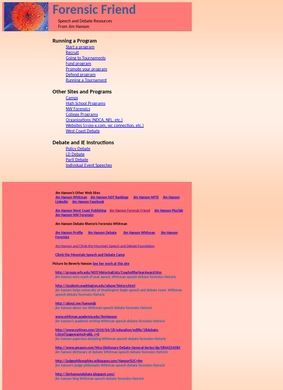
Crime scenes, DNA, and a morgue have nothing to do with the Forensic Friend Page. Forensics here carries its older sense: competitive speech and debate, the high school and college activity where students argue cases and deliver events in front of judges. Anyone who lands on the page expecting fingerprints and evidence bags will be surprised, and then, if they coach or compete, quickly relieved to find a resource built for their world instead.
Built by Jim Hanson under the West Coast Debate and West Coast Publishing banner, the Forensic Friend Page is a resource hub aimed at the people who keep speech-and-debate programs alive: coaches, program directors, and the students who want to get better at rhetoric. It is a plain instructional page, and it reads like one, which is at least honest about what it is. There is no gloss here, no attempt to look like more than a working set of guidance from someone inside the activity.
Running a program, start to finish
Most debate resources online teach argument technique and stop there. The Forensic Friend Page spends a good share of its attention on the unglamorous half of the job: the logistics of keeping a team in existence at all. That is a real gap it fills. Anyone who has watched a promising program fold because nobody knew how to fund it or fight for it in front of an administration will see exactly why this section belongs on the page at all.
The guidance is practical and administrative in the best sense. It walks a coach through the things a first argument textbook never covers, the parts that decide whether a squad survives past its first season. A lot of coaching advice assumes the team already exists and the buses are already booked. This page assumes nothing of the kind, and that is what sets it apart from the average how-to-win essay.
Starting, funding, and defending a team
This is where the Forensic Friend Page does its most distinctive work. It covers starting a team from nothing, recruiting participants, getting to tournaments, fundraising, and promoting the program around a school. It even addresses defending a program's existence, which anyone who has faced a budget committee will recognize as a survival skill in its own right. There is tournament-hosting guidance too, for the coach who has moved past attending events and now has to run one, with all the judging, scheduling, and logistics that involves.
Taken together, the Forensic Friend Page reads like advice from someone who has actually kept a team funded and on the road, not from a theorist writing at a distance. The recruiting and fundraising material in particular speaks to problems that never appear in a rulebook but sink real programs every year.
A coach who is strong on argument but weak on the politics of keeping a program funded is exactly the reader this part of the Forensic Friend Page is written for. The activity loses squads every year, not because the students lose interest but because the adult running it burns out on logistics nobody trained them for, and this is the rare page that treats that as the real problem.
Instruction across the events
On the teaching side, the coverage spans the main competitive formats. The Forensic Friend Page offers instruction for policy debate, Lincoln-Douglas, and parliamentary debate, and it does not neglect individual events and speeches, which are often where newer competitors start before they specialize. Each of those is a distinct discipline with its own conventions, its own pace, and its own idea of what a good round looks like. A parliamentary round and a policy round reward almost opposite habits, and a coach new to one of them needs an orientation more than a lecture.
A page that treats all of them gives a coach one place to send students regardless of what they compete in. How deep any single lesson goes is harder to judge from the outside, and a coach would do well to click through the actual instruction before trusting it to carry a squad all the way. Still, the breadth is real, and for a program running several event types at once, the Forensic Friend Page works as a common reference point that a whole squad can share.
Where the page points next
A fair amount of the Forensic Friend Page is a set of doors to other rooms. It links out to external programs, including debate camps such as Climb Speech and Debate Camps, and to college opportunities for students thinking past high school. It references debate organizations like the NDCA and the NFL, and it connects to other West Coast Debate resources and pages.
That makes the Forensic Friend Page function partly as a hub, sending a coach onward to the wider ecosystem instead of pretending to hold everything a program could ever need. That referral role is honest, though it also means the value of the page depends heavily on whether those outbound links still lead somewhere useful.
Contact information is sparse on the Forensic Friend Page. The page itself carries no phone number, email address, or physical address. What it does offer is links to Jim Hanson's professional profiles on LinkedIn and Facebook, plus connections to other debate sites, which give an indirect route to the person behind it. There is no contact page or tab of its own on the page as fetched, so reaching out means going through those social profiles instead of a form or a listed line.
For a free instructional resource run by one educator, that is understandable, though a visitor with a specific question is left to improvise a way to ask it.
Outside reputation gives genuinely little to report, and it would be dishonest to dress that up. A search for reviews or ratings of the Forensic Friend Page mostly surfaces an unrelated foreign-language thriller film also called "Forensic," reviewed on movie sites, which has nothing to do with this resource at all and only clutters any honest attempt to look the page up.
A follow-up search of the wider wcdebate.com domain returns the site's own instructional pages and product samples plus a traffic-analytics listing, and no ratings from Google, Trustpilot, Yelp, Facebook, or the like. So there is no third-party verdict here, positive or negative, to lean on.
That absence is the sticking point, and it is the thing I keep circling back to. The content of the Forensic Friend Page reads as useful and clearly written by someone who has done the work, but there is no way, from the page alone, to tell how current the links are, whether the camps and college opportunities it points to still run under the same names, or when any of it was last touched.
A resource built partly on defending a program's existence has to defend its own by staying maintained, and on that question the Forensic Friend Page gives a visitor no evidence either way.