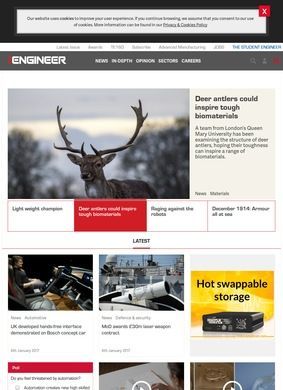
Offering a free printed copy on request is a good place to start, because it tells you what kind of operation The Engineer is: a working trade magazine that still puts ink on paper and posts it to people who ask, alongside the digital issues you can download from the site. That mix of print and web sits on top of a history most publications never get near. The Engineer was founded in 1856 by Edward Charles Healey, which makes it one of the oldest engineering periodicals in continuous circulation anywhere.
London-based and published monthly, it now runs as part of the Mark Allen Group. The remit is broad but coherent: engineering and technology news across the UK and further afield, reported for people who build things and the businesses that employ them.
The audience is not the general public. The Engineer is written for practising engineers, industry professionals, and the companies that operate across the engineering sectors, in the UK and internationally. That focus shapes the tone. Coverage assumes a reader who already knows the field and wants to keep pace with it, so the reporting tends to be specific about processes, programmes, and the firms involved instead of explaining the basics for outsiders. A publication that has held that same readership since the mid-nineteenth century has had a long time to learn what it needs.
Read the homepage description and the pitch is plain. Latest news and analysis up top, careers listings, downloadable magazine issues, and an archive that reaches back over its own 160-plus years. The Engineer is a reference point for a whole industry, not a niche blog with a narrow beat.
What the publication puts in front of engineers
The value of a title like this comes down to how much of an engineer's actual working day it speaks to, and The Engineer spreads its coverage across most of the sectors an engineer might work in: manufacturing, aerospace, automotive, energy, materials, and research and development. Someone in one discipline gets a window onto the others, which is often where the useful cross-pollination happens.
Below is what a reader gets when they land on the site and start clicking.
News, analysis and in-depth reports
The core of the offering is journalism: daily engineering news, longer analysis pieces, in-depth reports, and opinion. This is the part that justifies the subscription. News alone is a commodity, and plenty of outlets will tell you a factory opened or a contract was signed. The analysis and the in-depth reporting are where the title does the work that a busy professional cannot do alone, connecting a policy shift or a materials breakthrough to what it means on the shop floor.
Opinion columns add a human read on the same events, which keeps The Engineer from turning into a wire feed.
What holds the section together is judgement. A reader can find raw engineering announcements almost anywhere now, but sorting the genuinely significant from the noise is harder than ever, and that filtering is the quiet service a long-running title provides. The in-depth reports in particular give a subject room to breathe, the sort of treatment that rarely survives on a page paid for by clicks alone.
The digital issues and free print copy
Alongside the constant web coverage, The Engineer still ships as a discrete monthly product. You can download the interactive digital edition or a PDF, and you can ask for a printed copy at no charge. It sounds like a small point, but it is not for this readership.
A lot of engineering work happens in places where reading a curated monthly issue away from a screen beats scrolling a feed, and offering both formats means the magazine meets its audience wherever they read. The free print option also lowers the barrier for anyone weighing whether The Engineer is worth their time.
Careers listings
The Engineer carries job opportunities and careers listings, which turns a reading habit into something with a practical payoff. For a publication whose audience is engineers and the firms that hire them, pairing editorial with recruitment is sensible: the same people who come for the aerospace or energy coverage are often the ones weighing a move or hiring for a team. It is a modest section next to the journalism, but it gives the site a reason to be a regular stop instead of an occasional one, and it keeps the audience and the advertisers in the same place.
There is a practical logic to housing recruitment where the reporting lives. An engineer reading up on a shift in the energy or aerospace sector is exactly the person who might act on a vacancy in it, and employers know that a listing on The Engineer reaches a qualified crowd instead of a scattershot jobs board. The section will not compete with a dedicated recruitment platform on sheer volume, and it is not trying to. Its worth is the fit between who is reading and what is posted.
An archive that runs back to 1856
The archive is the part that no rival can simply copy. When a publication has been running since 1856, its back catalogue is a record of British and international engineering across nearly two centuries, and The Engineer leans into that with historical features, including pieces on its own long life. For a working engineer this is a curiosity; for a student, a historian, or anyone researching how a technology or a sector evolved, it is a genuine resource. Depth of that kind is earned slowly and cannot be manufactured by a newer competitor, whatever their budget.
It is also a quiet argument for the whole enterprise. A magazine willing to publish features about its own century-and-a-half of reporting is a magazine that treats continuity as part of the product, and for a field where today's breakthrough is built on decades of prior work, that long memory has real editorial use. The archive turns The Engineer into something closer to a working library than a monthly refresh.
The reach backs up the editorial. The Engineer maintains an active presence on LinkedIn, with a following in the region of twelve and a half thousand, plus a Facebook page, so the coverage travels beyond the site to where professionals already spend their time. Consistently billed as the UK's leading engineering publication, The Engineer has the pedigree to make that claim land, and the breadth of sectors it tracks means few engineers would find it irrelevant to their patch.
No single title covers everything well. The reporting on the fast-moving corners of a field is only as current as the last update, and a monthly cadence, even paired with daily web news, will always trail a specialist newsletter chasing one narrow subject. That is the trade-off of a broad publication: you get range and context in exchange for the very last word on any one topic.
Set against a direct alternative like Engineering and Technology, the IET's member magazine, the choice comes down to what a reader wants from the relationship. Engineering and Technology comes with the standing and membership benefits of a professional institution behind it, and skews toward that community. The Engineer is independent of any single body, older by well over a century, and pitched at the whole industry instead of one membership. For a reader who wants broad, sector-spanning coverage with a free way in and an archive nobody else can match, The Engineer is the one worth opening first.