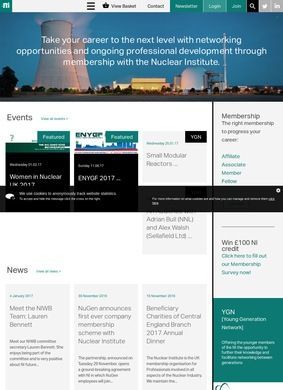
An Annual Dinner that pulls in more than 1,900 nuclear professionals is a fair signal of what The Nuclear Institute is and who it speaks for. This is the UK professional membership body for the nuclear sector, and the site is built around that job: qualifications, professional development, and a place where people who run reactors, do the research, or supply the industry can be recognised by their peers. It reads less like a marketing site and more like the front door of an organisation that expects members to come back regularly.
Earning professional standing through qualifications
The core of the offering is professional standing. The Nuclear Institute runs formal qualifications and grades of individual membership, up to Fellow status, alongside a Continuing Professional Development framework and eLearning modules that members are expected to log against their careers. That structure will feel familiar to anyone who has dealt with a chartered engineering or scientific body: membership is a credential you earn and maintain, and The Nuclear Institute treats it that way.
Mentoring routes for knowledge transfer
There is a mentoring scheme and volunteering routes too, which are a big part of how knowledge moves in a technical field where so much of it is passed hand to hand. The recognition side, awards and formal grades, gives that transfer a shape: someone who has spent years on decommissioning or reactor physics can point to a grade that says as much to an employer or a regulator, without having to re-explain their track record each time.
Membership tiers for organisations
Where the offering gets genuinely broad is the range of ways to belong. Beyond individual grades, The Nuclear Institute has Company membership, Corporate Affiliate membership, and an Educational Affiliate tier aimed at institutions. There is also a reciprocal arrangement with the American Nuclear Society, which is a practical touch for professionals who move between UK and US programmes or who need standing recognised on both sides of the Atlantic. That reciprocity is a practical draw for professionals mid-career, and it is not something every national body bothers to set up.
From student branches to senior fellows
Then there is the Young Generation Network, aimed at early-career professionals, which sits alongside regional branches and Special Interest Groups. A university network ties the student and graduate pipeline into the same organisation that certifies senior engineers. This end-to-end span is the most convincing thing about the body: a student joining through a campus branch and a Fellow chairing a special interest group are, in principle, on the same ladder. For a sector that constantly worries about where its next generation of engineers comes from, having one organisation cover the whole arc is a real argument for its relevance.
Conferences, journal and policy advocacy
The Nuclear Institute also does the things a mature professional body does but that are easy to overlook. It runs conferences and events, publishes a journal called Nuclear Future that carries industry insight, and operates awards and recognition programmes. It puts its weight behind policy advocacy, which for a nuclear body is not a small thing given how much of the sector's future depends on government decisions about new build, decommissioning, and skills funding. A shop and a job board are linked as well, though those are handled externally, so The Nuclear Institute points outward for those.
Behind the charity status
One fact worth stating plainly is that The Nuclear Institute is a registered charity, number 1125404. That is not decoration. It frames the organisation as a professional and educational body rather than a trade lobby, and it shapes what the site emphasises: development, standards, and recognition ahead of commercial promotion. Anyone weighing whether to join, or whether their employer should take out Company or Corporate Affiliate membership, will read that status differently than they would a private training vendor's pitch.
Who does the institute serve?
The audience is defined tightly and the site does not pretend otherwise. The Nuclear Institute serves nuclear professionals across the UK, from early-career entrants to experienced engineers and scientists, spanning research, plant operations, and the supporting supply chain. That focus is a strength. There is no attempt to be a general engineering institute or to chase adjacent fields; the qualifications, the events, and the journal all point at the same community. Someone outside nuclear will find little reason to be here, and that clarity is to The Nuclear Institute's credit.
What the site leaves harder to judge is the lived value of membership at each tier. The grades, affiliations, and networks are laid out clearly, but the day-to-day payoff, how active a given regional branch is, how much a Corporate Affiliate really gets beyond a logo and a few passes, how responsive the CPD and eLearning content stays as the sector shifts toward small modular reactors and new build, are the things a prospective member cannot fully weigh from the structure alone. The Nuclear Institute presents an impressive scaffold. Whether the scaffold is busy or quiet in the nearest branch, and whether the qualifications count for as much in hiring rooms as the site implies, are questions the pages set up without fully answering, and they are exactly the questions that decide whether the membership fee is worth it.