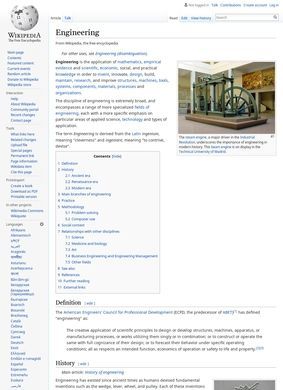
You hit a wall the moment you try to pin down what engineering really means. Is it physics? Is it just building things? Does software count, or only the work with steel and concrete? The question sounds simple until you start pulling on it, and most quick web results either oversimplify or bury you in jargon. Wikipedia: Engineering meets that confusion head on, opening with a working definition that treats engineering as the systematic application of natural science and mathematics to design, improve, or create systems, devices, and processes while staying inside real constraints. That last part, the constraints, is what separates this from a textbook platitude, and it sets the tone for everything that follows.
From ancient megaprojects to industrial revolution
From there Wikipedia: Engineering does something a lot of single-page references skip: it gives you history before theory. The historical arc runs from ancient megaprojects, the Egyptian pyramids and Roman aqueducts and the simple machines the Greeks worked out, through the medieval period with its windmills and early programmable devices, and on into the Industrial Revolution where steam engines, iron bridges, and machine tools turned engineering into a recognizable profession. This framing is genuinely useful, because it shows specialization as something that happened over centuries instead of presenting today's disciplines as if they fell from the sky. By the time Wikipedia: Engineering reaches modern practice, you understand why the field splintered the way it did.
And splinter it did. Wikipedia: Engineering enumerates more than twenty-seven recognized disciplines, the familiar pillars of civil, mechanical, electrical, and chemical engineering alongside aerospace, biomedical, computer, environmental, industrial, nuclear, petroleum, and software work. It does not stop at the obvious. Interdisciplinary corners such as naval, automotive, manufacturing, systems, and mining engineering each get a place, and those hybrid fields are exactly where a curious reader tends to get lost. Anyone trying to figure out which branch fits a particular interest can use the list as a map, and every entry links onward to its own deeper article.
Comparing engineering disciplines
The part worth returning to is the section on engineering practice. Plenty of reference entries define a profession and then walk away. Wikipedia: Engineering instead describes the design process and the problem-solving methodology that engineers actually use, the loop of defining a problem, weighing constraints, modeling solutions, and testing them. It names the computer-aided tools that run through nearly every branch now, CAD for design, CAM for manufacturing, and the simulation software that lets engineers stress a bridge or a circuit before anyone builds it. For a student or a career-changer, this is the difference between knowing what engineers are called and knowing what they do all day.
Wikipedia: Engineering is also careful about boundaries, and it draws them explicitly. It distinguishes engineering from science, from medicine, from biology, and even from art and business, which sounds academic until you realize how often those lines blur in casual conversation. Spelling out where engineering ends and applied science begins does real work for a reader who arrived precisely because the terms felt interchangeable. The distinctions are stated plainly, without the hand-waving that usually accompanies this kind of comparison.
Inside the engineering design process
Credit is due for not treating engineering as a purely technical pursuit. There is a section on the social dimension that covers engineering ethics codes, humanitarian engineering organizations, and the wider effect the profession has on society. This is the kind of material that gets cut when a writer is in a hurry, so its presence here reflects an entry that wants to be complete instead of merely correct. Whether you care about the morality of the work or just need to cite a code of conduct, it is sitting right there.
Wikipedia: Engineering pulls its weight on the practical resource side too. It embeds links to engineering education pathways, professional bodies including the forty-plus UK-licensed engineering institutions, specialty glossaries, and the standards organizations that govern industry practice. That is a serious set of onward doors for a reader who wants to leave the encyclopedia and go talk to an actual licensing board or training program. The inline citations let you check claims at the source, and the open-license model means the content can be corrected by anyone who spots an error, with Wikipedia: Engineering available across numerous languages through interlanguage links.
Ethics and resources for engineers
If there is a limit, it is the one built into the format. A general overview of an entire profession will always feel shallow to a working engineer who needs depth in a single subfield, and Wikipedia: Engineering reads more like a well-organized front door than a final destination. The breadth that makes it valuable to a newcomer is the same breadth that sends a specialist clicking onward within a paragraph or two. That is an honest description of what a top-level survey article can be, not a flaw in the execution.
So the verdict lands where the structure points. As a starting map of the field, Wikipedia: Engineering is hard to beat: free, well-sequenced from history through practice, generous with its onward links, and honest about the borders between engineering and its neighbors. As a place to learn how to actually do any one discipline, it was never going to be enough, and it does not pretend otherwise. Treat it as the orientation step, the page you read before you go deeper, and Wikipedia: Engineering does that job about as well as a single entry can.