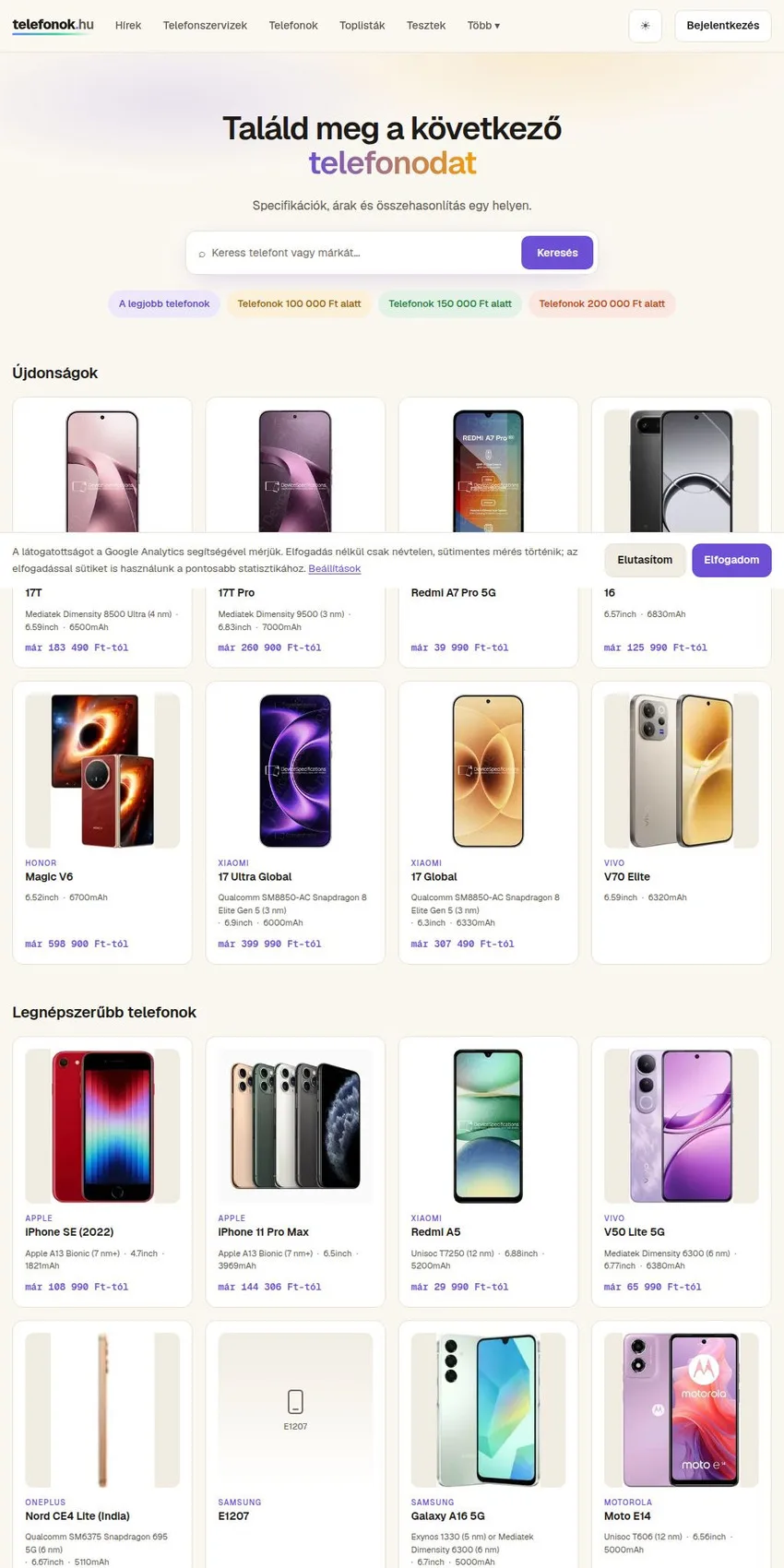
Telefonok.hu is a Hungarian-language information website dedicated to smartphones. It maintains a catalogue of mobile phone models with full technical specifications and tracks the prices charged by shops for each model. It also compares two to four phones side by side and provides a news feed on the mobile phone market. If you've ever opened six tabs to check whether it's worth changing your phone, this site aims to bring them all together in one place.
Its niche is the specifications catalogue and comparison portal – that corner of the internet which GSMArena covers in English. Sites of this kind do not sell phones. They sit between the buyer and the shop and take care of the tedious task of sifting through information, so that you don't have to.
Start with the catalogue, as everything else depends on it. The 'all models' page allows you to filter by brand, price, screen and battery. From there, you can move the models that pass the filters into the comparison view. There's also a brand index: choose a manufacturer and browse its models with current specifications and prices.
Where the comparison table comes in handy
The comparison tool takes two, three or four phones and displays them row by row. The screen, battery, camera, processor, storage and any other field in the catalogue have their own row. You can view the results as a wide table or as individual cards. Popular combinations are pre-set, so you can jump straight to comparing the iPhone 16 and the Pixel 10.
The feature I've always come back to, as a reviewer, is the 'Csak a különbségek' toggle. It means 'just the differences'. Toggle it on and any rows where the phones have identical specifications disappear. What remains is a short list of the elements that set them apart, a bit like a 'spot the difference' puzzle where someone has already circled the answers.
Why does this matter? A full spec sheet has dozens of rows, and most of them are identical for two phones in the same price range. Hiding irrelevant information transforms a wall of figures into a choice you can easily remember.
The buyer's guide hidden under the table
Beneath the comparison tool lies a guide, written in plain language, on what to consider when two phones are in direct competition. It's organised according to how much each difference is felt in everyday life. It also tells you to stop reading once the two phones no longer differ. This is a sensible way to read a spec sheet and, frankly, it's not one that most people learn.
When it comes to screens, the guide focuses on the refresh rate, panel type and maximum brightness, rather than the pixel count. A 120 Hz AMOLED screen offers a smoother experience than a 60 Hz LCD, whilst the difference between pixels is hard to spot on a six-inch display. It also reminds you to check the phone's width, as well as its diagonal measurement. When it comes to batteries, the website states quite bluntly that the mAh rating can be misleading, as the same battery lasts longer with a smaller screen and a low-power processor.
The practical question it asks is how far you can get with half an hour's charging and whether the charger is included in the box. A valid point; it's often not included these days. Wireless charging falls into the 'convenience' category, as it rarely keeps up with wired charging.
The section on the camera states that megapixels are the worst evaluation criterion you could possibly choose. A well-calibrated 12 MP main sensor often outperforms a poorly calibrated 108 MP one. Look instead for optical stabilisation, sensor size and aperture, and check whether any additional lenses are genuine. Those 2 MP depth and macro cameras, the guide notes, are mainly there to pad out the spec list.
Processors are treated in a similar way: for browsing and messaging, two consecutive generations offer an almost identical experience. The processor only really matters if you play games, edit videos or plan to keep the phone for years. Storage space is highlighted as the choice that is hardest to rectify later on, as most new phones no longer support memory cards. And then there is software support, the section which, according to the guide, hides the biggest shortcomings and is read the least.
Two phones at the same price may differ in terms of the number of years of updates: five or six on the one hand, two on the other. Is this an exaggeration? The website's reasoning is that a phone that has passed its update period does not slow down, but becomes more vulnerable to attacks. It's a fair distinction.
There is also a short list of features that rarely live up to the promises made in adverts: the number of megapixels, maximum charging power, raw performance scores, the number of cameras and RAM exceeding 8 GB. If two phones differ only in these respects, buy the cheaper one, the guide advises. As for prices, it notes that phones depreciate the most in the first six months after launch, so a one-year-old flagship model often outperforms a newly launched mid-range model. Prices in shops vary from week to week, sometimes by a significant margin for the same model.
Lists, reviews and news feed
In addition to the main catalogue, the site maintains a series of hand-picked lists. There is a top list compiled based on the site's own scores, on a scale of 1 to 10. The 'best price' lists use the lowest current selling price for each phone, whilst the themed lists cover large batteries, compact bodies, large screens, headphone jacks, 5G, NFC and gaming. The coverage is broader than the usual parade of Samsung and Apple brands; rugged Ulefone and Blackview models feature alongside entry-level Nokia phones.
The news section contains bylined and dated articles. At the time of writing this review, key topics included MediaTek's flagship 2 nm chip, the bug-fix update for the Pixel released by Google in September, Oppo's pocket charger and Samsung's presentation of the Fold8 aimed at iPhone owners. Longer articles use subheadings, conclude with a summary in the form of bullet points and cite their sources; the article on the Pixel cites Android Authority and The Verge. Brand names in the text link to the site's own pages dedicated to those brands, so a news item about Google is just a single click away from each Pixel model's technical specifications.
A site that is half catalogue and half magazine usually gives the impression of being made up of two sites stuck together; here, the two sections constantly refer to one another. In my opinion, however, its greatest strength is that it tells you which figures to ignore. Many specification websites list everything; few mention that the megapixel figure can be misleading. The website is in Hungarian, with prices in forints, and is aimed at buyers who want the technical specifications, price and selling points all in a single tab.
Business address
Simple IT SRL
Rue De La Malaisee 18,
Ottignies Louvain la Neuve,
1340
Belgium