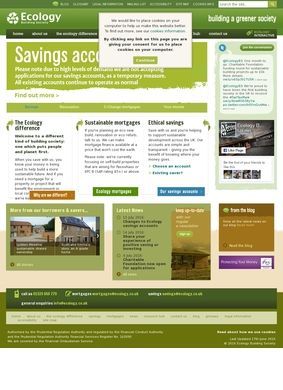
Can a savings account or a mortgage refuse, on principle, to fund a fossil fuel company? At Ecology Building Society the answer is a flat yes, and that single decision shapes everything else on the site. This is a UK mutual that lends only against projects with an environmental or community benefit, and that funds its lending with money from savers who want the same thing. The proposition is narrow on purpose, and the site reads like an organisation that knows exactly who it is talking to. There is no attempt to be all things to all customers, and that focus is the most striking thing about the whole operation.
Savings accounts and rates
The savings range is laid out plainly. There is an Eco Double Access Saver paying 3.45% AER and a 180-Day Notice Account at 3.60% AER for people willing to give up some flexibility for a slightly better rate. The Sea-Changers Impact Saver sits lower at 2.00% AER, the trade-off being that part of the return goes toward a marine conservation cause, so a saver knowingly accepts less interest in exchange for where the money goes. Alongside those sit Easy Access accounts, Regular Savings, Cash ISAs and a spread of Notice accounts. Rates and terms are stated up front, which is the right way to handle this, and a visitor can see the actual numbers before opening an application.
How deposits fund green lending
That spread covers most of the ways an ordinary person saves, from a tax-efficient ISA to a regular monthly habit. The deposits a saver places with Ecology Building Society are what fund the green lending on the other side of the balance sheet, so the connection between putting money in and where it ends up is more direct here than at a conventional bank. For someone who cares about that link, the savings book is the whole point, and the society does not hide the mechanism. It is unusually candid about the fact that lower rates on some products are a deliberate choice tied to the cause the account supports.
Mortgages for non-standard projects
The lending side is where Ecology Building Society departs most from a high-street bank. Instead of a generic residential product, the mortgages are organised by what is being built or changed. Self-build and off-site (modular) construction are covered, as is renovation and the conversion of one property type into another. There is a dedicated Eco Home mortgage, plus shared ownership and community living options for people buying into co-housing or similar arrangements. That structure tells you the society expects to deal with awkward, non-standard cases that a mainstream lender would decline or struggle to price.
Specialist self-build and renovation
This is genuine specialist territory. A timber-frame self-build, a barn conversion or a co-housing scheme tends to fall outside the boxes a volume lender can tick, and Ecology Building Society has organised its products precisely around those situations. Anyone who has tried to mortgage a half-finished or unusual property knows how short that list of willing lenders gets, so Ecology Building Society treating these as core business is filling a real gap. The product structure points to staff who understand construction stages and the release of funds at each one, rather than just a marketing label over a standard loan.
Commercial and community loans
Commercial lending follows the same logic. Community-led housing, sustainable business loans, developer finance and part-residential mortgages are all named as separate products. The customers implied go well beyond the individual saver: charities, community groups, voluntary organisations and developers working on sustainable schemes. Better terms for borrowers who install heat pumps or similar technologies mean the environmental position is priced in, not bolted on.
Verifying ethics through products
The useful thing about this organisation is that the ethical stance is verifiable in the products themselves. The refusal to lend to fossil fuel companies is a policy with consequences for the loan book, and the green technology incentives are concrete. A visitor does not have to take a values statement on trust, because the trust is expressed in what is and is not on offer. For an institution in a sector where green claims are often vague, Ecology Building Society makes its position legible from the product list alone.
Regulatory status and mutual ownership
For a financial institution the regulatory footing matters, and at Ecology Building Society it is solid. The society is authorised by the Prudential Regulation Authority and regulated by the Financial Conduct Authority, FSR number 162090. As a mutual owned by its members, there is no shareholder pressure pushing toward whatever pays best regardless of purpose, and that gives Ecology Building Society a coherence that bolt-on green initiatives at larger banks lack.
Customer satisfaction across platforms
The outside record is broadly positive and drawn from more than one place. On Trustpilot the society holds a 4-star rating across 56 reviews, and a separate aggregator cites a 4.5 overall figure. Smart Money People carries a much larger pool, with 582 reviews of the savings accounts scoring 4.91 out of 5, plus further product reviews on the same platform. Traders Union rates Ecology Building Society "Very Good" at 4.3 out of 5, and Fairer Finance lists both customer experience and product ratings. The picture is consistent: people who use Ecology Building Society tend to be satisfied, and the volume on Smart Money People shows the savings products performing as described.
One caveat is worth flagging because it cuts against the grain of the rest. The Good Shopping Guide gives Ecology Building Society an "acceptable" ethical score but notes that full Ethical Accreditation has not yet been achieved. For most savers that is a footnote, yet for an organisation whose entire pitch rests on ethics, an incomplete accreditation from a body that specialises in exactly this is a fair thing to weigh. Bank.Green, for its part, rates the society as a "Great" sustainable institution, so the environmental credentials of Ecology Building Society hold up well even where one specific accreditation is still outstanding.
Contact is straightforward: a phone number is on the site, email goes through a contact page, and day-to-day banking runs through a separate online portal. A prospective member can get in touch without hunting around.
If there is a limit to who Ecology Building Society suits, it is the obvious one. The rates are competitive but not always the top of the market, because some of the return on products like the Sea-Changers saver is consciously given up for a cause. Anyone optimising purely for the highest possible interest will find better headline numbers elsewhere. That is the point of the place, and the site is honest about it.
The verdict is clear but qualified. Ecology Building Society is a credible, properly regulated mutual with a genuinely distinct purpose and a strong satisfaction record, and the products back the ethical claims rather than merely asserting them. The self-build, renovation and community-led mortgage lines are a real specialism that few lenders match. The one honest reservation is the outstanding full ethical accreditation noted by The Good Shopping Guide. On the published evidence, the case for Ecology Building Society is real for savers and self-builders who share its environmental priorities; for those who do not, the rates alone will not pull them in.