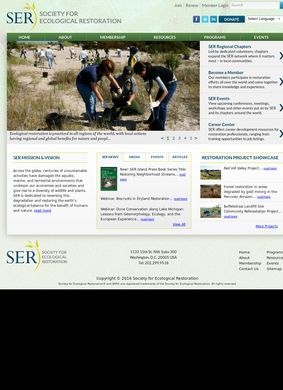
Professional certification is what I kept coming back to on this one. The Society for Ecological Restoration runs a full credentialing track: the CERP designation for established practitioners and a CERP-in-Training tier for people earlier in the work, with defined pathways for application, recertification, and moving from one level to the other. That is a serious commitment for a field that, until fairly recently, had no shared yardstick for who actually knows what they are doing on the ground. A landscape architect, a program manager, and a community volunteer can all point at the same standard now. The Society for Ecological Restoration built and maintains that standard, and publishes a public CERP Directory through its Restoration Resource Center at ser-rrc.org so anyone can verify who holds the credential.
Professional certification through CERP
Restoration ecology lives somewhere between field science and policy, and the offering reflects that split honestly. On the science side there is Restoration Ecology, the peer-reviewed journal published with Wiley, which is the kind of anchor that tells you an organization is doing more than running events. On the practice side, the Society for Ecological Restoration provides a Digital Ecological Restoration Toolbox, an e-learning course series, and a webinar library with live sessions still being added. The structure of what is available backs up the claim that research and field work belong together.
Research journal and digital learning tools
Membership comes in individual tiers keyed to career stage, alongside group and organizational options, which is a sensible way to handle a constituency that runs from undergraduates to government policy makers. The stated audience is wide: natural and social scientists, environmental engineers, urban and regional planners, program managers, landscape architects, community advocates, and students, spread across more than 70 countries. That breadth could easily turn into a watered-down catch-all, yet the certification track and the journal give the whole thing a center of gravity.
Membership structure across career stages
There is also an Open Doors Program aimed at emerging professionals, which reads as a deliberate attempt to keep the field from becoming a club only well-funded institutions can afford to join. Restoration work happens in places without big budgets, often led by people who came to it through a local degraded wetland or a community planting effort, and a program that lowers the entry cost is worth having for that reason. SER Connect, the members-only online community, gives those people somewhere to compare notes once they are inside.
Open Doors Program for emerging professionals
The regional structure is one of the more convincing parts of how the Society for Ecological Restoration is organized. Fourteen chapters operate worldwide, with thematic sections layered on top of the geography. A practitioner working on arid-land restoration faces problems that have little to do with someone rewilding a temperate floodplain, so the split between place-based chapters and topic-based sections is a practical answer to a real difference in the work.
Regional chapters with thematic sections
The biennial World Conference on Ecological Restoration is the marquee gathering, and the 12th edition has been announced for Lisbon, Portugal. A conference held every two years instead of annually is a small tell that the organizers want substance over churn, since each edition has time to draw genuinely new work. For a global membership that schedule also keeps travel demands reasonable, which fits an organization whose entire purpose is ecological health.
Conferences, volunteer campaigns, public resources
Alongside the headline event, the Society for Ecological Restoration runs Make a Difference Week, an annual volunteer mobilization campaign. This is where the organization reaches past its dues-paying members and into the broader public, turning a scientific society into something people can act on with their hands for a few days. It is a smart counterweight to the journal and the certification exams, which by nature speak to specialists.
The public-facing layer is more developed than many scientific societies manage. The Restoration Resource Center, the searchable CERP Directory, the toolbox, and the open course materials mean that someone who never joins can still pull useful things out of what the Society for Ecological Restoration has built. Many professional bodies lock everything behind membership. The Society for Ecological Restoration keeps a meaningful share of its work in the open, which is its own kind of statement about how the organization sees its role.
What the Society for Ecological Restoration is trying to do is stated plainly: advance the science, practice, and policy of ecological restoration to sustain biodiversity, improve climate resilience, and re-establish an ecologically healthy world. The three-part framing matters because restoration that ignores any leg tends to fail. Good science with no policy traction stays on the shelf. Field practice with no scientific grounding repeats old mistakes. Policy with neither just produces paperwork. The way the Society for Ecological Restoration maps its programs onto those three areas is the clearest evidence that the mission is structural rather than aspirational.
There is a question worth sitting with about scope. An organization spanning 70-plus countries, fourteen chapters, a journal, a certification system, an e-learning catalog, and a global conference is carrying a lot, and breadth can dilute focus. The counterargument is that ecological restoration is itself a sprawling field, touching engineering and botany and land-use law in the same project, so a body that wants to represent it credibly has to be broad. The certification program is what keeps that breadth tethered to a measurable standard.
How does breadth affect organizational focus?
For a working practitioner, a graduate student, or a planner trying to write restoration into policy, the Society for Ecological Restoration is among the small set of organizations that genuinely shape how the field operates worldwide. The Society for Ecological Restoration publishes enough openly that its scope and standards can be evaluated before any decision to join or pursue CERP. What is harder to weigh is fit: the certification track and the peer-reviewed journal are most useful to people whose work is close enough to formal restoration that a recognized credential and a global network would change how they operate day to day.