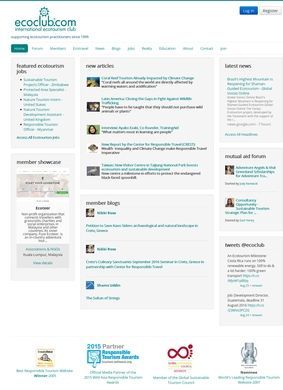
What does a site that has been talking about ecotourism since the late 1990s have to show for it? In the case of ECOCLUB International Ecotourism Club, the answer is a working community and a set of practical tools, well beyond a manifesto. The site runs on the tagline of ecotourism and sustainable tourism expertise since 1999, and the bones of that history are visible everywhere: a directory of listings, a certification scheme with published reports, a jobs board, and editorial content that keeps turning over. It reads like something that has been lived in for years.
Ecotourism consulting led by one director
The consulting work sits at the front. ECOCLUB International Ecotourism Club offers ecotourism and sustainable tourism consulting, both directly and through EU programmes, which is a more specific claim than the usual vague advisory pitch. The person behind ECOCLUB International Ecotourism Club is Antonis Petropoulos, named as both director and principal auditor, working out of Greece. Having one identifiable individual attached to the audits and the consulting is consequential, because the certification side leans entirely on that judgement being trustworthy.
Auditing lodges for the Ecolodge label
The certification side is the part worth examining most closely. The ECOCLUB Ecolodge programme is a free, audit-based recognition for accommodation, and the process is not a rubber stamp. Lodges fill in a multi-step questionnaire, supply photographic and video evidence, and then the audit report gets published. Publishing the audit is the unusual move. Plenty of green badges exist where you never learn what was checked or why something passed, so putting the report out in the open changes the weight of the recognition. A reader can read the reasoning instead of trusting a logo. For a small accommodation owner weighing whether the exercise is worth the effort, the price (nothing) and the transparency are both arguments in favour.
Why publishing audits builds trust
It also says something about how ECOCLUB International Ecotourism Club positions itself. A free certification with a public report is hard to game and easy to scrutinise, which suits an outfit that wants its standing to rest on method rather than fees. The audit trail is the spine of the whole proposition, and the fact that it is openly documented does more for credibility than any amount of promotional language could.
A global directory of ecotourism listings
Beyond certification, the global directory is the part most casual visitors will use. The ECOCLUB International Ecotourism Club directory collects ecotourism listings across Africa, Asia-Pacific, the Caribbean, Europe, Central America, North America, and South America, spanning more than fifty countries and covering accommodation, tours, and attractions. A directory of that geographic spread is genuinely useful as a starting point for someone planning low-impact travel, though its value depends on how current and how curated the entries stay, and a visitor can only judge that by clicking through their own region.
Networking tools for industry professionals
Sitting alongside the directory is a free networking platform aimed at professionals in the field. It carries a members directory, community posts, a jobs board, and realty listings for ecolodge sales. That last category tells you who the audience really is: the operators, buyers, and sellers who run the places, alongside the travellers. ECOCLUB International Ecotourism Club is clearly built as much for the industry as for the tourist, and the jobs board plus the realty section give it a reason for people to return instead of visiting once and leaving.
Editorial content and learning resources
The editorial and learning material rounds it out. There is a news section with interviews, publication reviews, green living articles, documentaries, and even music, plus an Eco Learning area and member-contributed photos, videos, and papers. Some of this will date faster than the directory, and a music section feels like a holdover from an older era of the web. Still, the volume of member contributions points to a community that actually posts, which is harder to keep alive than a static set of pages.
Checking travel tools and related projects
The travel tools are more of a convenience layer than a draw. A flight finder, a train finder, ferry booking, and a weather forecast are the sort of widgets many sites bolt on, and they are unlikely to be the reason anyone shows up. Two further projects, ROOTS Tourism and Ecological Tourism, are listed as well, placing ECOCLUB International Ecotourism Club as an umbrella for several efforts under one roof.
That breadth cuts both ways. A site holding consulting, certification, a directory, a professional network, editorial, learning resources, and travel widgets risks diluting its focus, and a few corners do feel like they get less attention than the audit work. The counterweight is that all of it stays inside one clear subject. Nothing here wanders off into unrelated territory, and the certification and directory remain the load-bearing pieces that justify the rest.
Is third-party validation available?
On credibility, the picture is mixed and worth being straight about. The testimonials on record come from lodge operators and academics, and they sit on the site's own about and services pages, which means they are self-published and should be read as such. A search for outside corroboration came up short: no Google, Trustpilot, or Yelp presence surfaced, so there is no independent rating to point to in either direction. That is not damning for a niche professional community, where the relevant proof tends to be the published audits and the named director instead of a stack of consumer star ratings, but a visitor who wants third-party validation will not find it easily. ECOCLUB International Ecotourism Club asks to be judged on its method rather than on a public scoreboard.
Finding contact details on the site
Contact is the weaker spot. The homepage shows no phone number and no street address, and while there are clear paths to list a business, post jobs, and join as a member, a visible email is not put front and centre. The membership and listing forms do give a route in, so it is not a dead end, but anyone wanting to reach the team directly has to dig. For an organisation that has been around since 1999 and trades partly on consulting, putting contact details somewhere obvious would cost nothing and would settle the question of who you are dealing with. It is the one area where ECOCLUB International Ecotourism Club undersells the openness it shows elsewhere.
Twenty-five-plus years on one subject, a named auditor, published reports, and a community that keeps contributing add up to something with real depth in a narrow field. The scattering of dated features and the buried contact route are the rough edges, and they are worth naming, yet they sit against a body of substance that most green-travel sites cannot match. ECOCLUB International Ecotourism Club is the more honest stop for an operator chasing genuine ecotourism recognition, or a traveller who wants to understand why a lodge qualifies as green. The published audit reasoning and the named human standing behind it are what a giant aggregator like Booking.com, for all its inventory and guest reviews, does not offer.