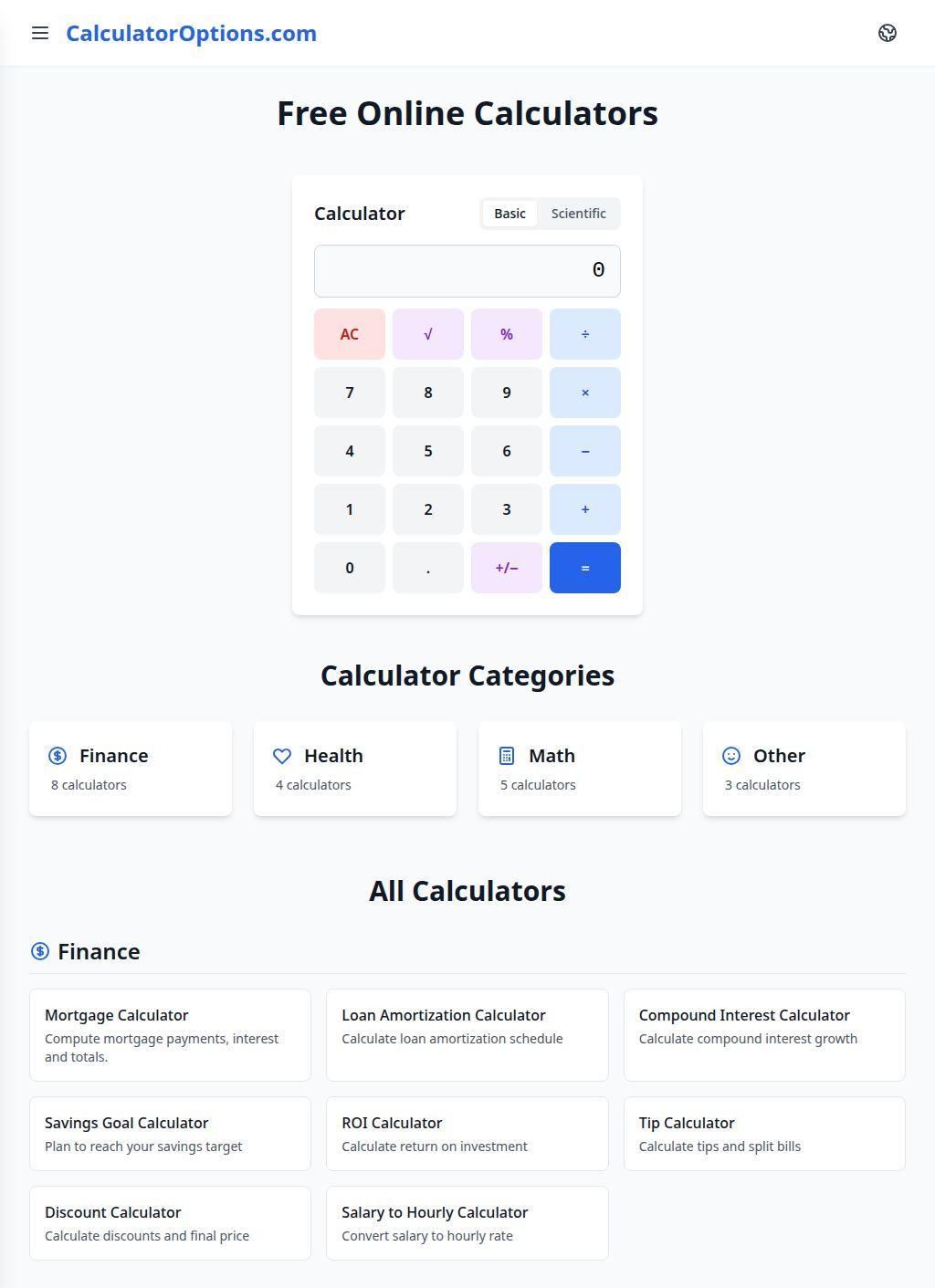
CalculatorOptions.com opens on its Scientific Calculator page, which is where the site makes its clearest statement about purpose. The tool targets students, engineers and researchers who need trigonometry, logarithms and exponents handled correctly, and it sits alongside a plain Basic Calculator that covers nothing beyond arithmetic. That split is deliberate: the simple operations live on one page, the heavier math on another, so a student doing calculus and a person splitting a restaurant bill do not have to dig through the same interface to find what they came for.
Finance, mathematics and health categories
The catalogue covers three broad areas. Finance is the densest, with calculators for mortgage payments, loans, interest, return on investment, savings goals and tip splitting. Mathematics runs from the basic-to-scientific range described above. Health gets its own category, though the detail available is limited: the category label appears, but the individual tools under it are not named in the brief. A visitor curious about health coverage would learn very little from the current presentation. For a free site that requires no login and sells no upgrade, the spread across finance and math is wider than expected, which makes the vagueness in the health section more noticeable by contrast.
CalculatorOptions.com names its intended audience explicitly: general consumers, students, engineers, scientists and financial decision-makers. That list is specific enough to be useful, and the layout matches it. A student reaches the scientific functions quickly. A homeowner lands in the mortgage and loan section. Someone reviewing investment options finds a structured set of finance tools. Each group ends up somewhere sensible rather than wading through a single bloated all-in-one tool. Splitting a site by user type is harder to execute than it looks, and the category structure here is evidence that someone gave it real thought.
One technical claim deserves attention because most free calculator sites never raise it. CalculatorOptions.com states that its financial tools use arbitrary-precision arithmetic to avoid floating-point errors. Anyone who has seen a spreadsheet quietly round a long interest computation into a slightly wrong figure will recognise why this is worth saying. A visitor cannot verify the implementation without feeding it real numbers from a genuinely complex amortisation scenario, but stating the intent at all puts CalculatorOptions.com a level above the average free calculator that simply trusts the browser's default math.
Comparing investment options side by side
The finance section gets the most scrutiny here because it is built for comparison work, not isolated sums. Several sub-tools let a user weigh investment options against each other and model different loan scenarios side by side. That is a different task from typing two numbers and reading an answer. Someone choosing between two mortgages, or checking a savings target against a deadline, gets a structure to work through it rather than a blank field and a guess. The ROI and savings-goal tools follow the same logic: they support a decision and stop short of just handing back a number.
The tip calculator sitting in the same finance bucket is a small indicator of how broadly CalculatorOptions.com is casting its net. It is an everyday non-specialist tool, and its place next to mortgage amortisation suggests the site is trying to cover both the casual restaurant-bill moment and the serious financial decision under one roof. That range can go either way. It widens the potential audience, but it also means no single category goes especially deep, so someone chasing a niche financial computation may find the coverage broad where they wanted it narrow.
Inside the widget embedding feature
The widget feature is easy to overlook on a quick pass and worth slowing down for. CalculatorOptions.com offers embeddable Calculator Widgets: a single line of code drops one of its calculators into another site. That shifts it from a destination someone visits into a component other site owners can borrow. A blogger writing about home loans, or a small finance site wanting a working tool instead of a static table, could use it without building anything from scratch. Whether the embedded version carries branding or tracking back to the host page is not visible from the brief, and that is a question worth asking before embedding anything on a site you care about.
Sustainability questions without visible revenue
CalculatorOptions.com is free across the board, with no subscription and no paid tier mentioned anywhere. That is the genuinely attractive part and also where a quiet question sits. A free utility site depends on someone continuing to maintain it, and there is no fee structure here pointing to a revenue model that would fund that upkeep. The site does not explain how it sustains itself, so a user has no visible signal that the calculators will stay current and the math will stay correct over time.
Contact runs through a single form, open for questions, suggestions and requests for new calculators. That last option is a reasonable touch: it treats the catalogue as something that can grow on user demand. There is no phone number or physical address listed, which is normal for a tool of this type. A web form is appropriate for a calculator site, and inviting calculator requests through it is more than many comparable sites offer. Even so, form-only contact leaves a visitor with no way to identify who operates CalculatorOptions.com or where it is based.
The outside picture is sparse in the specific sense that no user discussion or review thread turns up in a search. Results that surface belong to unrelated competitors such as calculator-online.net, calculator.net and online-calculator.com, none of which say anything about this site. There is no star count, no forum thread of people confirming the precision claim, no complaint about a broken tool. Zero third-party coverage is not the same as a negative verdict, but it does mean the arbitrary-precision pitch and the overall quality of execution rest entirely on what CalculatorOptions.com says about itself. There is no external confirmation either way, which is an honest limitation worth naming.
Someone who wants a quick mortgage estimate or a clean scientific calculator without ads gating the result or an account wall will find CalculatorOptions.com easy enough to use on its own terms. The categories are sensible, the finance tooling is oriented toward the comparisons people run when making real decisions, and the free-for-everything stance removes the usual friction. The basic-versus-scientific split, the savings-goal and ROI tools, and the open invitation to request new calculators all point to a site that has thought past the bare minimum. What remains unverifiable is whether the precision promise survives a genuinely difficult financial computation, and whether the site will still be maintained in two years with no obvious income to support it.