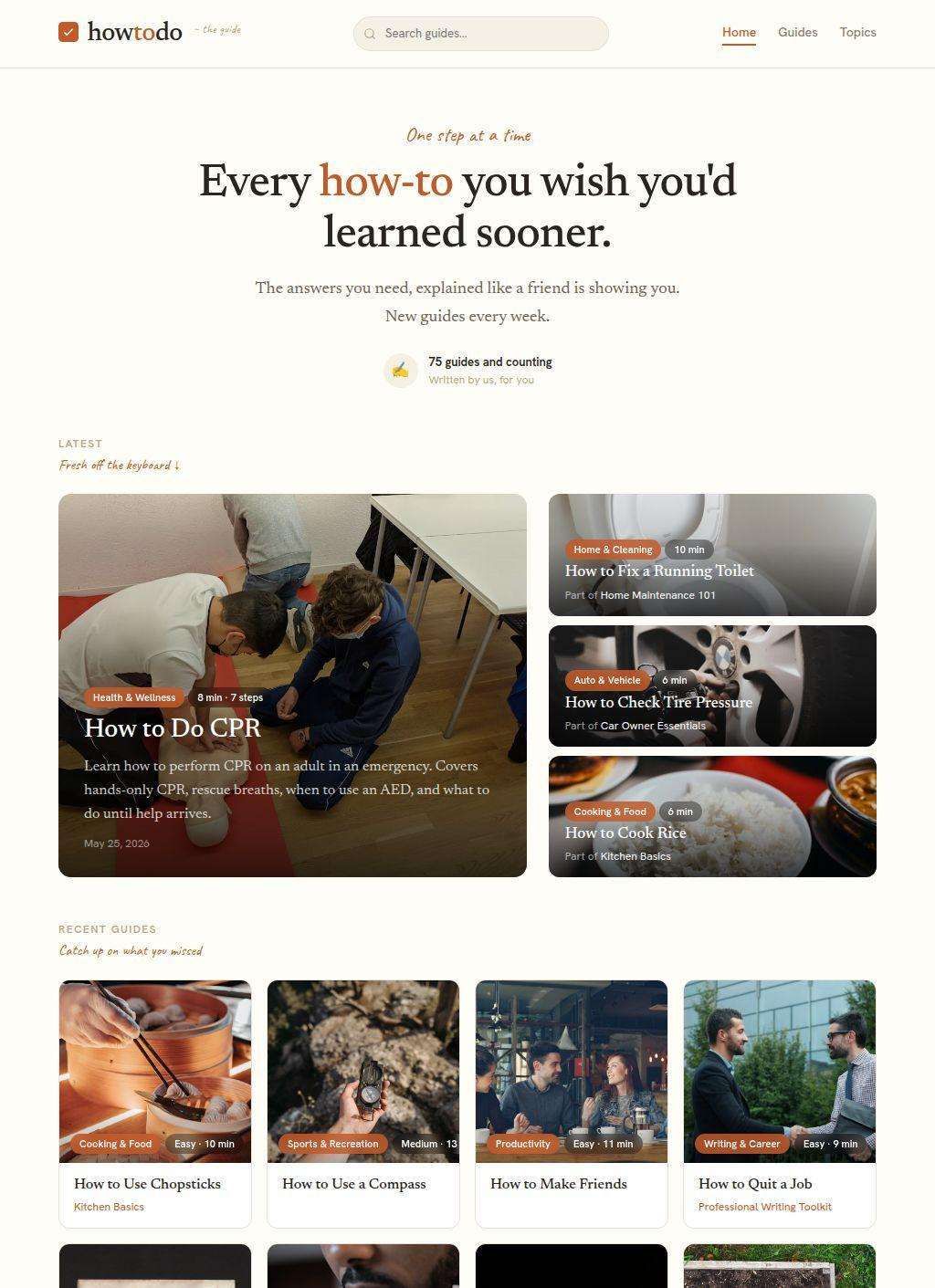
How To Do is a how-to and instructional reference site at how-to-do.net, filed here under Science and Reference. The domain name sets a clear expectation: practical guides, step-by-step walkthroughs, the sort of writing that answers a question someone typed in a hurry. What the expectation cannot do is fill in for the page itself, and that is where this entry runs into trouble straight away.
Server errors block access
During the work that went into this review, the site simply would not load. A direct request came back with a 403 Forbidden response, and a second attempt through a different fetching route returned a 500 Internal Server Error. Neither is a quirk of one browser or one moment. A 403 means the server saw the request and refused it; a 500 means something on the server side broke while trying to answer. Together they describe a domain that is either locked down hard against automated visitors or struggling to stay up. No cached copy and no indexed snapshot turned up either, so there was no side door to the content.
For an ordinary brochure site, a temporary outage would be a footnote. For a how-to resource it cuts closer to the bone. The entire value of a guide library is that someone can reach it the moment they need it, mid-task, hands dirty, looking for the next step. A reference that answers requests with errors fails at the one job it sets out to do. If a casual reader hit how-to-do.net the same way How To Do was reviewed here, they would see a refusal or a broken page and move on to one of the dozens of competing how-to sites that load on the first click.
Error codes suggest structural problems
There is a more forgiving reading, and it deserves an airing. A 403 can come from a firewall or a bot-blocking layer that turns away anything not arriving as a normal human in a normal browser. Plenty of healthy sites guard themselves this way and serve real visitors fine. But the 500 alongside it weakens that story, because a bot wall would usually keep refusing cleanly instead of collapsing into a server error. Without a single successful load, the friendly explanation stays a guess, and a guess is not something to build a recommendation on.
It is also worth noting that consecutive error codes on two separate attempts rules out a fluke. A one-off 500 can happen to any server. A 403 and a 500 on back-to-back routes points to something more structural, whether that is a broken configuration, an expired hosting plan, or an overzealous security layer that misfires. Whatever the cause, the result for a visitor is the same: How To Do does not open.
Content cannot be verified
Going only by the name and category, How To Do points toward the familiar territory of practical instruction: home maintenance, cooking, DIY fixes, everyday life skills, the kind of question that starts with the word "how." That is a crowded and useful corner of the web, and a well-made entry in it earns repeat visits. The catch is that not one of those topics could be verified. Whether How To Do covers ten subjects or a thousand, whether the guides are written by hand or scraped, whether they carry photos or video or plain text, whether they are accurate, all of it sits behind a server that would not open the door.
The structure, the depth, the quality of the writing, the breadth of the catalogue: every concrete thing a reader would actually weigh remains unknown. How To Do is, on the evidence available, a name and a promise with nothing confirmed underneath it. That is a harsh summary, but it is the accurate one.
No third-party information available
Outside the site itself, searches for the domain and related terms returned no third-party reviews, no ratings, no mentions of note. A great deal of solid, quietly useful content never attracts a single public review, and how-to material in particular tends to get used and forgotten rather than rated. Still, when the site itself will not load and the wider web has nothing to say about it, there is no second source to lean on. Both doors are shut at the same time.
Contact details unreachable
Contact details could not be assessed for the same reason. With no page to read, there was no way to check for a phone number, an address, a contact form, or hours of operation. None of that should be held against How To Do as a deliberate omission, since the cause is the outage rather than any choice on the operator's part. It does mean a reader has no confirmed way to reach whoever runs it, which compounds the basic problem of a resource that cannot be reached in the first place.
Concept and domain name
What can be said fairly is narrow. The concept is sound and the niche is genuinely useful. A working how-to library aimed at home repair, cooking, and life skills is the sort of thing people return to regularly, and the domain name is plain and memorable, which counts for something in a space full of keyword-stuffed URLs. The trouble is that a concept is all there is to go on. None of the practical strengths a reader needs, working pages, readable guides, accurate steps, a way to make contact, could be put to the test.
Verdict remains uncertain
How To Do may well be a perfectly good resource on a day when its server behaves, and the repeated errors may turn out to be a passing fault or an aggressive bot filter that ordinary visitors never notice. Or the site may be neglected and slowly going dark. From the outside, those two futures look identical. On the published evidence, there is simply not enough to recommend it or dismiss it, and until how-to-do.net answers a plain request without throwing an error, any verdict is provisional at best.