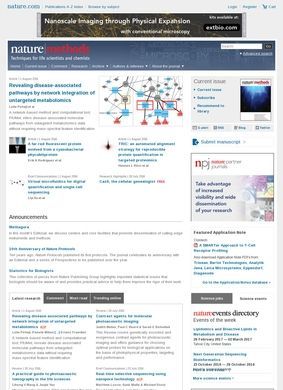
A chemistry listing that points to Nature Methods sets an odd expectation, because the journal is really a life sciences title that happens to publish a fair amount of chemistry-adjacent work. Its remit is methods: Nature Methods exists to describe how something is measured, imaged, sequenced, predicted or analysed, covering biology, physics and biomedical research alongside the chemistry running through all of them. That single focus is what separates it from the rest of the Nature Portfolio. You will not find a broad discovery paper here unless the discovery is a technique.
Content formats and article types
Published monthly by Springer Nature, Nature Methods runs original research articles built around novel methodology, and surrounds those with a wide spread of secondary formats: Reviews and Analysis pieces, Perspectives, Brief Communications, News and Comment sections, Technology Features, and editorial columns including the long-running Points of View series on data presentation. A Brief Communication describing a tweak to an existing protocol is a very different read from a full Analysis weighing several competing approaches, and knowing that distinction saves a lot of time. Anyone consulting the journal for the first time should note that the shorter formats often carry the most directly usable bench information.
Methods coverage across disciplines
The technical range on display is genuinely wide. Recent coverage includes advanced microscopy, with work on multimodal adaptive optical microscopy and on light-sheet and super-resolution imaging, plus macromolecular ensemble prediction, RNA interactomics, cell reprogramming techniques, mass spectrometry, and the visualization of scientific data. A chemist landing here would find the mass spectrometry and the ensemble-prediction material the most familiar territory, while the imaging papers sit closer to cell biology. That breadth is the point of a methods journal: a technique developed for one field tends to migrate, and Nature Methods is where that migration gets documented and benchmarked.
Assessing technique maturity for lab adoption
The content is organised with the understanding that Nature Methods does not expect every reader to be a specialist in the method being described. The Reviews and the Technology Features tend to set out the limitations of a technique as plainly as its strengths, which is unusual and useful when the whole purpose of reading is to decide whether to adopt the method in your own lab. A paper that only promoted its method would be near useless to someone trying to reproduce it. The editorial framing helps a non-specialist judge whether a tool is mature or still experimental, and on that front the journal generally delivers.
Beyond the articles themselves, the site carries the infrastructure you would expect from a major journal. There are submission guidelines, peer-reviewer support, open-access funding information, language editing services, full editorial policy documentation, and journal metrics. Researchers can subscribe to RSS feeds and email alerts, and the current issue is accessible online. For someone deciding where to send a manuscript, the policy and metrics pages are worth reading before anything else, since they spell out what the journal considers a methods advance against what it will reject as incremental. The peer-reviewer support and language editing services also indicate that Nature Methods is set up to work with authors whose first language is not English, which is no small thing in a global research base.
Audience and publishing barriers
The audience is clear and Nature Methods does not stray from it. It serves academic researchers, laboratory scientists and methodologists across the life and physical sciences worldwide. It is written for readers who already know roughly what they want to do and need a reliable, peer-reviewed account of how others have done it, including the failure modes and the controls worth running. That is a narrower readership than the flagship Nature title commands, but it is a readership that returns issue after issue because the content is directly actionable.
One caution worth raising is the open-access funding question. The journal publishes information about it, which is helpful, but the practical cost of publishing or accessing the most recent research can be a real barrier for smaller labs and for readers without an institutional subscription. The funding pages are upfront about this, and a prospective author should read them carefully before assuming a route to publication is affordable. That is a feature of the commercial scientific publishing model generally, and it shapes who can use what is on offer.
For the chemistry reader, the honest framing is that Nature Methods will be a sometimes-source rather than a core one. The analytical chemistry crowd will find the mass spectrometry and data-analysis methods relevant, and structural chemists may follow the macromolecular prediction work, but a synthetic organic chemist will rarely see their daily concerns reflected here. The journal goes deep on measurement and imaging methods, and a chemist whose work touches those areas will keep coming back, while one whose work does not will check it only occasionally. A focused journal serving its niche well is more useful than a sprawling one serving none.
Secondary content on data presentation
The quality of the secondary content deserves a note. The Points of View columns on figure design and statistics have been quietly influential well outside the journal's core readership, and they are the kind of material that gets passed around labs and cited in teaching. That a methods journal also invests in teaching scientists how to present their results clearly says something about how it sees its job. It is not purely publishing techniques; it is trying to raise the standard of how techniques get communicated. Standing in the research community comes from citation metrics and Impact Factor, both of which are consistently high, and from the fact that authors and readers in its niche treat publication here as a meaningful credential.
Comparing analytical chemistry and Nature Methods
Set against a title like Analytical Chemistry from the American Chemical Society, which a chemist might consider for the same measurement-focused reading, Nature Methods is the broader and more interdisciplinary of the two but the less chemistry-centric. Analytical Chemistry will give a chemist denser coverage of separation science, electrochemistry and spectroscopy aimed squarely at the field. Nature Methods will give them those same tools seen through a life sciences lens, alongside imaging and sequencing work they would not find elsewhere. For a methodologist working at the boundary between chemistry and biology, the Nature title is the stronger pick. For someone planted firmly in analytical chemistry, the ACS journal is the more obvious home, and Nature Methods becomes the one to read when a technique crosses over.