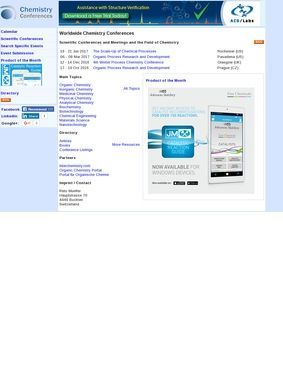
The domain chemistry-conferences.com has been registered, and that is roughly where the story stops. Load the address and you get a single line, "This Page Is Under Construction, Coming Soon," sitting above four auto-generated search links: Analytical Chemistry, Chemistry Conferences, Chemistry Research Articles, and Science. Those are the standard furniture of a parked domain, the kind a registrar's holding system drops onto any address that has been claimed but not built. They point outward into a search, not inward into a site. So the most useful thing to establish about Chemistry Conferences up front is plain: at the address in this listing, nothing has been built yet. Chemistry Conferences, as it stands today, is a name attached to a blank page.
A parked domain with no content
The name Chemistry Conferences promises an events resource. Most people arriving here would expect a calendar of academic chemistry meetings, abstract submission, registration, perhaps keynote listings or links to proceedings. What they meet instead is a holding screen and a row of generic category words. No event dates. No host institutions. No venues, no speaker names, no programme, no way to register for anything. The placeholder is the entire experience, start to finish.
Generic search links, not curated sections
It is worth being exact about those four links, because at a glance they can read as curated sections. They are not. Terms like Analytical Chemistry and Chemistry Research Articles were not written or maintained by anyone connected to the site; they are search prompts the parking system generates automatically, the same pattern that appears on countless undeveloped domains. Click one and you do not open a conference programme or a research index. You start a search that carries you away from the page entirely. For a visitor, that is the line between a working resource and a web address that has simply been reserved and left alone.
No launch timeline or organiser contact
There is nothing disreputable in a coming-soon screen by itself. Real projects sit behind one all the time while the genuine article gets assembled. The problem is that this page gives no indication anything is being assembled. There is no launch window, no contact, no statement from an organiser, no "back in the spring" note. It asks a reader to return later without saying what they would be returning for. Plenty of placeholders never become anything at all, and from the outside this one is indistinguishable from those.
Similar domain names create confusion
One more practical wrinkle. The chemistry-conference space is crowded with similar names. A quick search surfaces chemistryconferences.com, chemistryworldconference.com, and chemistryconferences.org, each a separate operation with no link to the hyphenated domain here. A researcher chasing a particular meeting could easily land on the wrong one and assume it is the same outfit. The Chemistry Conferences address in this listing is its own entity, and at the moment that entity is an empty shell.
No way to reach anyone behind the site
There is no way to reach anyone. No phone number, no postal address, no form, no contact page. On a placeholder that is no surprise, but it does shut down the one move that might salvage an unfinished site: asking the people behind it what they intend. Someone hoping to submit an abstract, sponsor an event, or even confirm that a real Chemistry Conferences event exists has nowhere to send the question. The wider web is equally quiet.
No reviews or third-party commentary exists
A search across the usual platforms returns no third-party reviews, no ratings, and no commentary attached to this exact domain; the only result for the address is the parked page itself. None of that is a black mark on quality, because there is no service or event for anyone to have reacted to. It is the predictable footprint of a site that has not yet done anything, and Chemistry Conferences has done nothing visible to date.
Trust requires details conferences cannot provide
That silence does cut deeper for an events brand than it would for most. Conferences run on trust in the particulars: who organises, where it is held, which bodies stand behind it, whether past attendees came away satisfied. With no record anywhere and no detail on the page, a cautious academic has no footing to commit time or registration money to Chemistry Conferences. Parked addresses also change hands, change purpose, or freeze for years, and with no statement of intent posted there is no telling which of those Chemistry Conferences will turn out to be. The fair reading treats the Chemistry Conferences listing as a name and a reserved web address, not a resource.
Replace the placeholder with actual event details
So the verdict is short, because the offering is short. The domain is held, the storefront is bare, and the visible content amounts to one notice and four machine-made links. A chemistry researcher or graduate student looking for a meeting to attend or submit to is better served by the distinctly named organisations that actually publish dates and programmes, returning to Chemistry Conferences only if it ever goes live with real ones. If the page later fills with a genuine schedule, organiser details, and submission tools, the whole assessment could flip. Whoever holds this domain has an obvious route to being taken seriously: replace the holding screen with the event itself, dates, location, organisers, and a contact.
What remains fundamentally unanswered?
What the page leaves unanswered is everything that would make Chemistry Conferences a thing rather than a placeholder: whether a conference is genuinely planned, who would run it, when it might happen, and whether the address will become a real resource or stay frozen as it is now.