From a reference genome to everyday medicine
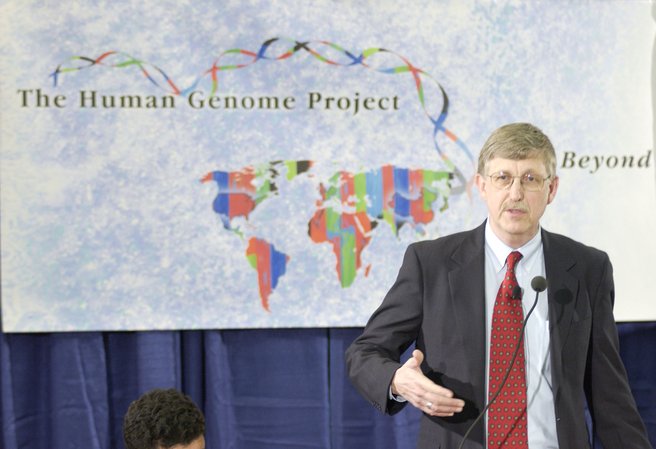
Almost every cell in your body carries the same instruction set, written in about three billion pairs of DNA letters. Reading that whole set once, for one representative human, was the job that created the National Human Genome Research Institute. The institute led the part of the international Human Genome Project run by the U.S. National Institutes of Health, and in April 2003 it announced that the human genome had been sequenced. That reference sequence is now the backdrop for a large share of modern biology and clinical genetics.
The work did not stop at reading the genome one time. The institute now studies how the sequence varies from person to person, what those differences mean for health, and how to bring genome information into ordinary medical care without harming patients or their privacy. A doctor who orders a genetic test for a cancer risk gene or a hard-to-diagnose childhood illness is drawing on methods and data that trace back in part to this institute.
The original project ran from 1990 to 2003, a thirteen-year effort that pulled in laboratories in the United States, the United Kingdom, Japan, France, Germany, and China. NHGRI coordinated the NIH share of that work. Early on, the sequencing centers agreed to what became known as the Bermuda Principles, a rule that new human sequence data be posted to public databases within a day, which kept the reference open for anyone to use. The 2003 announcement covered the great majority of the genome, and researchers spent years closing the last stubborn gaps. In 2022 the Telomere-to-Telomere Consortium, backed by NHGRI, published the first genuinely complete human sequence. One surprise from all this reading is how few genes there are: about 20,000 stretches of DNA that code for proteins, with most of the genome given over to regulatory and other non-coding sequence.
How the institute is organized
NHGRI is one of the 27 institutes and centers that make up the National Institutes of Health. It started small. In 1988 NIH set up an Office for Human Genome Research, which grew into the National Center for Human Genome Research in 1989 and became a full institute in 1997. James Watson led the early effort. Francis Collins directed the institute from 1993 to 2008 before he went on to lead all of NIH, and Eric Green took over as director in 2009.
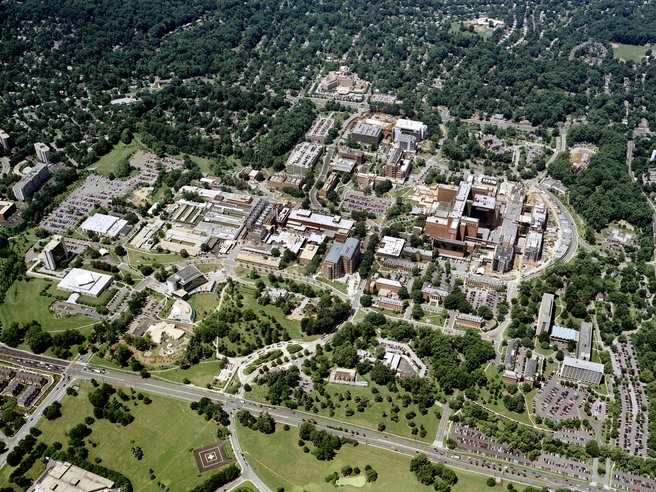
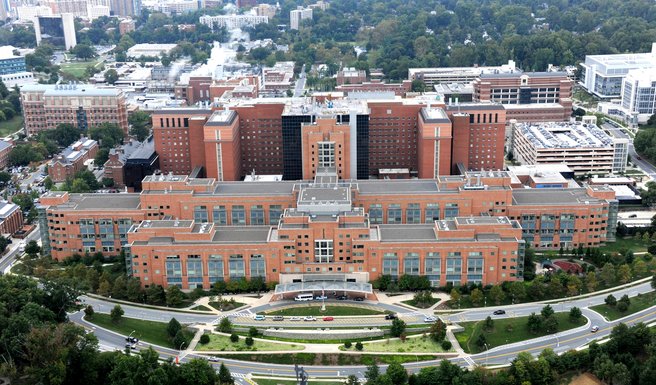
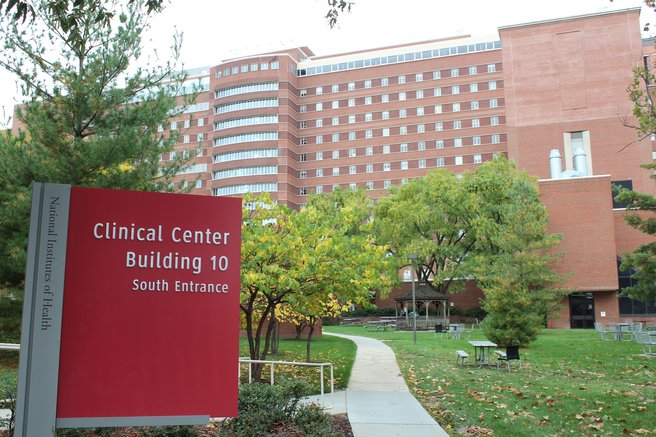
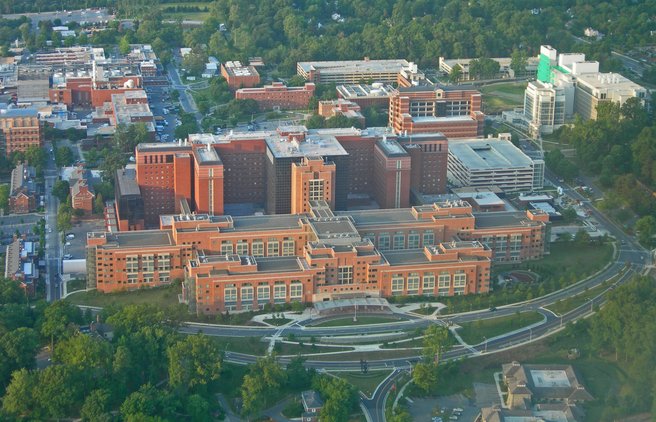
The institute works in two main ways. Its Division of Intramural Research runs laboratories and a genomics clinic on the NIH campus in Bethesda, Maryland, where staff scientists study rare inherited diseases and test new sequencing methods on patients who volunteer. Through its extramural programs it awards grants to universities and hospitals across the country, paying for much of the genomics research done outside the government. In fiscal year 2020 the institute's budget was about 650 million dollars.
Programs that shape the field
Several long-running NHGRI programs set standards that other researchers depend on:
- ENCODE, the Encyclopedia of DNA Elements, maps the parts of the genome that switch genes on and off rather than the genes themselves.
- The genome-wide association study catalog gathers findings that tie specific DNA variants to traits and diseases, from diabetes to heart disease.
- The institute has tracked the falling cost of DNA sequencing for years, following the price of reading one human genome as it dropped from many millions of dollars toward the cost of a routine medical test.
Ethics as part of the science
From its first budget the institute set aside money to study the ethical, legal, and social questions that genome data raises. That program, known as ELSI, was the first of its kind at a federal research agency. Its work helped shape the Genetic Information Nondiscrimination Act of 2008, a law that limits how employers and health insurers can use a person's genetic information. The point was practical: people will not use genetic testing if a result can cost them a job or their coverage.
Bringing genomes into the clinic
Sequencing a genome is now the easy part. The harder question is what a given variant means for a real patient, and several NHGRI-funded efforts work on exactly that. The Clinical Genome Resource, or ClinGen, gathers experts to judge which genes and DNA changes have enough evidence to guide care, and it shares those judgments with laboratories and doctors. A network called eMERGE has linked genomic data with hospital medical records to test how genetic risk information can be returned to patients and used in treatment. The aim is a point where a genetic result is as routine and as interpretable as a blood pressure reading.
Public resources and where it fits
Much of what the institute produces is meant to be used outside the laboratory. It publishes plain-language explainers, a talking glossary of genetic terms, fact sheets on specific conditions, and teaching material on genome.gov, written for students, patients, and clinicians who need to make sense of a genetic result. For a biology reference, NHGRI is the U.S. government's main home for genomics research and for the practical question of how genome science reaches patients.
The National Human Genome Research Institute sits on the NIH campus in Building 31, Room 4B09, 31 Center Drive, Bethesda, Maryland 20892. Its Communications and Public Liaison Branch answers questions from the public and the press at +1 301-402-0911, and its research, funding notices, and educational material are posted at genome.gov.

Business address
National Human Genome Research Institute (National Institutes of Health)
31 Center Drive, Building 31,
Bethesda,
Maryland
20892
United States
Contact details
Phone: +1 301-402-0911