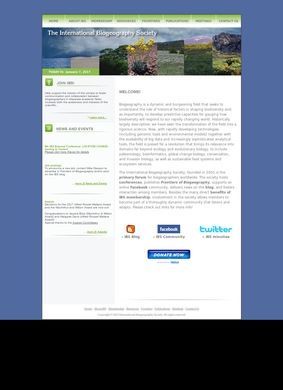
Joining a global professional body instead of going independent is a trade-off worth thinking through carefully, and The International Biogeography Society makes the case for membership in concrete terms. It is a not-for-profit 501(c)(3) scientific and professional association built around one discipline: the study of how life is distributed across space and time. The membership draws in researchers, students, and educators, and gives them a calendar, a peer-reviewed journal, and a governance structure to participate in.
Membership benefits for early-career researchers
The membership package rewards people who are early in their careers as much as established academics. Joining brings access to biennial international conferences, smaller off-year meetings, workshops, and webinars. On the practical side there are discounted conference registration fees, reduced publishing fees, and eligibility for student travel awards. Travel money is often the thing that keeps a graduate student out of the room where the field gets argued out, and The International Biogeography Society treats it as a real budget line, not a token gesture.
Frontiers of Biogeography journal
The society publishes Frontiers of Biogeography, a peer-reviewed, open-access journal hosted on the Pensoft platform. Open access is the right call for a specialist field like this, where readership is scattered across continents and institutions with very different library budgets. The journal carries new research findings in biogeography and is currently recruiting editors, a detail that deserves attention. A journal openly looking for editors expects to grow its publishing volume, and it hands ambitious mid-career scientists a concrete service role with real influence over what gets published.
Conference programme and recognition awards
The conference programme is the other anchor. Holding a flagship meeting every two years, with smaller meetings in the gap years, gives the calendar a workable rhythm: a big gathering to aim for, and lower-key sessions to maintain momentum between them. At the biennial conference, The International Biogeography Society also presents Recognition Awards that honour outstanding contributions to the field. Peer acknowledgement of this kind registers clearly on a CV in a narrow discipline where researchers broadly know one another's work.
Committee participation and member directory
Members can do more than attend events. The International Biogeography Society runs an active committee structure that lets members take part in governance and in specialised initiatives. For anyone who wants their professional body to be something they help steer rather than a fee paid once a year, that path is open and clearly part of how the organisation runs.
There is also a member directory, which is genuinely useful in a field this specialised. Biogeography sits at the seam of ecology, evolutionary biology, geography, and climate science, and a searchable list of who is working on what can shorten the path to a collaborator or a reviewer. Donation options sit alongside membership for people or institutions that want to support the work beyond their own dues. The society keeps a presence on Facebook, X, and YouTube, so its meetings and announcements reach beyond the membership list to the wider public it says it wants to engage.
Public engagement and scope
One thing worth flagging is scope. The International Biogeography Society frames its mission around education and public awareness, alongside the advancement of research among specialists. That outward-facing intent is consistent with a society that posts talks to YouTube and maintains social channels. Whether that public-facing effort is heavy or light, the stated aim is visible in how the organisation describes itself. A search of independent review platforms turned up no user ratings or testimonials for The International Biogeography Society, which is fairly typical for a niche academic association. The membership proposition has to be read from the institutional record and the published programme rather than from aggregated member scores.
You can find The International Biogeography Society through this business directory listing, which links through to the full programme details. What the public side establishes is the shape of the offer: a recognised scholarly society, a real open-access journal, a steady meeting calendar, awards with peer standing, and a route in for students that does not assume a generous travel budget.
If there is a limit to what an outsider can judge from the public face of The International Biogeography Society, it is the texture of day-to-day member life: how lively the webinars run between conferences, how responsive the committees feel, how quickly Frontiers of Biogeography turns around a submission.
Those are things you learn by joining and participating. For a graduate student or early-career researcher in biogeography, joining The International Biogeography Society looks like a direct path to the conferences, the journal, and the people who define the work. A straightforward check: weigh the membership fee against the registration discount on the next biennial meeting and see whether a student travel award applies to your situation. For an established scientist, the open editor call at Frontiers of Biogeography may be the more interesting move, putting your name into the running of the field and not simply appearing in the audience.