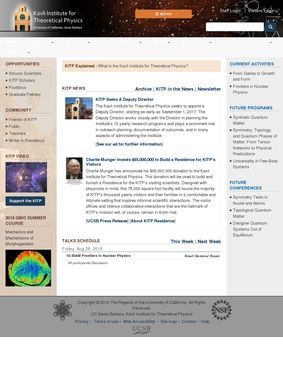
Almost no experiments happen at The Kavli Institute for Theoretical Physics, and it runs no telescopes. What it does instead is gather working physicists from many countries, put them in Santa Barbara for weeks or months at a stretch, and let them argue through one focused research problem with people they would otherwise see only at a conference. The institute sits inside the University of California, Santa Barbara, and draws part of its support from the National Science Foundation, which fixes its character as a national resource rather than a single department's project.
How the residential program works
The residential program is the thing to understand first, because everything else follows from it. A program runs long enough that the visitors stop being visitors and start functioning as a temporary working group. The topics shift year to year, but the recent slate gives a fair picture of the range: condensed matter physics, quantum matter and fractionalization, non-equilibrium dynamics, quantum science, ultracold molecules, and biological physics covering morphogenesis and biological learning. Work sitting at the meeting point of artificial intelligence and physics is also on the schedule, which is a live and contested area and a reasonable thing for an institute like this to host. Conferences and workshops tie into these programs, so a multi-month effort tends to spike into a denser week where more people arrive and the talks come faster.
Research topics across physics
The practical answer is time and proximity, and The Kavli Institute for Theoretical Physics clearly understands that the practical answer is the whole point. A program is useless if the people invited cannot get to it or cannot stay, so the institute supports both short stays and long ones with lodging assistance, visa guidance, computing facilities, workplace accommodations, and even referrals for medical care. That last item reads as small until you remember that a months-long stay means uprooting a life, sometimes across an ocean, and the people most worth inviting are often the ones with the most to arrange before they can come.
Support for visiting researchers
Opportunities are not limited to established names passing through. The Kavli Institute for Theoretical Physics runs graduate fellowships and postdoctoral scholar positions, which puts younger researchers in the same corridors as senior figures for an extended period. That kind of sustained contact is hard to arrange anywhere else, and it is a meaningful part of what The Kavli Institute for Theoretical Physics offers beyond the marquee programs. There is also an affiliate route, where external researchers can hold a formal affiliation without being on site continuously, which keeps the network wider than the building.
Fellowships and postdoctoral positions
For someone deciding whether to apply or to nominate a colleague, the site lays the structure out with enough specificity to act on. The distinction between a fellowship, a scholar position, an affiliate nomination, and a plain visitor stay is real, and The Kavli Institute for Theoretical Physics does not blur them together. That clarity counts when the decision involves moving for half a year.
Accessing talks and recordings
Most people will never apply for a residency, and for them the most useful thing The Kavli Institute for Theoretical Physics provides is the online talks archive. It holds freely accessible recordings of lectures, seminars, chalk talks, and public lectures, and it has been accumulating for a long time. A chalk talk in particular is worth flagging, because it tends to be the informal, work-it-out-at-the-board session where a researcher explains how they actually think, not the polished version prepared for a journal. Having those on open access is more valuable than it first sounds: graduate students far from any major physics center can watch the same material the on-site visitors heard.
Public lectures for general audiences
The public outreach programming sits alongside that archive and aims lower on the technical scale, bringing theoretical physics topics to general audiences. It is a smaller part of the operation than the research programs, and the site treats it that way, but it is a genuine offering. Between the archive and the outreach talks, a curious non-specialist has a real way in.
Who benefits most from this institute?
It is worth being plain about who the core of this institute is built for. The Kavli Institute for Theoretical Physics is organized around people doing theoretical physics at a professional level, and the programs assume that audience. A casual reader will get the most out of the recordings and the public lectures; the fellowships, scholar slots, and residential programs are aimed at a narrow and serious group. The site does not pretend otherwise.
Organizing around open problems
The breadth of active areas is the clearest indicator of what The Kavli Institute for Theoretical Physics is. Quantum matter, non-equilibrium dynamics, ultracold molecules, and biological learning do not naturally share a department, and gathering them under one roof says the institute is organized around hard open problems instead of a fixed subfield. The biological physics work is a good example, since morphogenesis and learning are exactly the sort of cross-boundary questions that benefit from putting a physicist next to people they would not normally sit beside.
If there is a limit worth naming, it is that the value here is concentrated and not evenly spread. The residential programs, the fellowships, and the scholar positions deliver the most, and they reach a small number of people at a time. The archive widens that reach, but The Kavli Institute for Theoretical Physics keeps its center of gravity with the researchers who physically show up. That is the nature of the place: it is a working institute, and the working happens in person.
What The Kavli Institute for Theoretical Physics publishes lines up cleanly with what such an institute should be. The programs are specific and current, the support for visitors is detailed in a way that shows the logistics have been thought through, and the talks archive turns a closed residential model into something with an open door. A student in another country can sit through a chalk talk on quantum matter the same week it was given, and a senior researcher can spend three months on one problem with the right collaborators in the next office. Those two facts describe The Kavli Institute for Theoretical Physics better than any summary could.