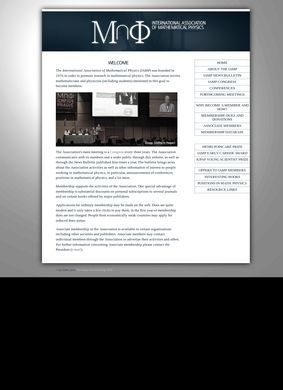
Once every three years, the International Association of Mathematical Physics holds its flagship meeting, the Congress. For a scholarly body that is a slow heartbeat, and it fits a discipline where a single result can take years to work out. The association was founded half a century ago to promote research at the border where mathematics and physics meet, and it serves the people who work there: mathematicians, physicists, and the students coming up behind them.
Between those triennial gatherings, the association keeps its members in contact through a printed bulletin and a running online seminar, so the three-year gap never becomes real silence.
What the association runs
The public-facing work falls into a handful of recurring channels, and each one answers a practical need a working researcher actually has. None of it is flashy.
All of it is the connective tissue a specialized field needs to hold together across institutions and borders. The International Association of Mathematical Physics runs the whole thing lean, with no sign of institutional bloat, which is part of why the modest dues stretch as far as they do.
The triennial Congress and the News Bulletin
The Congress is the main event, the once-in-three-years gathering where the field takes stock of itself. The News Bulletin does the work in between, published four times a year and carrying the association's own activities, announcements of upcoming conferences, and listings of open positions in mathematical physics.
For a researcher, the Bulletin is the steady pulse: a quarterly reminder of what is being organized, who is hiring, and where the next meetings will be. The International Association of Mathematical Physics uses it as the standing record of the discipline's calendar, and that job-and-conference function alone makes it worth a subscription for anyone building a career in the area.
The One World IAMP seminar and meeting listings
The One World IAMP seminar, run by the International Association of Mathematical Physics, is its online talk series, a way for members scattered across continents to hear current work without booking a flight. Alongside it the site keeps running listings of forthcoming meetings and conferences plus a set of resource links.
The online seminar does more than its modest billing suggests: it opens the field to a graduate student in a country with no local mathematical-physics group, who can now sit in on the same talks as a professor at a major department. That reach costs almost nothing to provide, and it does more for access than any single conference could.
Membership and what it returns
Membership is the engine that funds all of this, and the International Association of Mathematical Physics has structured it to keep the barrier low. Ordinary membership is open, applied for online, and the dues are modest to begin with.
A new member's first year of dues is waived outright, and a reduced-dues status exists for applicants from economically weaker countries, which is a deliberate choice to keep the field open to researchers who could not otherwise afford in.
Ordinary and associate membership
The second track, associate membership, is aimed at organizations instead of individuals: other learned societies and academic publishers can join and, through the association, put their activities and offers in front of the individual members. That arrangement quietly explains part of the value proposition, since it is what channels publisher deals to the membership. It is a sensible bit of plumbing, and one most members probably never think about while enjoying its results.
Those results are concrete. Membership brings substantial discounts on personal journal subscriptions and on certain books from major publishers, the kind of recurring saving that can cover the modest dues several times over for anyone who reads the literature closely. For a field where journal access is expensive and constant, that single benefit is a genuine reason to join the International Association of Mathematical Physics rather than merely follow it from outside. An independent researcher without a well-funded library behind them stands to gain the most from it.
Prizes, positions, and the wider draw
The association also administers the field's honours. It awards the Henri Poincare Prize, its most prominent recognition, along with the IAMP Early Career Award and the IUPAP Early Career Scientist Prize, the last two aimed squarely at researchers early enough in their careers for a prize to change their trajectory. Running these awards puts the International Association of Mathematical Physics at the center of how the discipline recognizes its best work, which is a standing that dues and seminars alone would not confer.
Smaller sections round out the offering in useful ways. There is a Positions in Mathematical Physics board for job listings, an Interesting Books section, and an Offers to IAMP Members page collecting the deals that associate members and publishers extend, laid out plainly, more like entries in a business directory than a marketing page. For a job-seeking postdoc, that positions board and the hiring notices in the News Bulletin may be the most-used corners of the whole site, and together they make the International Association of Mathematical Physics as much a career resource as a scholarly one.
A field this specialized has few places where its jobs are gathered in one spot, and the site fills that gap.
Weighed against a broader body like the American Physical Society, the International Association of Mathematical Physics is the narrower and more focused choice. The American Physical Society is larger, covers all of physics, and offers a deeper stack of services and meetings, which suits a generalist.
Someone whose work sits specifically at the mathematics-physics boundary, and who wants the Congress, the Poincare Prize community, and journal discounts tuned to exactly that literature, is better served here. The two are not really competitors so much as different-sized nets cast over overlapping water, and a serious mathematical physicist may reasonably hold membership in both at once.