An infrared observatory a million miles from home
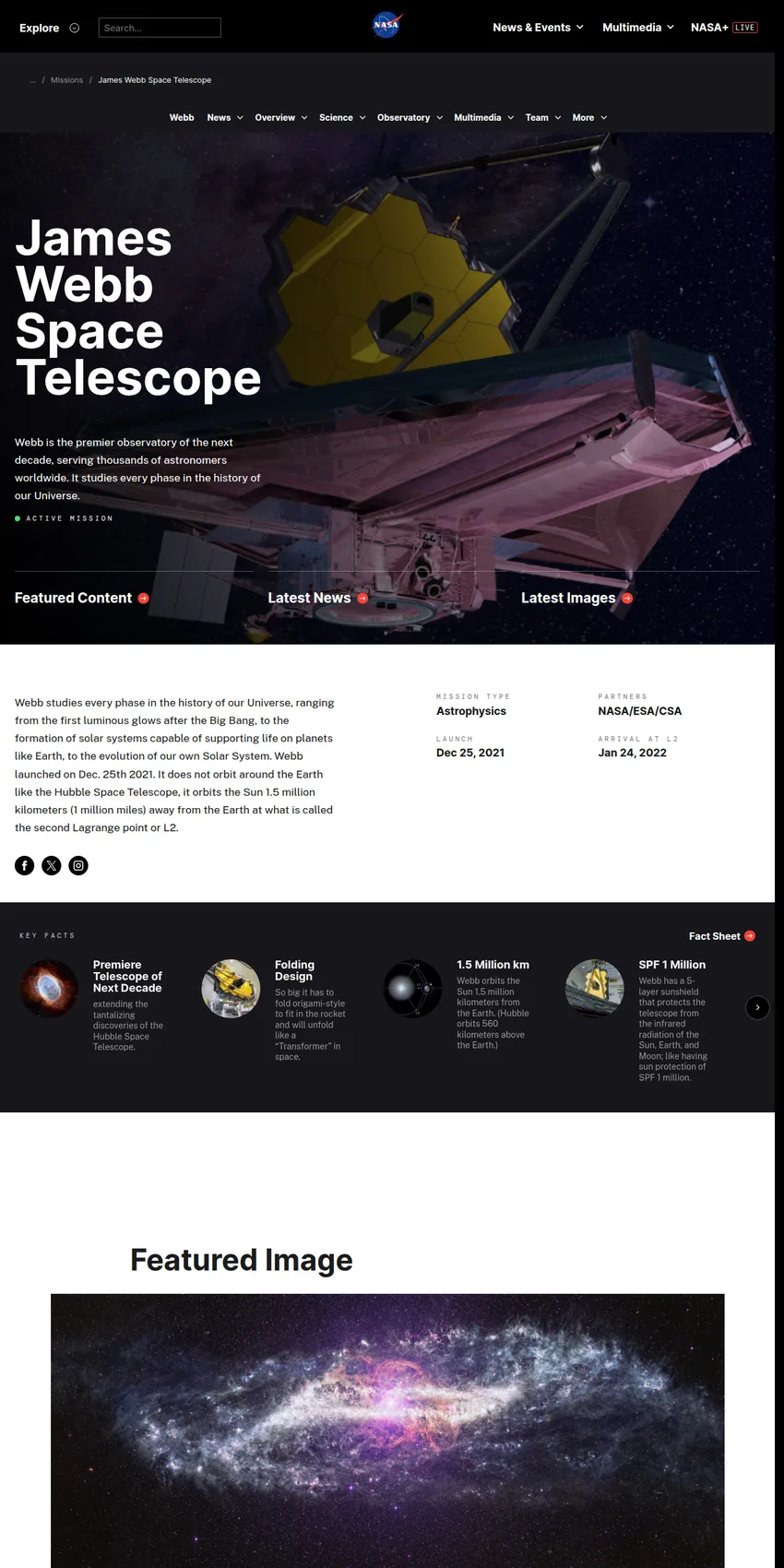
The James Webb Space Telescope does not circle Earth the way Hubble does. It orbits the Sun near a location called the second Sun-Earth Lagrange point, or L2, roughly 1.5 million kilometers (about 930,000 miles) beyond Earth on the side facing away from the Sun. From there the instruments stay cold and the view stays clear of heat and stray light thrown off by our own planet. The telescope reached that region about a month after launch and now traces a wide halo orbit around L2, keeping the Sun, Earth, and Moon all on one side of its heat shield.
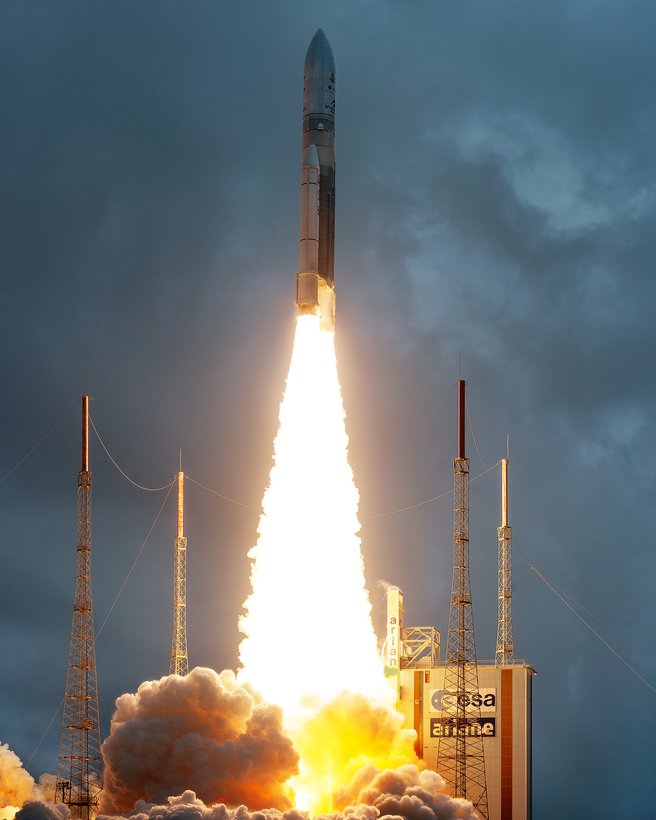
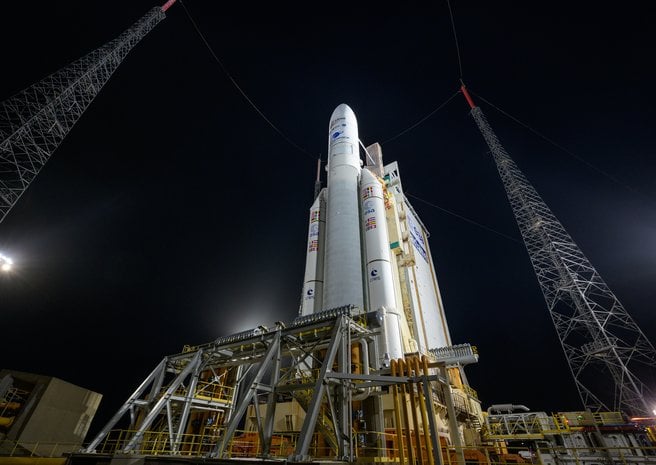
Launch happened on December 25, 2021, at 12:20 UTC. An Ariane 5 rocket carried the folded telescope up from the Guiana Space Centre in Kourou, French Guiana. The observatory was far too large to fly fully open, so it traveled folded like origami inside the rocket fairing and then spent about two weeks unfolding its mirror and sunshield once in space. Every one of those deployment steps had to work on the first try, because no repair crew can reach L2.
How the telescope is built
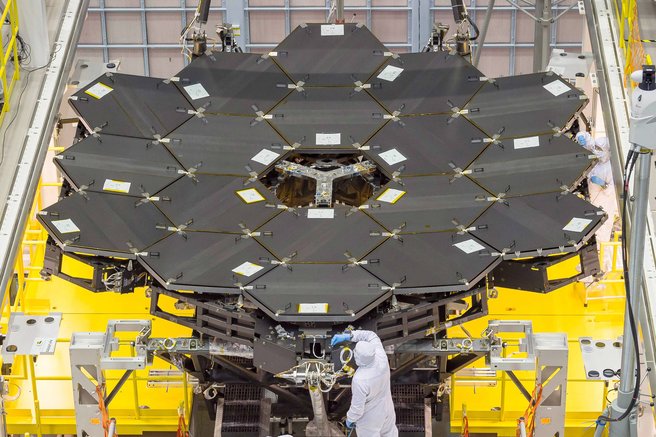
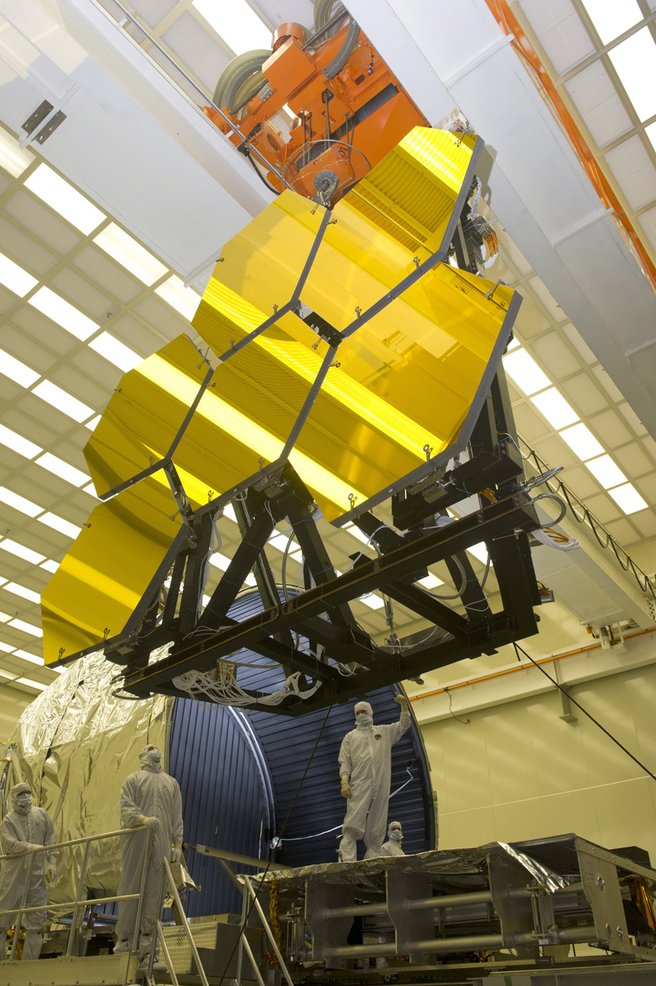
Webb collects light with a primary mirror 6.5 meters (21 feet) across, made of 18 hexagonal segments that lock together into one curved surface. The segments are beryllium, a light and stable metal, and each carries a coating of gold only a few millionths of a meter thick, because gold reflects infrared light well. Together the segments give about 25 square meters of collecting area, several times more than Hubble has. Small motors behind each segment nudge it into alignment to a precision measured in nanometers.
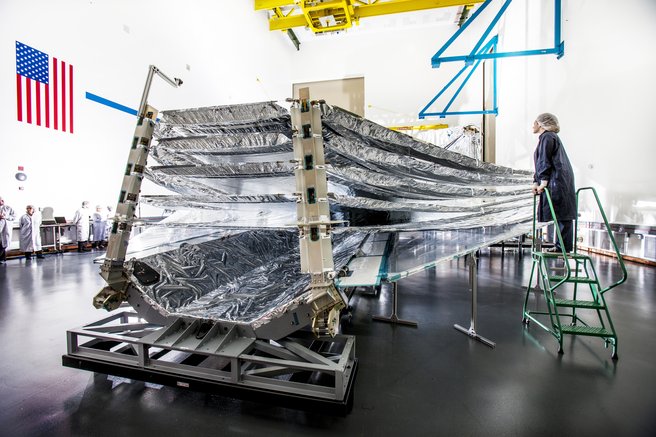
The science depends on detecting faint heat from distant objects, so the telescope itself has to be colder than the things it observes. A five-layer sunshield about the size of a tennis court, roughly 21 by 14 meters, blocks sunlight and lets the mirror and three of the instruments settle to about 40 kelvin, near minus 233 Celsius. The temperature gap between the hot Sun-facing layer and the cold telescope side spans hundreds of degrees.
The four science instruments
Webb carries four instruments behind the mirror, working across near- and mid-infrared wavelengths from about 0.6 to 28 microns:
- NIRCam, the near-infrared camera, takes the sharp images most people have seen and also reads the mirror alignment.
- NIRSpec, the near-infrared spectrograph, splits the light of up to a hundred objects at once to measure their chemistry and motion.
- MIRI, the mid-infrared instrument, reaches longer wavelengths and needs its own cryocooler to fall near 7 kelvin.
- FGS/NIRISS pairs the fine guidance sensor that keeps the telescope pointed with a near-infrared imager and slitless spectrograph.
The instruments came from an international effort. The European Space Agency provided the Ariane 5 launch and NIRSpec, and it shares MIRI with a European and American consortium. The Canadian Space Agency built FGS/NIRISS. NASA led the overall mission and supplied NIRCam and the spacecraft bus that carries everything.
What Webb looks at
Infrared light is the reason for the whole design. The universe has been expanding for billions of years, and that expansion stretches the light from the earliest galaxies out of the visible range and into the infrared. By reading that stretched light, Webb can record galaxies as they looked more than 13 billion years ago, within the first few hundred million years after the Big Bang. The first deep field image, of a galaxy cluster named SMACS 0723, showed thousands of galaxies in a patch of sky about the size of a grain of sand held at arm's length.
Closer to home, the same infrared vision sees through the clouds of dust that hide young stars in visible light, so Webb can watch stars and planetary systems while they form. It can also measure the light of a distant star as a planet crosses in front of it and pick out gases in that planet's atmosphere, such as water, carbon dioxide, and methane. That work reached the public on July 12, 2022, when NASA released the first full-color Webb images together with a reading of an exoplanet atmosphere.
Who runs the mission
The telescope is named for James E. Webb, who ran NASA from 1961 to 1968 during the Mercury, Gemini, and Apollo years. Building it took decades and cost about 10 billion dollars across NASA, ESA, and the Canadian Space Agency. NASA's Goddard Space Flight Center in Greenbelt, Maryland managed the development and now oversees the mission in flight. Day-to-day science operations, including scheduling observations and handing data to astronomers around the world, run through the Space Telescope Science Institute in Baltimore, the same institute that operates Hubble. Observing time is awarded by competitive proposal, so researchers at universities on every continent use the telescope without owning any part of it.
For an astronomy and physics reference, Webb belongs in the record as the largest infrared observatory yet flown and the instrument now setting the deepest views of the early universe. The mission is managed from NASA's Goddard Space Flight Center at 8800 Greenbelt Road, Greenbelt, Maryland 20771, reachable by phone at +1 301-286-2000, with public mission information and image releases posted at webb.nasa.gov.
Business address
National Aeronautics and Space Administration
8800 Greenbelt Road,
Greenbelt,
Maryland
20771
United States
Contact details
Phone: +1 301-286-2000