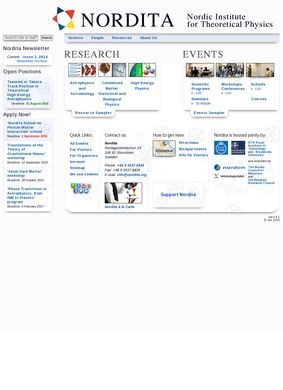
The Nordic Institute of Theoretical Physics turns out more than two hundred publications a year from a community of only about a hundred people, a ratio that tells you what kind of place it is before any of the science does. Known as Nordita, it is an academic research institute working at the theoretical end of physics, where the output is papers and arguments, not instruments and readings, and where a small group can produce an outsized volume of work.
Theoretical physics needs little more than people, time and computing, and that output figure is really a measure of how many capable minds pass through.
The Nordic Institute of Theoretical Physics spreads its research across six primary fields: astrophysics, high-energy physics, quantum information, complex systems, condensed matter, and statistical and biological physics. That is most of modern theoretical physics gathered under one roof. For the Nordic Institute of Theoretical Physics, six fields at once is a wide brief, not a narrow speciality, and unusually broad for an institute of its size. Most departments this small pick a lane; this one keeps a foot in nearly every part of the discipline at the same time.
The research and the people who do it
Two named thrusts organise much of the work. WINQ and COSMOMAG give the Nordic Institute of Theoretical Physics a pair of larger research directions to hang individual projects on, and those projects carry the kind of titles that make a physicist lean in and everyone else blink. One current example is exploring the dark sector with a new phase transition in the early Universe, which is precisely the sort of question a place like this exists to chase, and not to answer quickly.
A thrust is really an umbrella for a cluster of related projects, and grouping the work this way makes the institute's priorities legible from the outside.
It is also, plainly, busy. The Nordic Institute of Theoretical Physics runs more than twenty events a year, workshops, conferences and schools, which is a heavy calendar for roughly a hundred resident people and a sign the institute works as a hub that visitors pass through as much as a fixed body of staff.
A place that hosts that many gatherings is buying itself a constant supply of outside ideas. The schools serve a particular purpose: they are where the next generation of theorists gets trained, and running them keeps the Nordic Institute of Theoretical Physics plugged into the pipeline of new researchers.
Six fields of theoretical physics
The six fields are worth taking on their own terms, because the mix is what stands out. Astrophysics and high-energy physics form the cosmological end. Condensed matter, together with statistical and biological physics, pulls toward the messy many-body problems of real materials and living systems. Quantum information sits between the two, closer to computing and to the physics of information itself.
The Nordic Institute of Theoretical Physics covers a spread that at many universities would be split across separate departments that barely speak to each other. That breadth is the identity the Nordic Institute of Theoretical Physics trades on, and keeping the fields in one building is the whole idea. A condensed-matter theorist and a cosmologist rarely share a corridor, and the bet is that putting them there produces the odd collision a single-subject department never gets.
WINQ, COSMOMAG and the dark sector
The named thrusts are where the institute concentrates its ambition. WINQ and COSMOMAG are the banners, and a project like the early-Universe phase-transition work shows what sits beneath them: fundamental questions about dark matter and about the physics of the cosmos in its first moments. I will admit the project titles were the part of the site I lingered on longest, because they read like the contents page of a very ambitious few decades. For a working physicist, this is the real advertisement for the Nordic Institute of Theoretical Physics, far more than any mission statement could be.
Named projects with concrete titles tell a prospective collaborator what is being worked on this year, which is the information a research decision actually turns on.
Training students and visiting fellows
The teaching side is more open than the research titles suggest. The Nordic Institute of Theoretical Physics runs Master's thesis projects and a summer internship program for students, and a PhD Fellow Program brings in visiting researchers for longer stays. For a student trying to break into theoretical physics, a named fellowship and a structured internship at an institute of this reach are concrete footholds, the kind of opportunity that decides which way a career turns.
This is the part of the operation with the clearest path in. The summer internship is the obvious first rung, and the PhD Fellow Program the one that brings established visitors through for months at a time.
Talks the public can attend
Not all of it is walled off behind a physics degree. The Nordic Institute of Theoretical Physics holds public outreach seminars, among them the Scientifika Seminar and the News and Views Seminar, which open a narrow window onto the work for people outside the field. It is a modest slice of the operation next to the research output, and a genuine one, the only part of the programme built for anyone without a specialism to draw on.
A curious member of the public can sit in on a Scientifika or a News and Views seminar and come away with a glimpse of the work, even when the papers behind it stay out of reach.
Behind all of this is a particular structure. The Nordic Institute of Theoretical Physics is a joint Nordic academic center, run in partnership with KTH Royal Institute of Technology and Stockholm University and based at the AlbaNova center in Stockholm. That joint arrangement is the reason the community is as international as it is, pulling researchers, students, visitors and staff from across the Nordic countries and well beyond into a single group of around a hundred, and it is what makes the Nordic Institute of Theoretical Physics genuinely Nordic rather than simply Swedish.
The partnership with two Stockholm institutions, KTH and Stockholm University, gives it a permanent home and a steady flow of students without tying its identity to any single country, which is exactly what a shared Nordic venture needs.
The scale is the thing to hold onto. A hundred people. Two hundred publications a year, twenty-odd events, six fields between them. The Nordic Institute of Theoretical Physics is dense rather than large, and its value lies in exactly that concentration of effort in a small space. That density is the whole proposition, and it is what a big, sprawling physics faculty cannot easily reproduce.
What the site of the Nordic Institute of Theoretical Physics does not settle is who, beyond the field, it is really for. The seminars are open, but the publications, the thrust names and the project titles all assume a reader who already speaks the language of theoretical physics. Nothing on the site slows down to explain a term or to set a piece of research in a wider context.
A prospective PhD student or a visiting researcher will find the Nordic Institute of Theoretical Physics presenting itself with real clarity and every reason to apply. Everyone else gets an open door and a room that may still be hard to follow once inside, since nothing on the site slows down to bridge that gap.