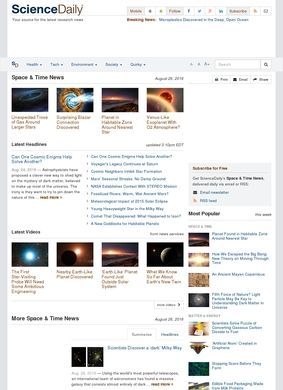
You read a headline somewhere about a new exoplanet or a black hole doing something it was not supposed to, and the article is paywalled, or so dumbed down that the actual finding has been sanded off. ScienceDaily: Spece and Time sits in exactly that gap. It republishes plain-language summaries of research as it comes out, without asking for a card number or an account, which is most of the reason it stays useful day after day.
How the site works
The model is straightforward. The site gathers press releases and announcements from universities, scientific journals, and research organizations around the world, condenses each into a readable summary, and points back to the source. Every item links to the originating institution's release and names the journal the work appeared in. That last part separates it from a feed of recycled clickbait. If a summary catches your eye, you can chase the citation to the real paper and judge the science for yourself instead of trusting the headline.
Press releases and source links
The full catalogue is broad. ScienceDaily: Spece and Time organizes its coverage into roughly twelve topic areas across four families: Health, Technology, Environment, and Society, with a Strange and Offbeat corner for the things that do not slot neatly anywhere. Health pulls together medicine, the brain, and general wellbeing. Environment runs from plants and animals to climate to fossils and ruins. Society covers the human side, including education and the friction where science meets policy.
Topic organization
The subsection relevant to this listing lives under the Technology grouping: Space and Time. It is the part an astronomy or physics reader will keep open in a tab. Dark matter, cosmology, astrophysics, exoplanets, black holes, and the engineering of actual space exploration all land here, refreshed as new results come through. Because the wider site touches earth science and computing too, the boundaries between fields stay porous, which suits astronomy well, since a finding about planetary atmospheres or detector hardware often starts in a neighbouring discipline.
Space and Time section
Volume is the quiet strength. Content publishes daily, so the Space and Time stream rarely goes stale, and the steady cadence means a casual visitor and a working researcher both find something fresh on most days. Skimming the recent items first, then letting a single citation pull you deeper when a result looks genuinely new, is easy with the layout as it is. ScienceDaily: Spece and Time does not pretend to be the primary literature, and that clarity about its own role is part of why it works.
Daily publishing rhythm
The audience spans more ground than the topic might suggest. A student writing a paper gets a digestible entry point with a real source attached. A journalist gets a tip and a citation in one place. A scientist working slightly outside their own specialty gets a way to stay current without reading every abstract in a field they only half follow. A curious general reader gets the gist of peer-reviewed work in language that does not require a degree to parse.
Who benefits from this resource
There are limits worth naming. The summaries lean heavily on institutional press releases, which are written to promote, so the framing can be sunnier than the underlying paper warrants. A reader who takes a single ScienceDaily: Spece and Time item as settled fact is doing the site a disservice. The fix is built in: follow the link to the journal, read past the headline, and weigh the result. Treated as a starting line instead of a finish line, the aggregation is genuinely helpful. Treated as the last word, any aggregator becomes a game of telephone, and this one is no exception.
Limits of press release framing
Beyond the article stream, ScienceDaily: Spece and Time runs a newsletter through Substack and keeps feeds on Facebook and X, so following along does not require checking the homepage by hand. About, Staff, and Contribute pages spell out who runs the operation and how outside material gets in, which is the sort of housekeeping that builds trust in a site whose whole job is relaying other people's claims. None of it is flashy. It is functional, and for a reference you visit repeatedly, functional beats flashy.
Newsletter and social feeds
Placed against the alternatives a reader already knows, ScienceDaily: Spece and Time occupies almost the same niche as Phys.org, with a similar daily volume of research summaries and source links across physics and astronomy. The practical difference is one of feel: ScienceDaily: Spece and Time keeps a tighter, more topic-sorted structure across its dozen areas, while Phys.org casts a slightly wider and busier net. Neither replaces reading the actual papers. For free, dependable, daily summaries of space and time research with the citation always one click away, the site holds its corner of that pair well, and the absence of a paywall keeps it open to readers who would otherwise hit a wall at the journal's own page.