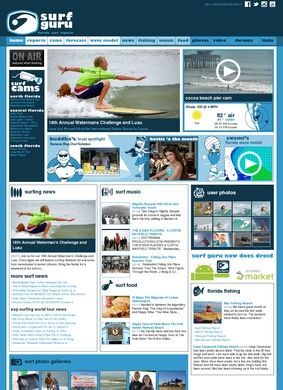
You are about to drive to Cocoa Beach at dawn, but you have no idea if the swell that looked promising yesterday actually held overnight. That is the moment Surf Guru is built for. The site pulls together live surfcam feeds from more than fifty beach locations strung along the Florida coast, so before anyone wastes a tank of gas, they can watch the water move in close to real time and decide whether the trip is worth it. Surf Guru frames itself as the leading internet surfing ezine for the Florida community, and that framing is at least arguable given the breadth of what it covers.
Live surfcam feeds across Florida
The camera network is the thing that makes the site useful, and it is genuinely broad. The feeds run the length of the Atlantic side, from Jacksonville and New Smyrna Beach down through Cocoa Beach and Stuart, then south past Jupiter to Miami. The Gulf gets its own attention too, with feeds from Clearwater down to Naples, and the Panhandle is covered from Panama City out to Perdido Key. That spread is consequential in a state where the surf can be flat in one region and firing two hundred miles away. A person who paddles out near Daytona and a person who chases waves on the Gulf side both have a reason to keep the tab open, and that dual-coast reach is something most regional surfing resources do not manage.
Checking swell and wave forecasts
Cameras alone do not tell you what is coming, though, and Surf Guru leans on forecasting to fill that gap. The site carries detailed wave and swell forecasts, separate Atlantic and Gulf wave models, and tropical weather tracking, which is no small detail for a Florida audience that watches hurricane season the way other regions watch snow. The pairing of live visuals with model data gives the site a practical rhythm: look at what the water is doing right now, then check what the models say about tomorrow and the days after. For a Brevard County operation, that combination is the core of the pitch, and it mostly delivers.
Community features and business spotlights
Beyond the conditions data, Surf Guru carries a layer of community and media that gives it more texture than a pure forecast tool would have. Surf news sits alongside event coverage, photo galleries, and videos, and the user forums appear to be active, which is harder to sustain than it sounds. A surf scene is local and opinionated, and a forum that people actually post in tends to mean the audience trusts the place enough to hang around. There are also business spotlights and advertising or sponsorship slots, so the site is clearly funding itself in part through the surrounding shop-and-service economy. None of that is hidden, and it does not crowd out the conditions content, which is the right balance for a site like this.
Cam technical support explained
The entire value of a surfcam network rests on the cameras working and the forecasts being current, and that is exactly the kind of promise that is easy to make and hard to keep across fifty-plus locations. Cams go offline. Mounts get knocked loose by storms. Feeds freeze. Surf Guru does account for this to some degree, since the contact page explicitly handles cam technical support as one of its categories, which implies the operators know outages happen and have a route for reporting them. That is a reassuring sign of an operation that maintains its hardware rather than letting it rot.
Does the network hold up in storms?
What a visitor cannot judge from outside is how reliably the network stays live during the moments that matter most, like the run-up to a tropical system when everyone hits the site at once and the wind is doing its best to take the equipment down. A camera that is dependable on a calm Tuesday is a different animal from one that survives a serious blow. The maintenance channel exists, the promise is strong, and the real proof only shows up in heavy weather. That tension is the honest limit of any pre-trip assessment.
Reputation across review platforms
On the question of reputation, the picture is mixed but not alarming. Surf Guru appears on smart.reviews with a 3.5 out of 5 rating, though the number of reviewers behind that figure is not stated, which makes it more of a faint reading than a verdict. The usual heavyweight platforms come up empty: no entries on Google, Yelp, Trustpilot, or the BBB turned up for Surf Guru. There are TripAdvisor results for businesses like Hawaii Surf Guru and LBI Surf Guru, but those are unrelated operations and should not be confused with the Florida site. For a niche regional ezine, a limited third-party footprint is not unusual; it does mean a newcomer has little outside evidence to draw on and has to judge it largely on what the site itself shows.
Contact options and social channels
Contact at Surf Guru is handled through a page that covers general inquiries, cam support, and advertising, with a presence on Facebook, Twitter, and YouTube and a podcast feed. The site does not list a phone number or street address on the homepage, so anyone wanting a direct line will work through the form-based route. For a community site that lives online, that setup is defensible, and the social accounts add a secondary way to gauge whether the operation is still active and responsive.
Assessing Surf Guru's overall value
Taken together, Surf Guru covers a lot of ground for a resource of this type. The community side gives Surf Guru staying power that a bare forecast page would lack, and the dual-coast camera network is the kind of infrastructure that takes real ongoing effort to operate. The genuine hesitation is whether fifty-plus cameras and the forecast feeds stay accurate and online through the exact conditions when a wrong call or a dead feed costs the most. Nothing on the homepage settles that; what the site does show is a well-structured operation that has been at this long enough to build community forums, maintain a podcast feed, and keep cameras running on two coasts. That is not nothing.