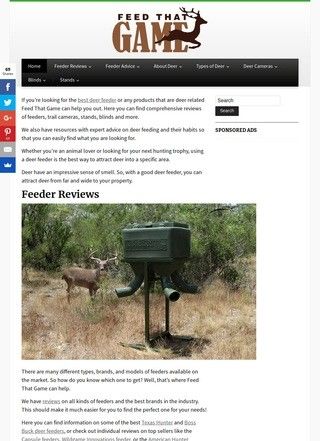
Where do you turn when you want to put a deer feeder in your field but have no idea which type holds up, which timer works, and whether a gravity model beats a spinner? Feed That Game addresses that exact problem. It is a content and affiliate site built around one subject, deer feeding, and it pushes into the wider territory of feeding wildlife and attracting deer onto a property. The homepage calls it a one-stop-shop for everything deer-related, and the structure backs that up: reviews, comparisons, buying guidance, and a stack of how-to articles aimed at people who actually have to bolt this gear together and keep it running through a season.
Feeder types and brand comparisons
The feeder coverage is where Feed That Game spends most of its energy. Several formats get their own treatment: gravity feeders that release feed as deer empty the trough, timed feeders that throw corn on a schedule, tripod units, hanging models, and tailgate feeders for the back of a truck. Brand names recur across the reviews, with American Hunter, Moultrie, Boss Buck, and Texas Hunter all getting attention. That spread is useful because those four sit at different price points and serve different setups, so a reader comparing a budget hanging feeder against a heavy tripod rig has somewhere to start. A line on the About page says feeder reviews go up weekly, which, if it holds, means the catalog keeps growing instead of going stale the way many one-topic affiliate sites do once the initial push is over.
Trail cameras and hunting blinds
Feeding deer is only half of why people set up a feeder, and Feed That Game clearly knows it. Trail camera reviews cover Stealth Cam and Cuddeback, the two names anyone who has shopped for a scouting camera will recognize, and pairing camera coverage with feeder coverage is sensible: you put out feed, then you want to see what is showing up to eat it. Hunting blinds and deer stands get their own reviews too, which rounds the equipment side into something closer to a full kit guide than a single-product pitch.
Building your own feeder plans
There is a practical streak running through the non-review material that I found more convincing than the product pages. Deer fence installation guides address keeping animals out as much as drawing them in, which is an honest acknowledgment that the same person feeding deer in one spot may be fighting to protect a garden in another. The DIY section goes further with free homemade deer feeder plans, and that is a real tell about intent. A site living purely on affiliate commissions has no reason to hand you instructions for building a feeder yourself instead of buying one through its links. Including those plans points to people who want the audience to stick around and return, rather than clicking straight out to a retailer.
Educational articles on deer behavior
The educational articles fill in the gaps that gear alone leaves open. Feed That Game covers deer behavior, species identification, where to place a feeder so animals will use it, setting up a digital timer, and broader habitat management. Feeder placement and timer setup in particular are the questions that trip up first-timers, the sort of thing you only learn after wasting a season on a badly positioned unit. Putting that next to the buying guides means a newcomer can read why before deciding what to buy.
The stated audience is both hunters and wildlife or nature enthusiasts, and the content genuinely splits along that line. The hunting side gets stands, blinds, and scouting cameras; the nature side gets species identification and habitat pieces with no shot fired at the end. Trying to serve two crowds can dilute a site, but here the overlap holds, since both groups are doing the same core thing of putting feed out and watching what arrives. The revenue model reads as affiliate marketing plus advertising, which is plain from the review-heavy build, and Feed That Game does not hide it behind pretend neutrality.
On reach, Feed That Game maintains a presence on Facebook, Twitter, Pinterest, and YouTube, all under the @feedthatgame handle. Pinterest and YouTube are well chosen for this subject: feeder builds and placement are visual problems, and a short clip of a timer in action teaches faster than a paragraph. Whether those channels are kept active is something a visitor would want to confirm before leaning on them, since a dormant feed can sit untouched for a long time.
Where is the outside proof?
Now the part that keeps this from being an easy recommendation. I went looking for outside opinion on Feed That Game and came up empty: no notable third-party reviews surfaced, no ratings on the usual platforms, nothing from other readers vouching for the accuracy of the buying advice. For a site whose entire value rests on steering purchase decisions, that absence is worth noting. It does not mean the content is wrong, and plenty of useful niche sites operate without ever accumulating public reviews. It does mean a reader is taking the recommendations largely on the strength of the writing itself, with no crowd of verified buyers to confirm that the favored feeders actually perform in the field.
The contact setup on Feed That Game follows a familiar affiliate-site pattern: a contact form exists at its own URL, but there is no phone number on the homepage or About page, and no physical address anywhere visible. For a content operation this is unremarkable, since there is no storefront and no customer service queue. What does matter for credibility is the anonymity of the reviewers. Knowing whether the writer hunts, manages land, or simply aggregates spec sheets would change how much trust to put on the verdicts, and Feed That Game does not say.
Comparing Feed That Game to competitors
Set against comparable single-subject affiliate sites, Feed That Game covers considerably more ground. The combination of multiple feeder types, four real brands, two camera brands, blinds, fences, behavior articles, and buildable DIY plans goes well beyond pages that exist only to funnel clicks through a handful of affiliate links. The weekly-update claim, if accurate, and the free plans both point toward an operation that wants a returning readership rather than a quick bounce. What it lacks is the external proof, no reviews, no named expertise, that would let a buyer trust the rankings without doing their own legwork.
The practical use of Feed That Game is clear enough. Treat it as a strong starting map of the deer-feeding equipment market: a place to learn the difference between a gravity and a timed feeder, to see which brands cluster at which price, and to pick up placement and timer know-how before spending money. Then verify the specific model against buyer reviews on the retailer itself, where verified-purchase volume gives you the confirmation this site cannot provide. The guide is well-built; the outside endorsement is not there yet.

Business address
Feed That Game
8426 Tuttle Road,
Bridgeport,
New York
13030
United States
Contact details
Phone: 3154277696