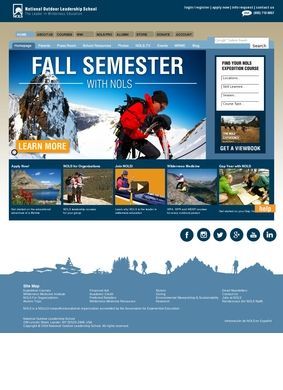
Someone signs up for a two-week backpacking trip and quickly runs into a practical question: who is teaching the group to read a map, pack a wound, ration food, and make a call when weather turns and a member of the party is struggling. That is the gap the National Outdoor Leadership School has been filling since 1965, and the site is built around answering it before anyone commits. The program listings do not sell scenery. They spell out course length, terrain, and the skills you leave with, which is the information a nervous first-timer or a parent actually wants.
Expeditions by age and experience level
The catalog is large and organized by what a person is trying to do. Expeditions form the core, more than 200 courses spanning backpacking, rock climbing, mountaineering, sea kayaking and canoeing, sailing, and winter travel on skis. Length runs from under two weeks up to a full semester or a year in the field. What keeps the sprawl legible is the way courses are grouped by who is going: teens aged 14 to 17, women 18 and over, adults 23 and up, LGBTQ+ participants, families, and working outdoor educators each get their own track. A 15-year-old and a 40-year-old signing on for the same discipline are not dropped into the same cohort, and the site makes that distinction plainly.
Wilderness medicine certification programs
Medicine is a whole division of its own. The Wilderness Medicine Institute runs over 400 courses, from a weekend Wilderness First Aid certificate up through Wilderness First Responder and Wilderness EMT, with recertification paths and hybrid or online formats for people who cannot sit in a classroom for a week straight. That certification ladder matters well beyond the paying student. Trip leaders, camp staff, ski patrollers, and field researchers pass through WFR training, so this arm of the National Outdoor Leadership School quietly credentials a large slice of the outdoor industry. The listings distinguish the levels clearly enough that someone can tell whether they need the two-day card or the ten-day one.
Semester and year-long immersive courses
For anyone wanting the deep version, the semester and year programs (more than 30 of them) put people in the field for months at a stretch, often carrying transferable college credit. These read as the flagship of the whole operation: immersive, multi-environment, and structured so a student comes out with both technical competence and something to show a registrar. Alongside them sit over 70 summer courses aimed squarely at teenagers, which is where a good number of participants first encounter the National Outdoor Leadership School before returning years later for the longer expeditions.
Custom training for organizations
The offering widens past individual enrollment too. There is Custom Education and executive leadership training pitched at organizations that want the decision-making and group-dynamics methods of the National Outdoor Leadership School applied to their own people. Risk Services extends the same institutional knowledge as consulting, which is a logical export for an organization whose entire model rests on managing hazard in remote places. And through its stewardship of Leave No Trace, the school runs outdoor ethics courses and instructor certifications that carry a set of practices well past any single cohort. The Leave No Trace piece is easy to overlook on the site, but it may be the widest-reaching thing here, since those principles end up on trailhead signs and in guidebooks far from any NOLS classroom.
Locations across multiple regions
Geography is handled honestly. The National Outdoor Leadership School works out of branch locations across the Rocky Mountains, Alaska, the Pacific Northwest, and the Southwest, plus international sites, and the course pages tie each offering to where it actually happens. That grounding is useful because terrain is the point. Learning glacier travel in Alaska is a different proposition from a canyon course in the Southwest, and the site lets a prospective student match ambition to place instead of booking blind.
The practical scaffolding around enrollment is present and reasonably complete. There are sections for financial aid and scholarships, which for a nonprofit is more than decoration given that a semester in the field is a serious expense. Detailed gear and equipment lists tell a student exactly what to bring or rent before they arrive. Admissions material walks through how to apply, alumni resources give returning participants a reason to stay connected, and the store handles the retail side. It is the kind of end-to-end coverage that suggests the organization has fielded every logistical question a hundred times and decided to just answer it on the page.
What a browser cannot settle from the outside is what a real course ultimately turns on: the quality and consistency of the instruction once the trailhead is behind you. A site can describe a WFR curriculum in precise terms and still not tell you how a given instructor handles a scared student at altitude, or how uniform the teaching is across dozens of branches and hundreds of contract educators. The National Outdoor Leadership School has the record and the scale to inspire confidence, and the breadth of the National Outdoor Leadership School catalog is genuinely impressive. Whether the field experience lives up to the catalog is something a student only learns after the deposit is paid and the van pulls away.