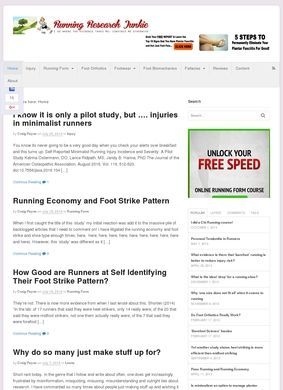
Craig Payne runs Running Research Junkie as a personal blog, and the gap between what he gives away and what he charges for is telling. Two paid online courses, the Clinical Biomechanics Boot Camp and the Running Shoes Boot Camp, sit alongside years of free critical writing about the science of running. That arrangement says more about the project than any about page would.
Topics covered from injuries to footwear
Payne describes himself as a university lecturer, clinician, researcher, and runner, and the content matches that spread. The archive is organised by problem. Injury categories go well beyond surface-level entries: plantar fasciitis, peroneal tendonitis, and stress fractures each get proper treatment instead of a paragraph pointing readers to a physio. Footwear gets its own substantial thread, with separate discussions of minimalist shoes, barefoot running, motion control designs, and running economy. Foot biomechanics, orthotics, and named running methods like Chi Running and Pose Running round out the subject map.
Focus on evidence over marketing
What sets Running Research Junkie apart is the angle Payne brings to all of it. A significant portion of his writing is devoted to pulling apart pseudoscience and the unsupported claims that travel fast in the running world, where marketing tends to lap the evidence. That posture cuts both ways for a reader. Arrive looking for a confident answer about which shoe will fix your knees, and you may leave with a more complicated picture and a longer reading list. Come wanting to know how strong the evidence behind a popular idea really is, and this is one of the few running sites built around exactly that question.
Archive size and additional content
The archive is the other reason to take Running Research Junkie seriously. Posts run back to 2013 and span more than twenty pages, so a search on a niche injury or a specific shoe concept usually lands on something written here. Beyond the main articles, Payne posts book reviews and direct critiques of individual research papers, which is useful for anyone trying to read the literature rather than the headlines about it. Articles carry comment sections, there is an email newsletter, and an RSS feed for people who would rather follow along than keep checking back.
Professional standing and citations
Payne's standing outside this site supports the content. He turns up in podiatry education contexts and is linked to Podiatry Arena, a professional forum in the field. An external podiatry wiki, Podiapaedia, references the site, and a number of running and coaching pages cite his posts. The audience citing him is professionals and coaches more than casual readers, which fits a blog pitched partly at clinicians. The consumer reputation picture is different: searches turned up no Google, Trustpilot, Yelp, or similar review listings. For a single-author technical blog that absence is unsurprising, since this format rarely collects star ratings, and credibility here rests on Payne's professional footprint instead of a crowd of public reviews.
How to contact Running Research Junkie
Getting in touch with Running Research Junkie is straightforward without being generous. A contact page sits in the navigation and routes messages through a form. There is no phone number and no physical address listed, which suits a personal blog more than it would suit a business expecting clients to phone. Social links to Twitter and Facebook appear on the author profile. None of this is a barrier for the kind of visitor the site expects: someone reading articles or signing up for a course, not booking an appointment.
It is worth being honest about who will get value here. The tone is academic and the content assumes you are willing to sit with nuance and citations. A beginner hoping for a tidy training plan or a shoe recommendation will find the constant questioning of easy answers frustrating. A clinician, a coach, or a curious runner who already reads research will find Running Research Junkie a rare resource that treats running claims with the scepticism they often deserve. The text-heavy, dated presentation is plain, and that plainness is part of why it reads as a working archive rather than a polished product.
Comparison with Runner's World
Set against something like Runner's World, which covers the same territory with broad, accessible, and frequently sponsored coverage, Running Research Junkie occupies a narrower and more demanding corner. Runner's World will tell you what is popular and how to get started. Payne is more interested in whether the popular thing is supported by the evidence, and he is willing to say when it is not. If the site published outside a professional context, the absence of any verifiable public ratings would be a genuine gap. Here it mostly reflects how niche the target audience is, and the depth of the archive speaks more to that audience than a star count would.