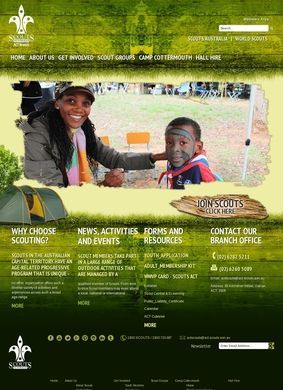
ACT Scouts is the Australian Capital Territory branch of Scouts Australia, the long-running nonprofit youth movement, and the site runs as the regional hub for everything that happens under that banner across Canberra and its surrounds. The program covers a wide age band, from children around five up to young adults in their mid-twenties, split into five sections that a young person moves through over time: Joey Scouts for the youngest, then Cub Scouts, Scouts, Venturer Scouts, and finally Rover Scouts. That structure is the spine of the whole operation, and ACT Scouts treats the outdoor and personal development curriculum as a progressive path described as specific to the ACT, not a generic national reskin.
Volunteer roles and governance
What works about the way ACT Scouts presents itself online is that it does not stop at recruiting children. There is a serious, separate stream for adults who want to get involved, and it is laid out in detail. Volunteers can come in as Scout Leaders, take Group Support roles, or join through a Student Volunteer Program, and beyond the front-line roles there is the governance layer: Scout Fellowship, the Branch Executive Committee, and both a Branch Scout Council and a Venturer Council. Anyone weighing up whether to give time to ACT Scouts can see the actual shape of how it is run, which is more candour than volunteer-driven groups typically bother to put on a public page. A family finder lets you locate the nearest troop by suburb, which is a practical touch that saves the phone-tree runaround.
Finding troops by location
The operational side is where the site shows its age in a good sense, meaning it has accumulated real tooling instead of a single brochure page. ACT Scouts points members toward a Training Portal with online registration, the Scouts Terrain activity management platform, an Extranet, an Event Registration system, and SAIT, the Scout Administration and Information Tool. None of these are glamorous, but for a parent or a new leader they are the difference between guessing and getting on with it. Most people will only ever touch the two or three systems that apply to them, so the density is less overwhelming in practice than it first looks.
Member portals and tools
Hall Hire is offered at Scout facilities, a practical touch that also tells you something about how the organisation funds itself: the halls are an asset, and making them available to the wider community keeps them productive. It is the sort of detail that rounds out the picture of a group embedded in local life across many years rather than one that retreated into a closed membership model.
Camp Cottermouth venue
Camp Cottermouth gets pride of place as a featured venue, and it carries its own small ecosystem: a dedicated Cottermouth Website, newsletters, a Camp in a Box offering, and Party Catering. There is also a scheduled event running over several days in early October 2026, so the camp is plainly an active concern rather than a relic kept on the site for nostalgia. For families new to scouting, a fixed physical base grounds the abstract talk of outdoor programs in a real place a child will actually go.
Safety policies published
The governance material is the part that lifts ACT Scouts above the level of a hobby club website. The Constitution, a Strategic Plan, an Operational Plan, and an Annual Report are all there to read, which means anyone can check the organisation's stated direction against what it claims to do. More to the point for any parent, ACT Scouts publishes its Child Safety policies, National Redress information, and a Risk framework, and it carries a Child Protection contact kept apart from the general office line. That separation is deliberate and sensible. A youth organisation that puts its safeguarding policy and its redress position in plain view is doing exactly what parents most need to see, and ACT Scouts does not bury it.
International scouting programs
Rounding out the offering are an International Scouting section, for families curious about jamborees and exchanges beyond Australia, and a Parent Guide that reads as an entry point for people who have never had a child in the movement. The Parent Guide does a lot of work, since the jargon of sections and badges and terrain platforms can be opaque from the outside, and a single plain explainer saves a newcomer real confusion. ACT Scouts also runs a news section and an events calendar, so the site gives returning members a reason to check back instead of treating itself as a one-time signup destination.
Site structure for new visitors
If there is a fair criticism, it is that the sheer number of portals and tools can feel like a lot to absorb on a first visit, and the site assumes a degree of familiarity that a complete newcomer will not have yet. That is the natural cost of being a genuine operating branch with members to administer, not a marketing front. A search for independent reviews of ACT Scouts on Google, Facebook, and Trustpilot turned up no public ratings at this time, which is common for regional branches of long-established membership organisations. Reputation here rests on the organisation's multi-decade history and on what the published governance documents actually say, which is a more solid foundation than a handful of star ratings.
Taken as a whole, this is a well-stocked, honestly run regional site for an organisation with a clear purpose and a long record of doing it. ACT Scouts gives equal weight to the children it serves, the volunteers it depends on, and the safeguarding and governance that hold the whole thing together, and it backs the program with a real venue and a working set of member tools. The group finder and Parent Guide are the right starting points for any family considering enrolment, and the governance shelf rewards anyone who wants to understand what ACT Scouts is committed to on paper before making any decisions.