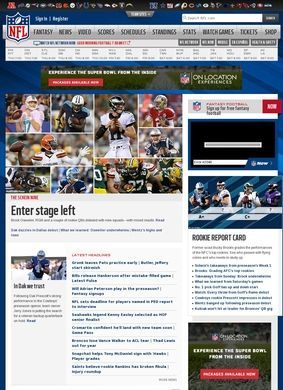
You are sitting in Europe or Asia on a Sunday night, kickoff is hours away in a different time zone, and you want to watch your team without hunting through sketchy pirate streams. That is the exact situation the international edition of NFL.com is built to answer, and it answers it directly: schedules, live game access, and viewing options are the first things the site pushes at a visitor coming from outside the United States.
Watching from outside the United States
The viewing menu is the heart of it. NFL Game Pass, delivered through DAZN, is the route to live and on-demand games for international fans, sitting alongside NFL RedZone for the whip-around coverage, NFL Network, and a deep bench of highlights and full-game replays. The Hard Knocks series is folded in for people who want the training-camp and behind-the-scenes side. For a viewer stranded by the clock, the practical value of the site is having all of these gathered in one place instead of scattered across half a dozen broadcasters and apps.
That gathering is the single clearest reason the international edition exists, and it is the problem the site solves best.
The first thing I went looking for on NFL.com was the schedule, and it sits a click from the top, which is the right instinct for a site whose visitors are usually trying to plan around a wildly inconvenient local start time.
What Game Pass, RedZone, and the Network each do
Each viewing product does a distinct job, and NFL.com is clear about which is which. Game Pass covers full games live and archived; RedZone is the fast-cut option for following every scoring drive across the league at once; NFL Network carries studio programming and select broadcasts. Bundling the DAZN partnership into the same hub means an overseas fan sorts out access from the league's own pages, a cleaner starting point than working backward from a third-party app store or a reseller. For someone in a market with no local NFL broadcaster, that consolidation is the whole reason to start here.
The one honest limitation is that the live product routes through DAZN across most territories, so a fan's real experience is only ever as good as that partner's stream in their own country, a dependency the league inherits and cannot fully control.
Stats, teams, and injury reports
Beyond live video, the reference layer on NFL.com is deep. Every one of the 32 teams gets its own page, organised by conference, and each one carries far more than a business directory entry would: rosters, results, and a running news feed together. Player statistics run all the way to Next Gen Stats, the tracking data that measures speed, separation, and throw distance.
News, injury reports, and transactions are kept current, and fantasy football coverage ties the numbers back to the game most casual fans actually play week to week. A curious visitor can move from a box score to a player's advanced metrics without leaving NFL.com, and the podcasts and photo galleries give the same story a longer-form and a visual treatment for anyone who wants to sit with it.
For a fantasy manager, that same statistical spine feeds the lineup calls that make a random Thursday game suddenly matter, and the injury and transaction feeds are the first place to check before locking a roster.
What else the site carries
The international framing shapes more than the video. NFL.com folds in coverage of the NFL International Games and the league's development work in flag football and grassroots programs abroad, which is the part of the operation aimed at growing the sport outside its home market. That focus makes the global edition read as a genuine regional product instead of a lightly translated copy of the domestic one.
The editorial engine underneath all of this is heavier than a scores page. News, features, and analysis run alongside the highlight reels, the photo galleries keep a visual record of the season, and the podcasts carry the conversation into the week between games. A fan outside the United States who cannot tune into local talk radio or a regional pregame show gets a reasonable substitute here, gathered in one place and in English, which for the audience of the international edition is much of the point.
Commerce sits close to the content on NFL.com. Tickets run through Ticketmaster, premium and VIP matchday experiences through On Location, and merchandise through NFL Shop, so a fan who decides to travel to a game can arrange the seat, the hospitality, and the jersey from the same starting point. Mobile apps for iOS and Android carry the whole thing onto a phone, which for a fan following games at odd local hours is where a lot of the watching will actually happen.
International games and flag football
The development strand deserves its own mention because it separates NFL.com from a pure broadcast portal. Coverage of overseas fixtures and flag football programs signals that the league treats international fans as active participants in the sport, and it gives a newcomer in a non-traditional market a way in that does not require already knowing the professional game inside out. For a parent whose kid just picked up flag football, that corner of the site may be the most useful one on it.
It reframes the whole property from a broadcaster into a front door for people who want to play, coach, or follow the game somewhere it is still taking root.
The honest read is that this is a well-stocked official hub doing the job it sets out to do, with the usual caveat that live access leans on regional deals like DAZN and the cost that comes with them, which the site does not hide. Having schedules, live games, stats, tickets, and merchandise gathered on NFL.com under one league-run roof beats piecing the same season together from separate services, DAZN dependency and all, for anyone watching from thousands of miles away.