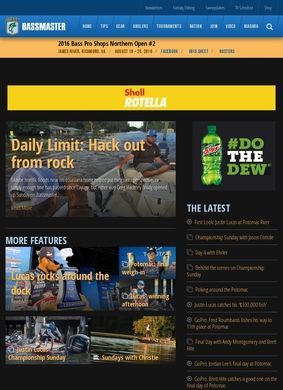
Bass anglers following the professional circuit in North America have one site that functions as the sport's official record, and that site is Bassmaster. It is run by B.A.S.S., the Bass Anglers Sportsman Society, the organization that sanctions and organizes the tournaments, which means schedules, standings, results and angler profiles all come from the body that runs the events. That authority holds in a sport where results get disputed and formats change; having the sanctioning body maintain its own public record removes the guesswork about what the official outcome was.
Tournament divisions and live coverage
Walk through the tournament side and the scope is broader than a casual visitor might expect. The Elite Series gets the heaviest coverage, with the Bassmaster Classic as its capstone, but the site also carries Opens, a Kayak Series, College and High School divisions, and the Nation amateur circuit for anglers who fish at a club level. For each division, visitors can check when and where events are happening, follow live coverage while they run, and pull up post-event results afterward.
There is an archive of weigh-in video, since bass tournaments are settled by total weight of fish brought to the scale, not by catch count or size. Individual angler pages let you read up on competitors, and standings update across the season. The breadth of divisions is more thorough than expected, particularly the inclusion of the amateur club level alongside the pros.
Instructional resources for anglers
What broadens Bassmaster past pure tournament reporting is the instructional side. The site publishes technique articles, bank-fishing guides for people without a boat, solunar tables for timing trips around fish activity, gear reviews and tackle advice. This is the working knowledge a beginner or improving angler goes looking for, and it sits alongside the pro coverage rather than being walled off somewhere else. The mix makes sense: the same person who watches the Bassmaster Classic on a Saturday wants to catch more fish on their local pond during the week, and the site addresses both halves of that without forcing them to go elsewhere.
Women in fishing
There is a BassmastHER section built around female anglers, which is a deliberate move in a sport whose competitive ranks have long skewed male. Whether it does enough is a fair debate, but carving out a named, ongoing space for women in fishing is something few outlets in this category bother with. It points to an organization thinking about who the next generation of anglers will be, rather than just who is winning today's tournaments.
Beyond reading and watching, Bassmaster gives visitors a few ways to participate. A fantasy fishing league lets followers draft pros and score them against real tournament outcomes, which keeps casual fans checking standings they would otherwise ignore. There is a podcast, The Cast, for people who prefer listening over reading. The conservation content covers fishery stewardship, and for a tournament body that angle is closer to self-interest done responsibly than it is to PR: no healthy fish populations, no sport, no Bassmaster. Easy to scroll past, but worth noting it is there.
Membership, shop and podcast
Membership is the commercial spine of the operation. It is sold directly through the site and bundles a subscription to Bassmaster Magazine alongside gear discounts. That is a clean value proposition for someone already inside the hobby, since the magazine has been part of the brand for decades and the discounts offset part of the membership cost for anyone who buys tackle with any regularity. An online shop rounds it out with branded apparel and accessories. None of this is unexpected from a membership organization, and Bassmaster presents it plainly as a way to support the operation and get something tangible back.
Social media presence
The social footprint is wide, spanning Facebook, Twitter, Instagram, YouTube and Snapchat, with YouTube drawing the most engagement given how much of competitive fishing now lives in video. That spread at least matches the ambitions of the divisions the organization runs, including the College, High School and BassmastHER pushes aimed at a younger audience. A site can have feeds everywhere and update none of them, so it is worth noting that Bassmaster keeps those platforms active and current.
Scope and usability
If there is a fair criticism, it is one of density. Bassmaster is trying to be the tournament authority, the instructional library, the magazine publisher, the shop, the podcast host and the social hub all at once, and a casual visitor who only wants to know who won last weekend may have to navigate past a lot before getting there. That breadth is also the point. The whole reason an angler would bookmark this over a dozen scattered blogs and forums is that Bassmaster keeps it all in one place, with the results carrying the credibility that only the sanctioning organization can provide.
Searches for independent ratings on aggregator platforms turned up no meaningful review count for Bassmaster. For a sport-governing body, that absence is unremarkable. People do not typically rate B.A.S.S. the way they rate a tackle shop; the organization gets judged by how it runs its tournaments, and for that the community forums and angler feedback cycles are the relevant arena.
Where Bassmaster lands depends almost entirely on why you showed up. If you fish for bass or follow the pro circuit, it is close to mandatory: the official record of every major division in North American competitive bass fishing, plus instructional material and conservation coverage that extends its usefulness well past tournament weekends. If competitive fishing holds no interest, the value narrows to how-to guides and solunar tables, which are solid but available elsewhere too. The verdict tilts strongly positive for the core audience. As a reference on competitive bass fishing, Bassmaster is hard to argue with.