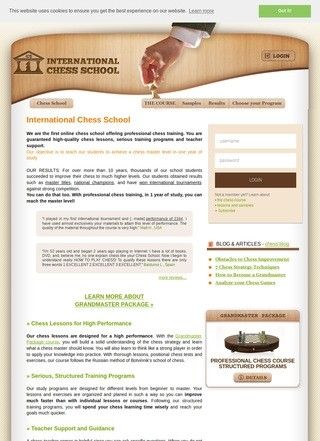
Can a chess school built around PDF lesson packs move a player's rating? That is the practical question this listing has to answer, and International Chess School puts most of its weight behind one structured answer: a 12-month course called the Grandmaster Package that runs a student from raw beginner all the way up toward master level. The material arrives as downloadable, printable lessons, so there is no app to log into and no video subscription ticking over in the background. You buy the course, you print the lessons, you work through them. For players who prefer studying away from a screen, with a board set up in front of them and a marked-up page beside it, that format has a real appeal that the modern lesson-app world tends to overlook.
The Grandmaster Package and Core Chess Course
The Grandmaster Package is the flagship offering of International Chess School, but it is not the only thing on offer. There is a Core Chess Course aimed at players who want the structured fundamentals without committing to the full year-long arc. The site frames the whole thing as a systematic curriculum, the kind of step-by-step progression where opening principles, tactics, endgames and middlegame planning are sequenced deliberately instead of grabbed at random from whatever video happens to surface that week. Anyone who has tried to self-teach chess knows how easy it is to drift, bouncing between unconnected lessons and never building a foundation. A planned route through the material is the genuine selling point here, and International Chess School leans on it openly.
Email support from titled instructors
What lifts International Chess School above a static set of files is the support arrangement. Every course purchase comes with personalized teacher help by email, included at no extra cost, with no cap mentioned on how often a student can write in. So a player stuck on a knight-and-bishop endgame or unsure why a recommended pawn break works can ask the instructors directly and get a human answer back.
Credentials and teaching authority
That single feature changes the character of the product. A PDF on its own is a book; a PDF plus a teacher you can email is closer to a correspondence course, and International Chess School positions it that way. The curriculum, it claims, is authored or overseen by Grandmaster-level instructors, which is the kind of credential that counts in chess instruction, where titles are earned over the board and not handed out.
Forum discussion versus formal reviews
Chess players are a famously hard crowd to bluff. They keep records, they track their own rating graphs, and they argue about training methods in public at length. That makes the discussion of International Chess School on Chess.com forums genuinely useful, because it comes from people who measured the results against their own rating history rather than taking the school's word for it. The threads run mixed but lean positive: several members report concrete rating gains and describe the courses as good value next to the alternative of paying a private Grandmaster by the hour, which can run into serious money fast. When a student says their numbers went up and they spent less doing it, that is the most credible endorsement a training program can receive.
Delivery format and writing quality
The criticism is worth airing, and it is fair. Some users dislike the PDFs-only delivery, missing the interactivity of video or a coaching platform where you click through positions on a live board. Others flag that the written English in the materials is not always native and occasionally reads a little awkwardly. Neither complaint touches the chess content itself, which is the part that determines whether the training works, but both are honest indicators of the experience. A prospective student who learns best from animated boards and clean prose should weigh that. Someone who is happy printing pages and working a physical set will find the format a non-issue.
No scores turned up on the formal review platforms for International Chess School. There is no Trustpilot tally, no Google star average, no Yelp or BBB file with a number attached to it. That absence is common for a niche specialist product sold to a worldwide hobby audience, and the candid forum discussion arguably tells you more than a handful of star ratings would. Still, it is a fair thing for a buyer to know going in, because it means the evidence you weigh is anecdotal user reports instead of an aggregated figure.
On contact, the picture is modest. The International Chess School landing page does not push contact details forward, but a support address, admin@chessmasterschool.com, appears on the FAQ and the chess-teachers pages, so the email route that powers the included teacher support is documented where it counts. There is no phone number and no physical address published, which suits a purely online operation but gives a cautious buyer less to anchor on. Payment goes through PayPal, and that is a meaningful detail for an international purchase: it adds a familiar dispute and buyer-protection layer for anyone parting with money to a school they cannot walk into.
The wider site fills in the parts a careful shopper checks before buying. International Chess School provides a method page laying out the teaching approach, an FAQ, bios for the chess teachers, plus terms, policies and a privacy policy. That is a reasonable spread of the documentation you want to see before handing over a card number, and the presence of named teacher bios and a stated methodology does more for trust than any amount of marketing language would. Because the whole thing is delivered over the internet, International Chess School reaches students anywhere with a connection and a printer, which is precisely the point of selling chess instruction as files rather than scheduled live sessions.
There is a clear-eyed way to read who this fits. International Chess School is built for the self-motivated player who wants a structured year of study, prefers working from print, and likes the safety net of being able to email a titled coach when a position stumps them. It is less suited to the learner who needs the pull of an interactive platform, gamified puzzles and polished production. The good news is that International Chess School is upfront enough about its format that you can tell which camp you fall into before spending anything, and the forum chatter gives you real users to sanity-check against.
Set International Chess School against Chessable, the obvious named alternative, and the trade-off comes into focus. Chessable sells slick interactive courses built on spaced-repetition with a move-by-move trainer, and for many players that polish is the whole draw. What it does not bundle as standard is an instructor who answers your specific questions by email at no extra charge. That personal teacher line is where International Chess School carves out its space, and combined with the structured year-long arc and the value the forums keep noting against private GM rates, it makes a defensible case. A player who wants a guided curriculum with a human on the other end of it, and who does not mind a printer doing the heavy lifting, has a sound reason to take International Chess School seriously.