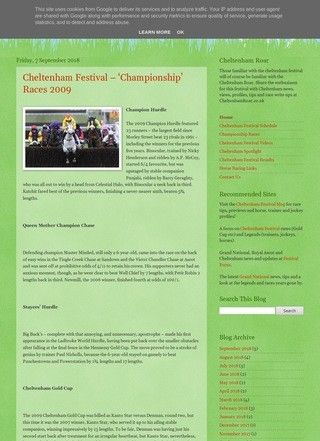
A profile of Easysland sits alongside a write-up of Douvan, and next to those you find a historical piece on Fulke Walwyn, the trainer whose Cheltenham record most modern followers know only by reputation. That mix tells you quickly what Cheltenham Roar is: a blog built by someone who cares about National Hunt racing enough to keep circling back to the Cheltenham Festival from every angle they can think of, from a single horse's form to a trainer legacy that predates most of the readers.
Festival coverage organized by year
The spine of the site is coverage tied to the Festival itself. There are race previews and results filed by year, running across 2018, 2019 and 2020, plus sections on the Championship races and a rundown of the Festival schedule. If you want to trace how a given renewal was called before the tape went up and then check what happened, the material is there to do it. The year-by-year organisation is the kind of structure that rewards someone reading back through a period, and it is more useful than a single undated pile of posts would have been.
Profiles of horses, jockeys, trainers
Beyond the race cards, Cheltenham Roar leans into profiles. Horses, jockeys and trainers each get their own treatment, and the writing does not restrict itself to whoever happens to be fashionable this season. Pulling Fulke Walwyn into the same library as a contemporary campaigner like Easysland shows the person behind it reads the sport historically, well beyond the confines of a pure betting diary. There is also a running list of what the site calls festival betting flops, which is a more honest topic than plenty of tipping blogs are willing to touch, since it means going back over calls that did not land instead of quietly dropping them.
Betting tips and commentary
Betting commentary runs through a lot of the content, which is to be expected for anything built around the Festival. Tips and views sit next to the previews, and the tone reads like a hobbyist working through his own opinions in public. I found the betting-flops thread the most telling part of the whole site, because a writer willing to catalogue his misses is usually more worth reading on his hits than one who only ever posts winners. Whether the tips themselves are any good is something a reader will have to judge over a season, and Cheltenham Roar does not pretend otherwise.
Cheltenham Spotlight links to other racing blogs
One recurring feature on Cheltenham Roar is worth calling out on its own. Cheltenham Spotlight points readers toward other racing blogs and sites, Cheltenham Buzz among them, which is an unusually generous thing for a small independent site to do. Most blogs treat every rival as competition for the same handful of readers. Sending traffic elsewhere puts the subject matter ahead of self-interest, and it gives the whole thing the feel of a corner of a wider enthusiast community instead of a walled garden trying to keep you on the page.
Archive extends back to 2017
The archive gives Cheltenham Roar some weight. Posts go back to at least 2017, arriving on a regular monthly rhythm, so this is not a site that flared up for one Festival and went dark. That said, the dated race coverage clusters around 2018 to 2020, and a prospective reader should go in understanding that a good deal of the headline material describes those runnings rather than the most recent one. For historical reading and for understanding how particular horses and trainers were assessed at the time, that is fine. For someone who wants this-week form on the next Festival, it may or may not be current, and the brief I am working from does not settle that either way.
Contact details require searching the site
On the practical side of trusting a site like this, the picture is mixed. There is a contact page at the site, reachable through its own tab, but the landing page carries no phone number, no address and no email out in the open. For a personal racing blog that is not alarming in the way it would be for a shop taking money, yet it does mean anyone wanting to reach the author has to go looking for the form rather than finding details up front. A visible line or two about who runs Cheltenham Roar would have gone a long way toward making it feel more accountable, especially given the betting angle, where readers are reasonably entitled to know a little about whose judgement they are following.
No independent reviews available online
A search turns up no independent reviews of Cheltenham Roar, and it is only fair to flag that up front. The phrase itself muddies things, because "the Cheltenham roar" is the name racing people give to the wall of crowd noise at the first race of the Festival, so results fill with betting-tips pages, Tripadvisor entries for the Festival as an attraction, and general write-ups about that roar, none of which are actually assessments of this website. So there is no rating or review count to lean on here, and a reader is left to form a view from the content on its own merits. For a niche hobby blog that is a common enough situation and not a mark against it, but it does put the weight of judgement back on the writing.
Enthusiast blog focused on National Hunt racing
Taken as a whole, the site knows exactly what it is and stays in its lane. It is not trying to be a broad racing portal or a live tipping service with push alerts. It is one enthusiast's ongoing record of the Cheltenham Festival and the National Hunt scene around it, with profiles, previews, results and a candid streak about losing bets. The Cheltenham Spotlight feature and the reach back to older trainers are the parts that lift it above a run-of-the-mill tips blog. The chief limitations are the age-clustered race coverage and the quiet approach to who is behind it.
Best sections for browsing between meetings
The year-filed previews and the betting-flops section, where the author grades his own record, are the strongest reasons to spend an afternoon browsing Cheltenham Roar. Reading around the Festival, digging into horse and trainer profiles, and checking how races were called against how they finished all make for a decent way to pass the time between meetings. Anyone chasing the freshest tips for the very next Festival should check the post dates first and read the older material as background, not live form. Getting in touch means going through the contact tab, since nothing else on the site offers a way to reach the person writing it.