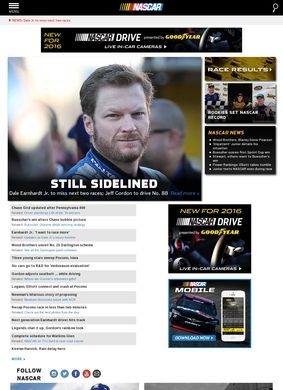
NASCAR sanctions more than 1,200 races per year across its national and regional series, a scale that most casual fans do not register when they think of stock car racing as a single championship. The official site at NASCAR.com is where all of that activity gets organized, documented, and served to the public in one place.
National series standings and statistics
The three national series sit at the center of the site: the Cup Series, the Xfinity Series, and the Craftsman Truck Series each get their own standings pages, driver profiles, and event calendars. Statistics go deep. Fans looking for lap-by-lap data, pit strategy breakdowns, or all-time records will find material here that does not require a third-party database. The season schedule pages include race-weekend formats, beyond dates, so anyone planning a trip to a track can see when practice, qualifying, and the race itself are scheduled before buying a ticket.
Streaming through broadcast partners
Streaming access is handled through NASCAR TV and the broadcast partners listed on the site, currently NBC, Fox, and Amazon Prime. The site does not pretend to offer everything under one paywall; it links out clearly to where each race will air. That honesty about the broadcast split is useful, even if the fragmentation is a genuine inconvenience for fans who want a single subscription to cover a full season.
Editorial content meets historical archive
NASCAR.com carries editorial content alongside the live-sport infrastructure, and the two sit closer together than on most sports sites. Race previews, post-race analysis, and team development stories run alongside the results tables in the same space. Video highlights and full race replays are available, with depth varying by how recent the event is. The historical archive is a genuine resource: records, season-by-season data, and driver career statistics go back far enough to be useful for research, not purely casual browsing.
Inside the NASCAR Hall of Fame
The NASCAR Hall of Fame has its own section, covering inductees, the selection process, and the Charlotte museum that houses the physical collection. It reads as institutional documentation, which is appropriate given that the Hall is a serious repository of the sport's history. The Drive for Diversity program and the Foundation also have dedicated space, presenting the sanctioning body's community and pipeline initiatives with enough detail to be informative.
Fan engagement tools
Fan engagement tools include NASCAR Fantasy Live, which runs alongside the Cup season and gives casual followers a reason to pay attention to the full field beyond a single favourite driver. The eNASCAR iRacing series, the esports competition run as a formal league, gets coverage here too, with standings and event results treated with the same structure as the physical series. That inclusion is meaningful: it signals that the sim-racing side of the brand is taken seriously, not managed as a footnote.
Comparing merchandise and ticketing options
The merchandise store, NASCAR Shop, covers apparel, die-cast models, collectibles, and accessories across drivers and teams. The range is broad enough to cover both the collector market and casual fan purchases. Ticketing for races at sanctioned tracks links out through the site rather than being sold directly, which keeps the purchasing flow consistent with how individual tracks handle their own inventory.
Sponsorship and corporate information round out the offering. Teams, brands, and media partners have entry points into the ecosystem through the site, though that layer is clearly secondary to the fan-facing content. Regional and touring series are documented too, which matters for the amateur and semi-professional competitors who race under NASCAR sanction but rarely appear in national broadcast coverage. The site treats these lower-profile series with the same structural care as the Cup Series, which is not something every major sports organization gets right with its feeder leagues.
Assessing the site's depth
The site is comprehensive in a way that reflects an organization running a professional sport at scale. Navigation could be cleaner in places; the volume of content means some sections take a few clicks to reach, and the broadcast partner links can feel like they are pushing the user away from the site. These are minor friction points, not structural failures. The depth of race data, the breadth of series coverage, and the integration of historical records give NASCAR.com a weight that few sports properties match in their official digital home.
The site functions well as a record-keeper and calendar, but it does not fully replace the experience of watching through a broadcaster's app or attending a race in person. That gap is inherent to what a sanctioning body's site can reasonably do. NASCAR.com is the authoritative source for what happened, when, and who won; it is less useful for following along in real time unless you are already subscribed to the right broadcast package. For the fan who wants results, standings, and context in one place, it is the most reliable source available. For the fan who wants to stream and react as the race unfolds, the site points outward to partners who do that better.