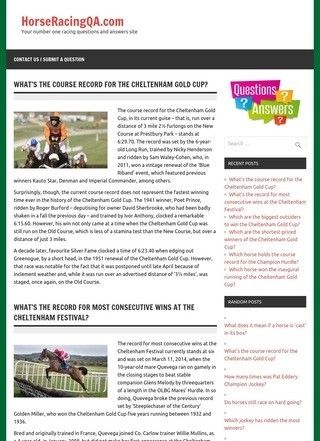
Rule 4 deductions, handicap weights, why a horse can be withdrawn after the market has already formed: these are the questions that send people to Google at two in the afternoon on a Saturday, and HorseRacingQA.com, trading under the name Horse Racing, is built to catch them. Horse Racing is a question-and-answer reference for one sport, nothing else, and that self-imposed limit is the most honest thing about it. No football accumulators, no casino reviews grafted on for traffic. A question about the Grand National pays structure and Horse Racing has a page ready; a question about jockey records and there is one of those too.
From festival previews to racecourse grading rules
The breadth inside that narrow lane is genuine. Coverage extends from the showpiece festivals, with the Cheltenham Festival and the Grand National treated as recurring subjects with their own dedicated threads, down to the procedural rules that most commentary assumes you already know. Racecourse grading, the Grade 1 to Grade 4 structure, gets a proper walkthrough rather than a passing mention. That is the sort of distinction thrown around in race previews and almost never explained to newcomers. Horse Racing seems to have identified those friction points deliberately, because they appear again and again in the archive: Rule 4 deductions, accumulator settlement, official ratings, how handicaps are compiled. The writing is patient without being condescending, and it does not dress up a simple answer in qualifications to look thorough.
Navigation by horses jockeys trainers and racecourses
The paginated archive runs to at least 153 pages at current count. For a single-topic reference that is a meaningful number, because it means the long-tail questions get answered, the ones that sit below the headline queries and never get a clean reply elsewhere. Horse Racing covers horses, jockeys, trainers, owners, and racecourses as distinct categories, each with its own lane in the navigation. On top of that there is a site-wide search tool, which on a site of this size is not optional. An FAQ section pulls together the most common queries for readers who do not want to browse. Two honest routes to an answer, which is the right structure for a reference resource.
Checking past results and jockey records
A historical layer runs through the material alongside the explainer content. Past race results, jockey records, horse ratings across seasons: Horse Racing can settle a casual argument about which jockey holds a particular record or how a horse was rated in its prime. That turns it into something more than a glossary. A reader who follows racing only in March and on Grand National day can use Horse Racing to fill in the weeks between those two events without being pushed toward a bookmaker's sign-up offer first.
State-specific betting pages for US readers
One thread sits at an angle to the rest: state-specific betting guides aimed at the US market, including a page on Ohio online betting. It is a visible editorial choice to chase American search traffic, and it introduces a tension in the overall focus of Horse Racing. A British punter looking up Cheltenham form will skip those pages without noticing them; a US reader hunting for legal betting options in their state will be glad they are there. Whether the double audience dilutes the specialist feel depends on what a reader came for, but the strain of it is present and worth noting.
Submitting a question to grow the archive
Horse Racing has a question submission form, which pushes it past a static library. Visitors can send in their own questions, meaning the archive grows at least partly from real curiosity instead of a keyword list alone. That is a healthier model for a Q&A site, because the gaps get filled by what people actually want to know, not by what an editor guesses they might search for. The page count already on offer shows Horse Racing has been running for long enough to accumulate genuine depth, and the submission route gives it a structural reason to keep expanding.
Contact page and anonymous authorship
Contact runs through a single page that doubles as the place to submit questions. No phone number, no postal address, no named person behind the writing. For a betting-adjacent reference site that is worth stating plainly: trust matters when odds and money are part of the subject, and the anonymity of the authorship is a real gap. The contact route functions for sending a query, and a reader who wants a definition or a rules explanation does not need to know who wrote it. A reader deciding whether to stake real money on an interpretation from this site is in a different position.
Verifying answers without outside reviews
A search across the usual platforms did not turn up notable third-party reviews or ratings for Horse Racing. No accumulated star scores, no forum threads praising or criticising it. That puts the quality question back on the content itself, which is fair enough. Read a few answers in areas you already understand and check them against what you know. The explanations of Rule 4 and racecourse grading on Horse Racing are accurate and clear. The historical records can be checked against official sources by anyone who wants to take that step. Horse Racing survives that kind of spot-checking well, though the absence of any external corroboration means the verification falls to each reader individually rather than being settled in advance by accumulated outside opinion.
On balance, Horse Racing is a solid single-sport reference for anyone who wants plain written answers about racing rules, festival coverage, or the terminology that surrounds the betting markets. The 153-plus pages cover genuine breadth: the ceremonial occasions, the procedural rules, the historical records, and the practical questions about how money works at the track.
Horse Racing does not try to be a tipster or a form guide; it tries to explain the sport, and within those limits it succeeds more than it fails. The US betting pages introduce an editorial tension that a purist will notice, and the anonymous authorship is a real limitation for a subject where accuracy has financial stakes. Neither flaw makes the content wrong. They make Horse Racing a resource worth cross-checking when the answer has consequences, which is a sensible posture toward any single-source reference without an established track record outside its own pages.