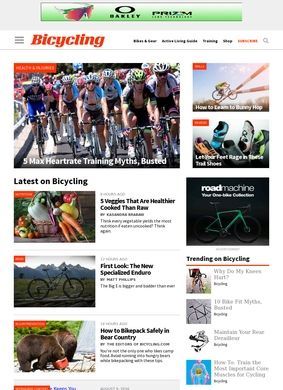
Bicycling.com delivers a depth of cycling coverage that a quick web search rarely surfaces on its own. A lot, as it happens, and most of it comes from people who ride for a living. This is the digital edition of Bicycling Magazine, the long-running Hearst title, and the site reads like the print version grew a deep archive and learned to update itself daily.
Gear reviews sorted by riding style and budget
The gear reviews are the spine of it. Bikes get tested by staff editors who put tens of thousands of miles on them, and the verdicts are sorted in ways that match how people shop: by riding style, by type, by brand, and by budget. If someone wants a gravel bike under a certain price, or the best value commuter, the structure is built to answer that without making them wade through a single sprawling page. If you found Bicycling through a business directory listing and are wondering whether it merits a bookmark, the answer is probably yes.
That testing-by-mileage approach separates the bike and gear coverage from the shallow roundups that float around the rest of the internet. A review here tends to come from a person who took the thing out in real weather and reported back, which is a different exercise from rewriting a spec sheet. The reviews cover full bikes and the smaller stuff around them, the components and accessories, and the sorting by budget is the detail that keeps people coming back. Most riders are not buying in a vacuum. They have a number in their head, and Bicycling respects that.
Training plans and nutrition guidance
No, and that is worth saying plainly, because a lot of cycling sites quietly become storefronts. Training is one of the larger pillars here. There are structured plans and fitness advice aimed at riders who want to get faster, ride farther, or simply hold a wheel on the weekend group ride without blowing up. Sitting next to that is health and nutrition guidance, which is the part of cycling that newcomers tend to ignore until a long ride teaches them otherwise. Eating to ride, recovering between efforts, fueling on the bike: these get their own treatment instead of being buried as a footnote to the gear.
Maintenance articles for common repairs
Then there is the how-to side, the maintenance articles that walk through the jobs every rider eventually faces. Cleaning a drivetrain, fixing a flat, setting up tubeless tires, adjusting a derailleur. A magazine with this kind of history has run these pieces many times over, and the depth shows. For a beginner who has just bought a first real bike and is slightly afraid of the cassette, this is the section that pays for itself in saved shop visits.
Racing coverage and culture writing
News and racing coverage rounds out the daily reasons to come back. Bicycling follows the sport, from professional racing to the broader stories moving through cycling at any given moment. Alongside the racing sits the culture writing, the editorial features that treat riding as something people build a life around rather than a transaction. A reader can arrive for a tire review, stay for a training plan, and leave having read a feature about a rider they had never heard of. The sections, broadly, are Bikes and Gear, Bike Reviews, Training, Health and Nutrition, News, and Culture, and each one is doing real work.
Serving road cyclists, mountain bikers, commuters
The audience is deliberately wide. Bicycling is written for road cyclists, mountain bikers, commuters, and recreational riders, and it does not pretend everyone is racing. A person who rides three miles to work on a hybrid is served here, and so is someone training for a hundred-mile event. That breadth is a genuine editorial choice, and it is harder to pull off than it looks, because the temptation in cycling media is always to drift upmarket toward the carbon-and-watts crowd and lose the people who just want to enjoy their bike. Bicycling does not make that mistake.
Newsletter access to expert recommendations
One practical note on access: the site offers a newsletter subscription that opens up the expert reviews and recommendations, so the most useful buying guidance is partly tied to signing up. For a reader who buys a bike or major component once every few years, that trade is easy to weigh. The recommendation work is exactly the kind of thing worth a subscription when the alternative is guessing on a four-figure purchase. Bicycling has been running long enough that its archive of buying guides and component comparisons goes back well before the current crop of gear-review sites existed, and that history gives the recommendations a context that newer publications have not had time to build.
It is a working publication with editorial muscle behind it, not a content farm dressed up as one. The gear verdicts come from accumulated miles, the training and nutrition advice is substantive enough to follow week to week, and the maintenance pieces are the sort a rider bookmarks and returns to with greasy hands. The cultural and racing writing gives the whole thing a pulse beyond product cycles. If there is a limit, it is the breadth itself: a site trying to speak to a brand-new commuter and a category racer in the same week will sometimes feel like it is talking past one of them, and a reader has to know which sections are theirs.
The bike reviews alone justify the visit when a purchase is on the horizon, and the training and maintenance archives give a reason to come back between purchases. Bicycling has the editorial history and the staff testing to back its recommendations, which puts it ahead of most cycling sites that aggregate specs without ever riding anything. The real limit is not quality but scope: the publication covers so much ground that a reader will need to self-select the parts that apply to their riding. That is a minor inconvenience given how much is there. A search found no independent review platform entries for Bicycling, which is not unusual for an established magazine brand, and nothing about the site gives reason to hesitate.