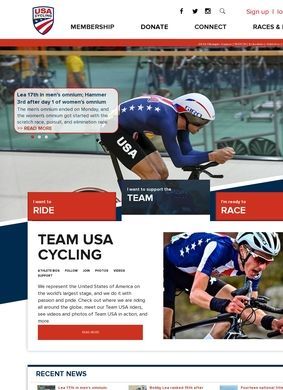
A racer can pull up their finishing results, request a category upgrade, and renew a license from a single account, and that combination is the practical core of what US cycling does. As the national governing body for competitive cycling in the United States, it runs the paperwork and the rankings that turn a weekend of racing into a tracked, official record.
Membership management sits right at the front of the site, because for most riders the relationship with US cycling begins with a license and a category number, and everything else, the results, the rankings, the eligibility, hangs off that.
The organization oversees competition across a wide set of disciplines: road, mountain bike, track, BMX, cyclocross, gravel, and paracycling. Each has its own calendar, its own national championships, and its own path through the ranks, and US cycling sanctions the events that make those results count toward anything. Event organizers work the same system from the other side, with tools for sanctioning a race, listing its location, and uploading results afterward, so the data a promoter enters on Sunday flows back into the rankings a rider checks on Monday.
That loop, from a promoter's results upload to a rider's ranking, is the quiet engine under everything else on the site, and it runs the same way for a local criterium as for a national championship.
What the governing body handles
The site is built around the machinery of organized racing rather than casual riding. It manages who holds a license, which categories they sit in, where events are taking place, and how results and rankings are recorded, and it hands clubs, teams, and organizers the same infrastructure from the administrative side. US cycling covers the recreational rider entering a first race and the elite competitor chasing a national title inside one framework, which is a lot of ground for a single organization to hold together.
The design assumes the visitor already races or wants to, and it spends little effort on anyone browsing idly. Almost every feature is aimed at a rider who competes or an organizer who runs events, and the tools are grouped around those two roles.
Membership, results, and category upgrades
Membership is the entry point, with join and renewal handled online, and the category system is what gives racing its structure. A rider climbs through the categories as they accumulate results, and US cycling processes those upgrades and keeps the rankings that decide seeding and eligibility for bigger fields. Race results, national-championship listings, and a club and team lookup round out the everyday tools, so a competitor can find their own numbers, see which events are coming, and check which teams are active nearby.
Collegiate cyclists and paracyclists are folded into the same structure rather than shunted off to a separate site, which keeps one record following a rider across categories and seasons. For anyone racing regularly, this account is the paper trail of their whole competitive history. Racing-category upgrades are handled through the same login, so a rider requesting a move up stays inside the US cycling system that already holds their results.
Team USA and the disciplines
A dedicated Team USA section covers the national teams by discipline, tracking the athletes who represent the country in international competition. This is where the governing-body role reaches its top end: the same organization that licenses a first-year Category 5 rider also fields the national squads. US cycling lists national-championship events across each discipline, giving riders a concrete target to point a season at, whether that means a regional field or an actual title.
The breadth here is the point, since a track sprinter and a gravel racer have almost nothing in common except the body that sanctions and ranks them both. National-championship listings for each discipline give the calendar a set of fixed peaks, and the results from those events feed straight back into the rankings that decide who lines up where.
Education, officials, and the Foundation
The education section runs deeper than a rulebook dump. It carries the official rule books, encyclopedic resources on cycling terminology, and certification programs for coaches and officials, which is how US cycling trains and certifies the people who run the sport, alongside the ones who pin on a number. Those certifications matter because a sanctioned race needs trained officials to be valid, so the education arm feeds directly back into the events side.
A separate Foundation section handles grants, scholarships, and donations aimed at athlete development, funding the pipeline that eventually stocks the national teams. Between the coaching and officiating programs and the Foundation grants, US cycling reaches well past the start line into how riders, coaches, and officials are trained, certified, and supported over a career.
The rule books and terminology resources also give a newcomer a way to learn the sport's language before a first start line, which lowers the barrier for someone stepping up from recreational riding.
A newsletter signup and social accounts on Instagram, Facebook, Twitter, YouTube, TikTok, and Strava sit on the homepage, pointed at the same audience the results and rankings serve. The through-line across every section is the license and the category number, the one piece of the US cycling site a racer returns to again and again.