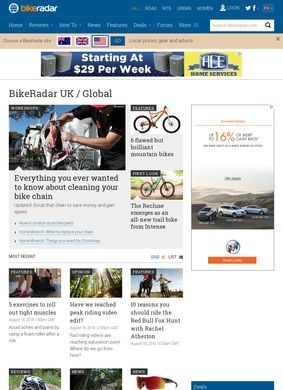
Bike Radar runs on thousands of product reviews, each carrying a rating and a price comparison, which makes it less a magazine site than a searchable verdict machine for anyone trying to spend money on cycling gear without regret. The brand belongs to Immediate Media Co., the publisher behind a stack of British enthusiast titles, and that lineage shows in how the coverage is organised. You do not land on a blog with scattered opinions. Bike Radar drops you into a structured catalogue of bikes, helmets, clothing, shoes, lights and accessories, sorted, scored and cross-referenced against what else is on the market.
Disciplines and separate sections
The spread of disciplines is the first thing worth pinning down. Road cycling, mountain biking, gravel, e-bikes and a dedicated women's cycling section all get their own lanes. A road racer and a trail rider are shopping for almost entirely different objects, so a site that lumped them together would force everyone to wade through irrelevant material. Bike Radar keeps those streams separate, so a gravel rider hunting for tyre clearance advice never has to scroll past enduro suspension talk, and a road cyclist is not nudged toward trail gear they will never use. That editorial discipline takes a real staff to maintain across years of new product cycles.
Road, mountain, gravel, e-bikes
The review archive is the centre of gravity at Bike Radar. When a publication claims thousands of product reviews, the worry is always padding, the same paragraph recycled with a new model number. What pushes against that suspicion is the ratings system and the pricing comparisons sitting alongside each entry, because those force a writer to commit to a position. A helmet either earns four stars or it does not, and a reader can sort by that. The pricing element also means the reviews do double duty as a shopping tool, telling you whether a light is good and also roughly what it costs against rivals.
Review archive with ratings
On top of the individual reviews sit the buying guides, and these are where Bike Radar aims squarely at the person who has not yet decided. Best hybrid bikes, best helmets, best radar lights: the format gathers scattered verdicts into a single ranked recommendation. A Bike Radar guide to the best radar lights, for instance, quietly teaches the reader that rear-facing radar is even a category worth considering before it tells them which one to buy. That is the kind of framing a beginner needs and a specialist can skip.
Buying guides for decision-making
Alongside the gear coverage there are beginner cycling guides, training advice and maintenance how-tos, the practical material that turns a person who bought a bike into someone who actually rides and looks after it. Health and nutrition articles round it out, which fits how cycling has drifted from pure equipment obsession toward fitness and wellbeing. A newcomer can plausibly use Bike Radar to choose a first bike, learn to fix a puncture and work out what to eat before a long ride, all without leaving the same domain.
Instructional content beyond gear
A pure affiliate operation would stuff every page with buy links and skip the unglamorous how-to material, since teaching someone to true their own wheel sells nothing. The presence of that instructional layer points to an outlet trying to be a reference a rider returns to, not a funnel that exists only to harvest a commission on the way to a checkout. Whether Bike Radar fully clears that bar is a matter of reader trust, but the structure at least pushes in that direction.
Revenue model and affiliate links
Bike Radar is reasonably honest, structurally at least, about how it pays for itself. Three revenue streams are visible: the editorial content, affiliate links on the product reviews, and the sale of print magazine subscriptions through a media shop. The affiliate model deserves a clear-eyed note, because it is the one that can tug at a reviewer's independence. When a glowing review carries a link that earns the publisher money on a sale, a sceptical reader is right to keep that in mind. The ratings and side-by-side pricing at least make it harder to hide a weak product behind warm prose, since a two-star score is a two-star score regardless of the link beneath it.
Print subscriptions, podcast, web
The print subscriptions tie Bike Radar back to its magazine roots and give the operation a footing that does not depend solely on search traffic and ad impressions. There is also a podcast, which extends the brand into the format cyclists reach for on long indoor-trainer sessions and commutes. The mix is sensible, and it means Bike Radar expertise gets packaged for readers, listeners and print subscribers instead of being locked to one channel.
Audience from beginners to specialists
The audience, by the site's own framing, runs from raw beginners to advanced riders, and globally rather than just within the UK. That is an ambitious span. Serving a first-time buyer and a category racer from the same masthead risks pleasing neither, yet the disciplined separation of sections and the layering of beginner guides under deeper technical reviews is the structure that makes the span workable. A novice stays in the shallow end of guides and how-tos; an experienced rider dives into granular component reviews. Bike Radar holds both without forcing either to read the other's material.
Contact and reputation
A contact link sits in the Bike Radar footer, easy enough to find. The landing page does not surface a phone number or email address directly; those live a click further in. For a large publisher this is normal. A media outlet is not a local shop that needs its number above the fold, and editorial teams route enquiries through a single form on purpose. Anyone wanting to pitch a story or query a review will need to navigate to that separate page, which is a minor friction and nothing more.
External ratings difficult to locate
On outside reputation, there is an honest gap to report. A search for what others say about the site keeps colliding with "bike radar" the safety device, the rear-facing sensor that warns riders of approaching cars. No Trustpilot, Google or comparable platform ratings for Bike Radar the media brand surfaced in that search. The absence is not evidence of a poor reputation; it is the predictable fate of a brand whose name doubles as a generic product term. No business directory listing for Bike Radar turned up independent ratings either. The verdict has to rest on what the site itself demonstrably does.
On that score it demonstrates a great deal. The depth of the review archive, the ranked buying guides that translate raw verdicts into recommendations, the instructional material that earns nothing yet builds trust, and the multi-format reach across print, podcast and web all point to a serious editorial operation rather than a content farm assembled for affiliate revenue alone. The affiliate links are the one element to keep a cool head about, but the rating system blunts the worst of that concern. For a cyclist at any level trying to decide what to buy or how to ride better, Bike Radar is a substantial resource, and the breadth of it rewards return visits.