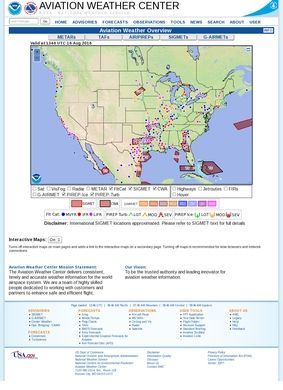
Running NOAA's National Weather Service- Aviation Weather Center as the official U.S. government clearinghouse for aviation meteorology is a deliberate policy choice, not an accident of bureaucratic sorting. The audience is narrow and named: pilots, dispatchers, flight planners, air traffic managers, and the briefers who feed all of them. What lands on the page is the working data those roles need. This is not a general weather portal with a few aviation extras bolted on, and it makes no effort to look like one.
Graphical forecasts for aviation
The centerpiece is the Graphical Forecasts for Aviation tool, usually shortened to GFA. It pulls together ceiling and visibility, cloud layers, precipitation, thunderstorms, turbulence, icing, winds, and temperature into a map you can read across U.S. airspace and step through in time. That single tool answers most of what a flight planner needs before pushback. The fact that it covers turbulence and icing alongside the basics is what separates it from a consumer forecast, and it is also where NOAA's National Weather Service- Aviation Weather Center quietly assumes you already know how to read these layers. This is reference material for trained users, and it does not pretend otherwise.
Hazard advisories and coded products
Around the GFA sits the full hazard-advisory machinery. NOAA's National Weather Service- Aviation Weather Center issues SIGMETs for significant en-route conditions, and G-AIRMETs and AIRMETs for weather that is less severe but still consequential in the cockpit. Center Weather Advisories support air traffic control coordination, so the same products feeding a single pilot also feed the people sequencing traffic across a region. Terminal Aerodrome Forecasts and METAR current-observation data come in both map and plain-text formats, letting you scan a chart or grab the raw coded string depending on what you trust more in the moment. I tend to think the dual map-and-text presentation is the smartest design decision on the site, because the two audiences for that data genuinely read it differently.
Pilot reports and synoptic data
The spread of products is the strongest argument for NOAA's National Weather Service- Aviation Weather Center. PIREP and AIREP submission and viewing close the loop between forecast and reality, letting crews report what they actually hit and letting the next crew see it. Radar and satellite imagery are available, as are wind and temperature aloft data, which any planner needs to build a realistic cruise profile. Significant Weather prog charts show fronts and pressure centers for the broader synoptic picture, and the World Area Forecast System grids extend coverage to international operations rather than stopping at the U.S. border.
Specialized dashboards for operational tasks
NOAA's National Weather Service- Aviation Weather Center also fields a set of focused dashboards for the moments when general charts are not enough. A Terminal Weather Dashboard concentrates on airport-specific conditions, and a Winter Weather Dashboard exists for the season that causes the most ground-side disruption. Pre-duty weather briefing packages bundle the relevant products for crews starting a shift, and a Traffic Flow Management Portal connects the meteorology to the broader job of moving aircraft through congested airspace. These are not generic widgets. Each one maps onto a specific task someone in aviation has to complete under time pressure.
Archive access and programmatic API
Two further pieces matter for anyone working with the data programmatically. NOAA's National Weather Service- Aviation Weather Center provides archive access to historical records, which is the difference between a live snapshot and something you can study, audit, or use to train a model. There is also a public Data API for pulling products directly into other software, so a dispatch system or a third-party flight-planning app can ingest the same official feeds without scraping a web page. That API is what developers will care about most, and its presence confirms NOAA's National Weather Service- Aviation Weather Center expects its data to live inside other tools, with the website itself as just one of many consumers.
FAA and ICAO compliance standards
Standards are the other reason to treat this as the baseline. The products meet FAA and ICAO requirements, and NOAA's National Weather Service- Aviation Weather Center runs 24 hours a day delivering both real-time observations and forecasts. Official status, continuous operation, and formal compliance together are exactly what you want from the source that other aviation weather services are themselves often repackaging. When a commercial app shows you a SIGMET, there is a good chance it traces back here.
Professional interface with steep learning curve
If there is a knock on the experience, it is the learning curve, and that is a fair trade for the depth. NOAA's National Weather Service- Aviation Weather Center is not trying to be friendly to a curious passenger. The volume of coded products, the assumption of fluency in METAR and TAF formats, and the operational framing all point at a professional user. A student pilot can grow into it, but the first visit can feel like walking into a tower cab mid-shift. That is the cost of having everything in one place at the authoritative level, and NOAA's National Weather Service- Aviation Weather Center clearly accepts that cost on purpose. Friendliness was never the brief. Accuracy and completeness were, and on both counts it delivers what the job demands.
Complete toolset for aviation weather operations
Taken whole, NOAA's National Weather Service- Aviation Weather Center gives you forecasting tools, hazard advisories, observations, imagery, specialized dashboards, briefing packages, an archive, and an API, all under one roof and all aligned to the standards the industry flies by. The GFA tool alone justifies a bookmark for anyone planning flights, and the API justifies one for anyone building software that touches aviation weather. The breadth covers preflight planning, en-route hazards, terminal conditions, and post-flight reporting without leaving you to stitch sources together yourself. NOAA's National Weather Service- Aviation Weather Center has no real competition at the official level in the U.S., and for the professionals it is built for, that is not a minor point.