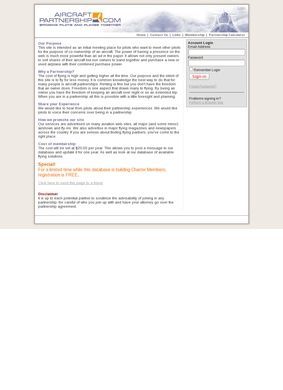
A Partnership Calculator sits near the center of what Aircraftpartnership.com is built to do: a pilot plugs in the number of partners and a down payment figure, then watches how the cost of owning a light aircraft splits across a group. That single tool tells you more about the site's intent than any of its marketing language. The whole premise is cost-sharing, and the founder, a private pilot who came back to flying as an adult, built Aircraftpartnership.com around the plain reality that buying and keeping an airplane alone is expensive enough to ground a lot of people who would otherwise fly.
How the partnership calculator works
The core function is matchmaking. Aircraftpartnership.com runs a searchable listing of pilots who are either looking to join a partnership or hoping to find others to share a purchase with. The framing is explicitly a replacement for the old way of doing this, which was classified ads in aviation newspapers that reached a narrow slice of the right people. An online directory of pilots in the same situation is a sensible answer to that problem, and Aircraftpartnership.com does not try to be anything grander. It connects people who want to split ownership of a plane, and it gives them a way to find each other.
Matching pilots seeking shared ownership
Beyond the listings, the calculator is the piece worth examining. Aircraft partnerships live or die on whether the math works for everyone, and a tool that lets a prospective partner adjust variables before any money or any conversation gets serious is genuinely useful. Two partners on a sixty thousand dollar plane carry a different burden than four partners on the same airframe, and seeing those numbers laid out changes how a person approaches the whole idea. It is the difference between a vague wish to own and a concrete sense of what a share costs each month.
Registration was described as free in a pilot forum reference, which lowers the barrier for someone who is only testing the water. For a site like this, free access is not incidental to the model; it is the model. A matchmaking service only works when enough people show up, and a paywall at the front door would thin out the very pool that gives the listings their value. Free membership and a planning tool together make the early steps easy, which is the right call for a niche where the audience is small to begin with.
The About Us page leans on the founder's own story, a returning adult pilot who hit the cost wall himself and decided to do something about it. That origin gives Aircraftpartnership.com a clearer reason to exist than a generic classifieds board would have. Someone who lived the problem tends to build the tool he wished he had, and the calculator reads like exactly that.
On outside footing, Aircraftpartnership.com gets a real but quiet mention. A thread on the Pilots of America forum points to it by name as a free resource, and it came up specifically as an option after AOPA shut down its own aircraft partnership service. That is meaningful context. When a major membership organization steps back from a service, the independent sites that fill the gap inherit a need, and being named in that conversation puts Aircraftpartnership.com in front of the exact pilots it wants to reach. A Reddit r/flying discussion also touches on partnership websites in general, though without singling this one out.
Reputation and contact information gaps
What is missing is any structured reputation. No ratings on Google, no Trustpilot score, no Yelp or BBB presence turned up for the site. For a small aviation tool that is not damning, since this kind of niche resource rarely accumulates star ratings the way a restaurant or a retailer does. The forum mention is notable precisely because it comes from working pilots talking among themselves, the exact audience Aircraftpartnership.com wants to reach. Still, a prospective member has little to go on beyond that single endorsement, and there is no easy way to gauge how active the listings are or how many partnerships have come out of it.
Activity levels remain unclear to outsiders
Activity level is the open question that the public pages do not answer. A matchmaking directory is only as good as its current inventory of people. If the listings are full of pilots who are actively searching, Aircraftpartnership.com delivers. If they have gone stale, the calculator still works but the matchmaking does not. Nothing in the indexed pages or the search results settles which of those is true, and that uncertainty sits at the heart of whether the site is worth signing up for today.
The contact situation deepens that doubt. No phone number, no physical address, and no confirmed contact page showed up in the search snippets. For a free service run by an individual pilot, light contact information is not surprising, and the registration flow may well route communication once a member is inside. But a visitor weighing whether to trust Aircraftpartnership.com with their interest in a shared aircraft purchase has no obvious way to reach the person behind it before joining. That is a fair thing to want, given that a co-ownership arrangement involves real money and real legal exposure between strangers the site introduced.
So the picture is mixed in a specific way. The concept is sound, the calculator is a smart and practical addition, free registration is the right model, and a respected pilot forum vouches for Aircraftpartnership.com as a successor to a service AOPA abandoned. Against that, there is no visible sign of how busy the directory is, no third-party track record to lean on, and no clear contact path for a cautious first-timer. The idea is clean and the problem is genuine. Whether enough pilots are currently using Aircraftpartnership.com to make that idea pay off for the next person who joins is the thing nobody browsing from the outside can confirm, and that gap is where the real uncertainty lives.