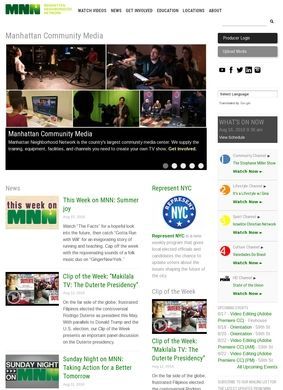
Manhattan Neighborhood Network (MNN) is a nonprofit public access community media center based in New York City, founded in 1992 to give Manhattan residents a working route onto local cable television. The structure behind it is unusual and worth understanding before judging the service: public access channels exist because of a First Amendment mandate that ordinary residents be able to broadcast, and Manhattan Neighborhood Network (MNN) is the body that turns that abstract right into actual studio time, cameras, and airtime for people who would otherwise have no broadcast outlet at all.
Studio access and production facilities
What Manhattan Neighborhood Network (MNN) provides is concrete and easy to verify against the site. There are two production locations, one near Hudson Yards on 38th Street and another in Harlem, and members get free use of production studios, editing suites, and the broadcasting infrastructure that pushes their work onto the air. Several public access cable channels carry the output across the city, and the same programming is livestreamed globally, which extends the audience well past anyone with a Manhattan cable box. For a community media operation, that combination of physical facilities plus a distribution pipe is the genuinely useful part, and it is spelled out clearly enough that a prospective member knows what they would be getting.
Orientation and membership requirements
The path to using any of it runs through a free orientation session held once a month. Complete that, and the facilities open up at no cost. This is the standard public access model, and it is sensible: the orientation filters for people who will treat shared equipment responsibly and teaches the basics before someone is handed a professional camera. The trade is that access is gated on timing, so a person who misses a given month waits for the next one. That is a minor friction, not a real barrier, but it is a practical detail the site is upfront about, and being upfront about it counts for something.
Media education programs
Beyond raw facility access, Manhattan Neighborhood Network (MNN) runs a teaching arm. There are media education classes, hands-on training with professional gear, and dedicated youth programming through a Youth Media Center. That last piece is where the organization reads as more than an equipment lending library. Teaching teenagers to shoot, edit, and tell their own stories is slow, unglamorous work with no obvious commercial payoff, and the fact that Manhattan Neighborhood Network (MNN) builds a whole center around it says something about who the place is for. The audience it names is broad: residents, artists, storytellers, journalists, nonprofits, and young people, and the programming maps onto that list rather than just gesturing at it.
Community events and member portal
Manhattan Neighborhood Network (MNN) is a production house and more. The network hosts community events, including comedy nights and film screenings, which gives members an audience in the room as well as on a channel. Registered members also get a portal at members.mnn.org, a useful sign that the back end is organized around people who return regularly rather than one-off visitors. None of this is flashy. It is the infrastructure of a working media center, described plainly.
How to reach Manhattan Neighborhood Network
On reaching Manhattan Neighborhood Network (MNN), there is little to complain about. The contact page carries a phone number, a street address on West 38th Street, two email addresses for general and location-specific queries, and a categorized contact form that routes a message to the right desk. The phone number also turns up on the Facebook and Yelp listings, so a member who never lands on the official site can still find a way through. For an organization that depends on walk-in members and orientation attendees, that level of openness about how to reach the building is exactly right, and it removes the usual worry about whether a nonprofit's stated services translate into a staffed, reachable place.
Outside opinion is mixed in a way that is more informative than a single clean rating would be. The Yelp listing for MNN gathers around twenty reviews along with several dozen photos that document the facilities and events, which is visual evidence that backs up the site's own claims. A local aggregator, manhattan-nyc.com, shows a much higher figure near 4.9 stars across roughly four dozen reviews, and a Facebook page tied to MNN producers reports that 96 percent of a small set of reviewers recommend it.
Member satisfaction versus staff experience
The dissenting note comes from Glassdoor, where about twenty anonymous employees rate the organization around 2.8 out of five. That is a workplace score, not a verdict on the service members receive, but it is honest to flag the gap: the people using the studios sound considerably happier than some of the people staffing them.
That contrast is worth sitting with for a moment, because it shapes how much weight to give the glowing community numbers. Public-facing reviews of a free service skew positive almost by default, since the people motivated to write are usually the ones who got real value from equipment they did not have to pay for. The Glassdoor figure is a useful counterweight, hinting at the internal strain that often comes with running a chronically underfunded nonprofit. Neither set of numbers is the whole story, and a fair reading holds both: a service that delivers for its members, run by an organization that may be stretched behind the scenes.
Inside the service delivery model
The verdict lands as a qualified yes aimed at a specific group. For a Manhattan resident, artist, journalist, or young person who wants to make video and get it broadcast without paying studio rates, Manhattan Neighborhood Network (MNN) is a serious and well-documented option, and the free orientation makes trying it close to risk-free.
The reach is deliberately local, so anyone outside the borough gets little from it beyond the livestream, and the workplace reviews point to internal friction the outward-facing materials understandably skip. Within its mandate, though, Manhattan Neighborhood Network (MNN) is the real thing: a genuine public access center with studios, training, channels, and an open door, doing the patient civic work it was set up in 1992 to do. The published record is detailed enough to evaluate without waiting for an in-person visit, and what it describes is an organization that has been at this for more than three decades without losing the original purpose.