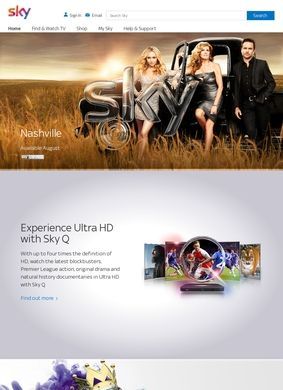
Someone whose living room satellite dish stopped working in the wind, or who simply never wants a dish bolted to the wall again, lands on the Sky site looking for a way out. That exact person is the one British Sky Broadcasting Group has clearly been designing around for the past few years. The whole structure of the site pushes you away from the old hardware and toward Sky Stream, a small box that pulls everything in over your broadband, and Sky Glass, a television with the streaming software baked straight into the set.
Moving away from the satellite dish
No engineer on the roof, no cabling. If the original reason you came was "I want Sky without the dish," the answer is right there near the top of the page. British Sky Broadcasting Group has effectively turned its own founding technology into one option among several, and the site does not pretend otherwise.
Keeping Sky Q and Sky Go options
That said, the satellite heritage has not been thrown out. Sky Q still exists for households that want the traditional set-top box, and Sky Go lets existing subscribers carry their channels onto a phone or tablet when they are away from the sofa. So the site is quietly serving two audiences at once: the people who want the newest dish-free kit, and the long-standing customers who are happy with what they already have screwed to the wall. British Sky Broadcasting Group does not force a migration, and the breadth of options on a single domain is genuinely useful when you are trying to compare your choices. For anyone who found this listing through a business directory search, the site itself does the comparison work far better than any summary can.
Sky TV channel lineup
The television side is where the catalogue is deepest. Sky TV bundles a set of in-house channels that most people in Britain could name without prompting: Sky Atlantic for the prestige drama, Sky News, Sky Comedy, and the two heavyweights that drive a lot of subscriptions, Sky Sports and Sky Cinema. Sky Sports is the page worth lingering on if live competition is your thing, because it carries Premier League football, Formula 1, cricket, golf, and boxing under one roll of channels. Sky Cinema runs dedicated film channels alongside on-demand titles, and there is a separate Sky Kids strand for households that need children's programming kept apart from the rest. Taken together, this is the part of British Sky Broadcasting Group that most people are paying for, and it remains the strongest reason to look at the brand at all.
The channels are grouped by what you want out of an evening rather than by some internal product code. Sport in one place, films in another, the news and comedy and drama within easy reach. That sounds obvious, but plenty of large media sites bury their best material under marketing pages, and British Sky Broadcasting Group mostly resists that. Someone who only cares about Premier League football can get to Sky Sports and understand the offer without wading through the rest of the catalogue.
Broadband and mobile bundles
Beyond watching, the company has spread into the plumbing that feeds the screen. Sky Broadband sells fibre packages in tiers, Essential at the entry end, then Superfast and Ultrafast as you climb, so the speed you pay for maps onto how heavily the house streams. Sky Mobile sits alongside it with SIM-only and device plans on a 5G and 4G network, which makes the bundle-everything pitch easy to follow: TV, internet, and phone all billed by the same name. For anyone who has spent an evening untangling three separate providers, the appeal of consolidation is not hard to see. It also tells you something about where British Sky Broadcasting Group sees itself going: less a satellite broadcaster, more a household utility that happens to own a lot of channels.
Extra products beyond subscription
There are also a few products that sit slightly off to the side. Sky Store lets you buy or rent individual films outside any subscription, which is handy if you want one new release without taking on a movie package. Sky Protect moves the brand into home insurance, a notable stretch for a media firm. And then there is NOW, formerly NOW TV, the no-contract route into a lot of the same Sky content for people who refuse to sign anything long-term. NOW is the answer to the most common objection to the main service, the lock-in, and it lets you cancel without calling anyone. That is a real practical difference if you are uncertain about the full Sky commitment.
Commercial customers get their own door through Sky Business, which packages TV, broadband, and mobile for pubs, salons, waiting rooms, and other premises that need licensed screens. It is a sensible separation. The kit and the licensing a bar needs are not the same as what a family wants, and British Sky Broadcasting Group keeps the two journeys from colliding.
Beyond the UK market
One thing worth flagging for anyone outside the United Kingdom: the brand is not UK-only. British Sky Broadcasting Group operates across Ireland, Germany, Austria, Italy, and Spain as part of Comcast and NBCUniversal, so the exact line-up of channels, prices, and devices shifts depending on which country's storefront you reach. The British version is the fullest, but it is not the only one, and that ownership structure explains why the catalogue feels so large. A subscriber in Dublin or Milan is dealing with the same parent, British Sky Broadcasting Group, even if the buttons and bundles look different.
Which Sky product do you need?
If one reservation applies to a platform this big, it is the sheer number of named products that can blur together before you have worked out which ones you need. Sky Q, Sky Stream, Sky Glass, Sky Go, Sky+, NOW. Each has a real and distinct purpose, but a first-time visitor has to do a little reading to sort the streaming box from the streaming app from the smart television. The site does explain the differences, yet the explaining is necessary, and that is a fair price of having this much under one roof. A patient visitor will sort it out in a few minutes; an impatient one might click away before working out that Sky Glass and Sky Stream are not the same purchase.
No significant third-party review presence for the site itself was found across the usual platforms, which is typical for a corporate landing page rather than a local venue. The product reputation of British Sky Broadcasting Group is tracked extensively in press and consumer forums, but the listing itself carries no independent rating. At this scale, the brand is its own reference point.
For the person who arrived wanting the dish gone, the path is short and the verdict is straightforward. The hardware that once defined British Sky Broadcasting Group is now optional, the content that made it worth paying for is intact, and the no-contract exit through NOW exists if the full package turns out to be more than you need. The harder part is scope: a single film tonight calls for one answer, and handing TV, broadband, and mobile to one provider calls for another. The site lays both out clearly enough to decide.