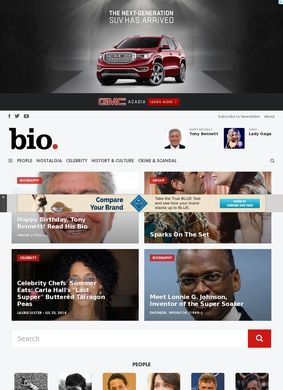
Betsy Ross and a contemporary true-crime subject can sit two clicks apart on the same site, and that range is the clearest way to understand what The Biography Channel does at biography.com. It is the web home of the Biography brand, run under Hearst Digital Media as part of the A+E Networks and Hearst orbit, and its job is to turn the televised idea of a life story into something you read instead of watch. The result is a deep library of biographical profiles and articles stretching across centuries and walks of life, organised so a person looking for one figure does not have to wade through everything else.
Category system organizes profiles
The spine of the site is its category system. Profiles are grouped under headings like History and Culture, Musicians, Athletes, Movies and TV, Artists, Power and Politics, Business, Scientists, Scholars and Educators, Activists, and True Crime. That spread tells you the editorial brief is genuinely broad. A reader can move from a political figure to a scientist to a musician without leaving the same framework, and the categorisation does real work because the alternative on a site this size would be a search box and luck. The taxonomy is the difference between a reference you can browse and a pile you have to dig through.
Article formats and supporting features
Most of what you find takes the form of long-form biographical articles that try to cover a whole life from early years through the work a person is known for. Around those, The Biography Channel builds out photo galleries, curated lists, and pieces that come with text-to-speech audio, so a profile can be listened to instead of read. The lists suit the way people actually arrive at this material, often via a broad-theme search for a category of figures, and a well-built list gives them somewhere useful to land. None of these formats is exotic, and that plainness is fine.
What The Biography Channel is reaching for, and mostly hits, is the general reader who wants factual background on a public figure without committing to a full book. Someone has heard a name in the news, or in a documentary, or in a classroom, and wants the shape of that person's life in a few minutes. That is a real and constant need, and the site is built squarely around it. The figures covered range from founding-era Americans to current entertainers and the subjects of recent true-crime interest, which keeps the library relevant to both school assignments and whatever happens to be in the cultural conversation that week.
Search tools and saved content
Practical tools are present without crowding the reading. There is a sitewide search, which on a library this large is less a convenience than a requirement, and it is the most direct route in for anyone who already knows the name they want. A newsletter signup is available for readers who want to be pulled back to the site automatically. There is also a My Bookmarks feature that lets a visitor save profiles to revisit, which is a sensible addition for anyone using The Biography Channel for research and assembling a short stack of people to read across more than one sitting. That saved-content feature is more useful here than on most editorial sites, because biographical research tends to sprawl across several subjects at once.
Social integration runs through the usual channels, with links out to X, Facebook, and Instagram, which is how a brand of this kind keeps its profiles circulating beyond direct visits. There is also a commerce strand called BIO Buys, a section of product recommendations that sits alongside the editorial material. It is worth knowing it exists because it indicates the site is not purely a reference work; part of the operation is pointing readers toward things to buy. Whether that helps or distracts will depend on what someone came for, though it stays in its own lane and does not bleed into the profiles themselves.
Inside the television connection
The connection back to television is the part that gives The Biography Channel its particular character. This is not a standalone web encyclopaedia that happens to share a name with a TV channel. The Biography Channel cross-links to the broader Biography television and streaming brand and to A+E Networks programming, so a written profile can lead a reader toward a documentary on the same subject, and a viewer can come the other way to read more. That two-way traffic between the page and the screen is the whole point of the brand existing in both places, and The Biography Channel treats the written profiles as a genuine half of the offering, not a promotional appendage to the shows.
Editorial standards and institutional backing
For accuracy and editorial weight, the institutional backing is relevant. Content published under the Hearst and A+E umbrella comes with an editorial apparatus behind it, which matters when the entire value of a biographical resource rests on whether you can trust what it tells you about a real person's life. A profile of a historical figure or a living public person carries different stakes than a recipe or a listicle, and The Biography Channel is structured as a place that takes that seriously, with named categories, consistent article structure, and a clear lineage to an established media operation. That is the foundation a reader is implicitly relying on every time they accept a date, a relationship, or a turning point as fact.
The True Crime category deserves a separate mention because it is the area where the site's range is most visible and also most pointed. Putting true-crime subjects in the same library as scientists, activists, and founding-era figures is an editorial choice that reflects where public curiosity actually goes, and it keeps The Biography Channel current in a way a purely historical reference would not be. It also sets the tone for how the site reads overall: serious enough to handle a scholar, populist enough to handle whoever is dominating attention this season, and comfortable holding both in one place.
As for independent reviews, a search for user ratings of biography.com turns up coverage of the television channel rather than the website as a standalone product. There is no meaningful tally of platform reviews to report. The Biography Channel's standing comes from its media lineage and the volume of content published over many years, and that is what a reader is actually weighing when they decide whether to trust a date or a biographical detail.
If there is a limit to what The Biography Channel does, it is one of depth rather than breadth. These are profiles and articles, not exhaustive scholarly treatments, and a reader who needs primary sources, footnotes, or the granular detail of a full biography will outgrow the format quickly. That is not a flaw so much as a definition of the lane: The Biography Channel aims to be the reliable first stop, the place you go to get oriented before deciding whether you want to go deeper elsewhere. Measured against that aim, the combination of broad coverage, sensible categorisation, and a steady supply of new subjects does the job well. What stays after moving through the site is how consistently the written content feeds back toward the screen brand it grew from.