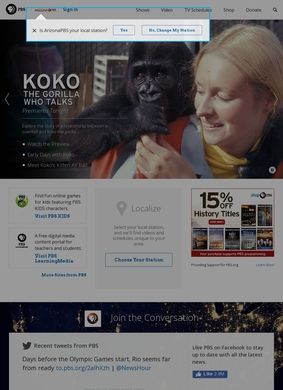
PBS (Public Broadcasting Service) is the United States public television network, a non-profit headquartered in Arlington, Virginia and built as a membership organization of more than 330 locally operated stations. The website is the front door to most of what that network produces, and it leans heavily on free on-demand streaming. Current episodes sit next to deep archive material, and the catalogue spans drama, documentaries and independent film, history, news and public affairs, science and nature, arts and music, food, and the practical home and how-to programming that public television has always done well.
Series that define American television
The series roster is where the site shows its weight. Frontline carries the long-form investigative reporting. NOVA covers science. Masterpiece holds down the imported drama that a lot of viewers came for in the first place, and American Experience handles US history at length. The Ken Burns documentaries are gathered here too, alongside NewsHour for daily news. Several of those titles have run for decades and define entire genres on American television, so having them streamable in one place, without a paywall, is the practical reason most people open the site at all.
Programming for children and families
PBS (Public Broadcasting Service) does not stop at adult prime-time programming. PBS KIDS is a separate children's arm with its own site and app, built around the early-learning shows that generations of US families grew up on. It is walled off enough that parents can hand a device over without much worry, which is a deliberate design choice and not a minor one given how much children's content elsewhere mixes ages and intentions indiscriminately.
Teaching resources aligned to classroom standards
Then there is PBS LearningMedia, a free library of curriculum-aligned resources aimed at PreK through grade 12. Teachers can pull clips, lesson material, and interactives tied to actual classroom standards, and students can use the same pool. A commercial network would never bother to build something like it because there is no advertising logic behind it, and it quietly explains a large part of why the network exists in the form it does.
Streaming across devices and platforms
The PBS App ties the streaming experience together across phones, tablets, and the major TV platforms, so the on-demand library is available beyond a desktop browser. Registered users get a few extra conveniences, including personalized watchlists and newsletters, and there is a podcast slate for people who would rather listen. The PBS Shop sells branded merchandise, with proceeds folded back into the network, and there is a current "America @ 250" collection assembled around the country's semiquincentennial.
How the federated station structure works
One thing worth keeping in mind while browsing is the federated structure underneath all of this. The national site is the aggregator, but the member stations are independent, locally run, and responsible for their own community programming and outreach. That is why a viewer in one region sometimes sees scheduling, local productions, or availability that differs from another region. It is a feature of how PBS (Public Broadcasting Service) is organized, though it can surprise anyone who assumes a single uniform national catalogue.
Funding without advertising revenue
The funding model shapes the tone of the whole operation. PBS (Public Broadcasting Service) runs on viewer donations, fees paid by member stations, corporate underwriting, and federal money routed through the Corporation for Public Broadcasting. Because there is no conventional advertising revenue driving the programming, the editorial slant of the site tends toward depth and public service over click-chasing, and the absence of an ad wall is immediately noticeable to anyone arriving from a commercial streaming platform.
Finding material for research and learning
For research, the value is concrete. A history teacher building a unit, a parent looking for screen time with some substance behind it, a documentary viewer chasing a Frontline investigation, or someone working through the Burns catalogue all land on material that is serious and, in most cases, free to watch. The breadth can be its own minor obstacle, since the home page tries to surface many genres at once and the sheer volume of titles takes a little patience to navigate. The search and the watchlist features help once an account is in play.
Archive access as a public service
What the site does best is make a large public archive genuinely accessible. PBS (Public Broadcasting Service) is not competing on flashy interface design or aggressive recommendation engines, and it does not need to. The programming itself, much of it produced or co-produced under the network's own banner, is the reason to be there, and the streaming layer mostly stays out of the way of it. PBS (Public Broadcasting Service) reads as an institution that treats its catalogue as a public good first and a product second.
The educational and children's strands deserve separate mention from the main streaming pitch, because they reach audiences who would not otherwise be browsing a television site at all. PBS LearningMedia in particular turns the network into something closer to a teaching tool, and PBS KIDS extends the same care to the youngest viewers. Together they make PBS (Public Broadcasting Service) more than a streaming destination, and they are the parts a casual visitor is most likely to underestimate on a first pass.
Put plainly, the catalogue is deep, the access is free, the structure is federated, and the mission is clear. PBS (Public Broadcasting Service) makes slow, long-form programming that is largely uninterested in chasing trends, and the site reflects that priority at every level. Viewers looking for that kind of content will find more here, free and well-organized, than almost anywhere else online.